• The move to the new server is done. There are some software and database maintenance updates in process. This has us passing the hat around to help out. We appreciate any donations. Seriously, even a dollar helps. The payment page may be found here - https://www.audiokarma.org/support.html

Allied 333/Pioneer sx34 - minimum work required

P. S.

Active Member
Hi,
I just scored an Allied 333 (for $5!! + 1 hour drive). It's my 1st tube amp. I have some experience with restoration/recap of solid state units but tubes are new to me and they seem to be coming with totally different set of problems to resolve.

I was very excited to see that my Allied 333 actually started without any issues on full 120V and only required pots deoxit. It has all original parts (incl matsushita tubes). No smoke, hum, no distortion, super nice, clean sound. I was really excited to hear it sing! Played it for several hours last Sunday till late night from Spotify until my phone battery gave up ;-)

Then next day I watched some videos of tube amp caps blowing up in spectacular way and figured out that maybe I should take some precautions to prevent that.
Since the unit seems to be working fine - I am not interested in fully overhauling it. Just make sure it does not blow up. I have a couple questions with regard to that. Maybe somebody can help:

Basically my plan for now is to swap out only electrolytic caps.


- Are there any other items I should consider that can blow up and burn? (e.g. resistors etc.)
- in general it's safe to put bigger than required voltage caps than into solid state as long as capacitance matches. Does the same principle apply to tube amps? (they operate on voltage so I am not sure here)
- should i be aiming for 105 Celsius rated caps all over or are 85C good as well?
- my plan is to use Nichicon audio grade - are they considered to be "good" for tube models? In terms of preserving the original sound. Or maybe there are better brands?
- can I safely replace axial leaded caps with radial lead
- PIO and ceramic caps - do I leave them alone or swap out?
- will I need to re-bias the tubes after the capacitor swap?
- the unit has 2 big, silver Nichicon caps on the top. Each of them has 4 legs marked YXUO. Does this qualify for replacement as well?
- should I consider buying a variac and use it permanently when powering the amp on or will it be able to hold instant 120V?

Thank you,
-Peter
 
Register to hide this ad
resistors should be OK, but if anything looks torched, change it and try to figure out why its cooked.

higher voltage is OK but don't go nuts with it. 25v caps don't need to be replaced with 450v ones. Not more than double the original voltage is perfectly fine. If you find anything really low in there like a sub-10v cap, those are fine up to 50v if needed. Prob will have to translate values to modern ones too. 20uf becomes 22uf, etc. If the values are within 10%, no trouble at all.

105c is better if you can get it.

Mostly these want general purpose caps. Tube gear almost never passes audio through electrolytic caps. They're mostly power supply filtering, and in a few cases it will be cathode bypass. I guess you can use audio caps on the cathodes but honestly its not necessary.

Radial for axial is fine if it fits decently. Sometimes the original form factor is just easier to fit though, depends on the specifics. Radial are a lot less expensive.

If this is typical of other Japanese gear, it'll be filled with grey oil capacitors used for coupling purposes. They aren't real reliable and get very prone to electrical leakage. I'd change them all to modern film caps. Opinions are endless on this, but I use a lot of basic yellow Illinois MPW caps and have no complaints about them.

ceramic are probably OK. I don't love the sound of them but you can change it or leave it as you see fit. I'd only consider changing ones in the audio path anyway. Anything in the tuner bits should be left alone.

Maybe, but you should check it even if you don't replace anything just to verify its happy.

Yes. Those are the big multi-section high voltage filter caps. 3 or 4 section most likely, you'd have to read the markings. Typically there will be a common connection, might be a terminal, might be the can. Typically its negative but not always. The can will tell you for sure.

I'd do a bucking transformer rather than a variac. No knob to easily bump. Don't know this one specifically so no idea how happy or unhappy it is on 120v+ line voltage.
 
@gadget73 Thank you for advice - it helps a lot.
I am badly tempted to continue running this amp "as is" with old caps but looks like I need to resist and get the replacements. ;-)
I will post my recap list here as soon as it's complete. Hopefully somebody else will be able to use it.

BTW - what's the best place to get the multi-section can caps and PIO caps? I am thinking about a guitar shop.

Peter
 
If it has the gray Japanese coupling caps... I've never seen one test good for leakage. Leaking positive voltage onto the grids of the output tubes will make them overheat, leaking DC onto tone controls will make them noisy.

Schematic should turn up with a Google search; I have it otherwise.
 
@RossW interesting idea about using individual caps. I think I saw this somewhere on a photo in related thread about allied 333. It showed 3 caps clustered together. I assume I should buy individual caps, each with adequate capacitance with the single stage of the multi-stage cap. Then connect the positive leads separately to individual caps and negative all together to the negative lead ?
 
If this is typical of other Japanese gear, it'll be filled with grey oil capacitors used for coupling purposes
Not the usual suspects, but they do need, or will at least benefit from, replacing. :|

The 333/SX-34 is messy below decks :( Looks like the family dog ate a collection of wire and passive components and barfed it up under the chassis.
Knight333underneath.jpg

I replaced the coupling caps in this one with some little Panasonics from either Mouser or Digikey... don't remember which offhand -- although I could go upstairs and look. It wasn't mine, but, as fate would have it, it eventually ended up here more or less permanently a couple of years ago.
 
Gawd. That's about as bad as a 1000A.
It is worse in the sense that it's more compact*.
On the "plus" side, it does use 6BM8s, so there are less total tube bottles/sockets to deal with.
Still, borderline nightmare to work on IMO.

_________
* Although, truth be told, I've never bothered to rehab the 1000A that's here; it's just a shelf queen, since I don't have the heart to harvest the OPTs out of it and use them for something worthwhile! ;)
 
JJ and F&T make some multi-sections. I think AES sells them, but anyplace that does guitar amp stuff also probably has them. CE Mfg makes twist-lock. Hayseed Hamfest will do custom ones, but I don't know if they do only twist-lock or if they do clamp-in as well. I might do some F&T or JJ clamp in caps in addition to individuals underneath. Depends what exactly you need and what you have space for.

The "chicklet" caps also work fine. I've used them. Only real trouble with those is the lead length is sometimes just not enough.
 
I've got 3 of these in the queue and 2 of the tuners derived from it in the queue too. I'll be enjoying what you post as you work on yours. Haven't actually listened to one yet.
 
So I finally got to fixing this amp and still have some questions if you don't mind.
I had no problems compiling the list of electrolytic caps (8 pieces total in the bottom + 2 multi-stage on top)

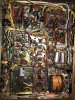
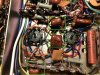
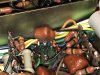
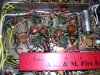
Now trying to find the "gray paper in oil caps" mentioned earlier by @mhardy6647 and @gadget73. I could not find any but there are a bunch of brown-ish caps all over the place. Wondering if I should replace these.
I am attaching a photo with some of them marked by green rectangle. They seem to me like mica capacitors but I am not sure. Can somebody help identify them?

During my search I found this excelent thread about vintage caps which might be useful (pictures + recommendation which types typically need replacement)
https://www.radiomuseum.org/forum/replacing_old_capacitors.html

IMG_4500.jpg IMG_4496.jpg IMG_4497.jpg
-Peter
 
Last edited:
Yeah, I don't see any of the classic grey PIO caps. Those brown caps are in fact film caps and given the amount of wax migration I would plan on replacing them as well.
 
The wax is probably there as a moisture barrier. I doubt it migrated. They look like ceramic-case film caps, polyester if I had to guess. Possibly they are fine if you really don't want to change them. They should be checked for leakage though. Even in-circuit you can power it and look for voltage at the output end. If the cap is bad you'll find a few (or many) volts DC at the grid of the next tube. One thing with some early film caps, and I don't know these specifically, but they can develop intermittent opens, especially if you move them. Basically the wire lead breaks inside the body and randomly loses contact. I would try to not disturb these unless you are changing them. It might produce more problems.

The grey Elna cap is quite possibly a PIO cap but that looks to be the only one.
 
I've heard bad things about the grey Elna caps (I see a few in the posted pics.) No personal experience yet as I have several of these in the queue still waiting for attention.
 
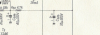
The elna cap is my candidate for replacement. However I am not sure how to tell if this is a PIO or electrolytic cap. It seems to me like a electrolytic polarized cap and this is what I ordered. Now that I look at the schematics - different caps have some geometric symbols next to them - triangle, square or none. Wondering if this is how pioneer would code the capacitor type back in the days? (screenshot with 2 such caps is attached)

Thank you for all the advice!

Screen Shot 2020-07-27 at 9.01.02 AM.png
Peter
 
whats the value on it? 1uf or larger is almost definitely electrolytic, under 1uf is most likely not. Some of the Japanese PIO caps specifically say "OIL" on them.

The silver ones next to it would be electrolytic. 100uf, 160v it looks like. Should be a polarity marking on there someplace.
 
Back
Top Bottom