• The move to the new server is done. There are some software and database maintenance updates in process. This has us passing the hat around to help out. We appreciate any donations. Seriously, even a dollar helps. The payment page may be found here - https://www.audiokarma.org/support.html

Almost finished a Receiver repair, then disaster strikes. What to do?

Donguri

Active Member
Arrgh, Just my luck...
Been repairing a Harman Kardon HK 450 with a couple of faults that was solved. Changed transistors and caps in the Pre-amp.
Sounded great and was just about to finish it when disaster struck.

Had cleaned all the pots and wanted to test if the scratchiness on Bass and Treble had went away.
Powered on the unit and put one of the plastic knobs on the Bass shaft to test, no problems there, removed the knob to try the Treble, sounded good, but then while I was pulling away the knob from the Treble pot shaft to test the Balance suddenly a big BANG came from the speakers and a LOUD crackle / frying started from the Right Channel...
Powered down, put it up on a Dim bulb and with Speaker switch disengaged no faults.
But as soon as the Speaker switch was engaged the DBT becomes bright with a pulsating movement from weak to bright, the Loud crackle started on the Right CH and a weaker kind of pulsating woom can be heard from from both Channels (kind of like the "Welcome hum" in the NAD 3020).

What on earth could have caused this by just removing a plastic knob from the Treble? was it shorted against the faceplate or something?
How does one go about to troubleshooting this?

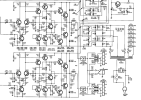
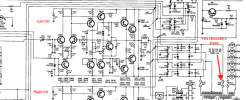
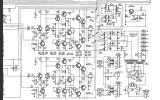
HK 450 Pre-amp.png HK 450 Main-amp.png
 
Register to hide this ad
A good question. Above my "paygrade" for the most part.

I know how both the digital and analogue controls function and it might be possible that the two metals if touched might not have liked each other.

Many a guitar player has blown an amp by a faulty plug in, but this was mostly cable break down. Again, two wires touching.


Q
 
Sounds very frustrating, so I am afraid it is back to basics, isolate which section is the problem (power supply/preamp/poweramp)- though given the treble control I would put a scope across the inputs to the power amp stage and see if the noise is coming from the premap, and more likely the tone control section.
 
Thanks for chiming in to you both even though this seems to be a tricky one.

Before this occurred the Right CH had some Bacon frying / crackling that I traced to 2 bad 2SC1344 in the preamp that I repaired with KSC1845´s, the unit had been running fine a couple hours after all was replaced.

After the bang, The Bacon frying sound I hear now is MUCH more amplified, so I'm wondering if one can draw the conclusion that it is in the Main-Amp?

This video in this post demonstrates the same DBT behavior as in my case:

I´ve made some troubleshooting, here are some of the findings:

  1. The Dim bulb only pulsates when the Speaker switch is engaged, disengaged it stays dim.
  2. This unit has an soft start circuit and Mark the fixer mention in one post that sometimes this circuit can make DBT oscillate, however it didn't oscillate before this happened when I tried it on DBT (can't remember if I did engage the Speakers at that time though)
  3. I tried to measure the Base on the Q501 & Q502 (the new ones in Pre-amp) but Voltages where jumping like hell and couldn't make any conclusions.
  4. On the Speaker dummy load I measure 0.2V - 1.6V in BOTH CH, and on the R-CH Bias trimpot measuring erratic voltages (On DBT), I mean 1,6V even a millisecond wouldn't that trip the speaker protect switch? Same with the Fuses, wouldn't they normally blow in high current draw?
  5. With FU2 removed the bright DBT pulsing stops however you can still see a small weak dim pulse, the loud crackling stops as well in the R-CH but still with a occasional small pop in the speaker. I'm not quite sure what this FU2 is connected to, tried to read the schematic but not quite sure I understand if it is supposed to be like a "Right Channel Fuse" since with that fuse removed a small pop still can be heard in the Speaker? Hopefully this can give someone some leads on what to do next.
  6. How does one go about to disconnect the Main-amp on this unit? There are no Pre/Main connectors and I don't see any obvious points to disconnect (still learning this)

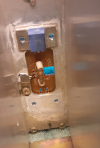
HK 450 Fuse.png
 
What wattage bulb is in your tester? Assuming 50-80W, getting it to pulse means a big draw, big draw forces bulb to soak up a lot of power, bulb chokes off circuit, circuit dies no more draw, bulb quits soaking up the power, circuit comes back to life, big draw comes back, ad infinitum. So you know that you have a circuit that is causing your draw, it's not going to be a faulty treble pot that I can see. A draw that big in a circuit to me would point to the amplifier. Another clue it only happens when you have speakers hooked up and you select them, amp sees load and promptly goes into big draw. Likely parts - outputs, drivers, open/faulty bias variable resistor. Q422 Q424 Q418 Q420 VR404 I would check these with the power OFF, compare them against the other channel and look for a clue. Anyway that's somewhere to start, I would not take it off of the dimbulb until you are certain shorts have been resolved. I have never worked on an hk450, so this is just my generic advice.
 
What wattage bulb is in your tester?
Thanks for the input and explanation, helped me understand what might be happening.
I'm using a 40W bulb, thought that was safer (This unit is a High Current 30W receiver) have an 60W bulb at hand as well if that is better?

The HK450 is a real pain to repair the Preamp and clean the pots since you have to do a total disassembly of the front panel, dial pointer and lighting bracket and so on, so in a way it was lucky it happened when everything still was disassembled for easier trouble shooting (trying to look on it from the bright side...)

I really don't hope it is the Outputs since it is some unobtanium batwing transistors but will check all the recommended transistors positions but in the R-CH, will try to check it tomorrow when back home.
BTW, If one removes the C401 and C402 input capacitors to the Main amp would that isolate / disconnect the Main amp from the circuit?
 
The fact that the DBT is bright only with speakers connected, to me, points to the power amp section.

The fuse you removed is the +V rail feeding both channels. So, probably a Transistor in the + rail is bad.

The fact that you still hear crackling noises without the fuse, could mean you have 2 different problems. A noisy Transistor making the noises, and some damaged Transistor not able to hold the current when you connect the speakers. It could be the same transistor doing both things though.

I'd start removing and testing the output transistors.
 
The fuse you removed is the +V rail feeding both channels. So, probably a Transistor in the + rail is bad.

Hello Elnaldo, Thank you for clearing up the function of the FU2 fuse.
Very interesting, so when you mentioned possible 2 different problems I did a quick signal check on the Base of the two before problematic "Bacon frying" transistors Q501 & Q503 in the Pre amp on my cheap hand held oscilloscope.
The good channel equivalent transistors does produce a signal but not the Q501 & 503 so maybe the new KSC1845´s got destroyed again somehow.

Checked continuity on Outputs and drivers but nothing jumped out.
Will deal with the Power amp first, but won't have time to remove the Outputs until the coming days though.
 
Removed the R-ch outputs from circuit, Thermal grease had hardened so much on one that I couldn't make it budge so left it in place for now.

Both measured OK in diode mode and on the cheap multi tester but:
2SD587A was 290 Hfe
2SB617A was 72 Hfe
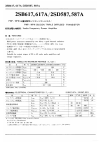
A spec sheet said Hfe2 is Min. 40 and Max. 200 Hfe so 2SD587A might be bad?
Want to confirm that these really are bad since they are very rare.

-The pulsing DBT disappeared when these transistors were removed and with the FU2 fuse in place.
But when measuring DC offset on the Good L-ch it jumps around quite a lot, so I suspect the Voltage problem still persists.

Emitter resistors measures same in both channels.
Plan to check the Drivers and maybe replace the Bias trimpot.
Any other recommended steps / measurements from here on?

Hk 450 Output.png

page-000001.png
 
It could very well be something upstream of them causing the problem. Its not impossible that the outputs are the issue, but if they don't test as shorted or open its not an absolute guarantee.

having positive voltage show up at the outputs could be missing / low negative supply, an open emitter resistor, a faulty transistor upstream, hard to say for sure. I suppose if you really wanted to experiment, switch the outputs channel to channel and see if the problem moves.
 
It could very well be something upstream of them
I see, then I'm thinking of measuring the voltage on the Drivers, Bias transistor and up the chain on both CH tomorrow.
The SM offers a very good Voltage chart.
Ofc measuring still on DBT.

Maybe as a last resort switch Outputs.

Will report back with the findings.
 
Doesn't seem like the Outputs was the cause.

Made some initial measurements (not 100% accurate since the swings where so fast)
By the time I measured Q419 I discovered that the voltage swings was going from Minus to Positive, so Q415 and Q417 measurements might also have those minus to positive swings.
The swings are very fast.
The swings are also present in the good L-ch but only in miliVolts.

+B1 -B1 +B2 -B2 all measures 18-19V (+ and - respectively)
Does this tell anyone something?

HK450 Main amp Volt.png

HK450 Main amp SM.png
 
the voltage swings indicate some sort of oscillation. Since its not both channels I'm thinking probably not the soft start / DBT interaction thing that was mentioned previously. If it were we should see the power supply voltages swinging in both channels, and you'd see it at the main filter caps as well. The fact that its half what it ought to be is probably the DBT. Maybe try a larger bulb and see if that comes up some.

This is with the input coupling caps removed yes? The fact that I'm seeing a ~200mv swing at the base of Q401 almost makes it seem like the problem is before Q401, but if the caps are out nothing should appear there.
 
This is with the input coupling caps removed yes?
Appreciate the prompt response.
No the input coupling caps C401 and C402 are not removed, should I remove them?
So my next step should be to try a larger bulb? I have an 60W at hand.
Should I focus on the Main amp or the preamp where I suspect the Q501 and *edit* Q503 are bad (the frying bacon)?
 
Last edited:
Removed the C401 and C402 input coupling caps and the wild voltage swings stopped!
There still seems to be something wrong in the Main amp area since at least the voltages on Q415/Q416 doesn't match up, but will deal with that later.
The voltages at the Preamps R-ch Q501 and L-ch Q502 BCE also stabilized.

almost makes it seem like the problem is before Q401
So, probably a Transistor in the + rail is bad.

These inputs made me thinking,
Following the + rail back towards the Preamp I checked out the +B5 / -B5 voltages on both the (are they called bypass caps??) C19 and C20 as well as the connecting C12 and C13 and found a discrepancy.
I'm still on a 40W bulb:

The - rail measures 9.10V (SM states 15V)
The + rail measures 12.46V, so since the voltages has been measuring about 60% up until now this sounds high right?
Could it be Capacitors and not Transistors alone being the fault?
Is some Cap letting through to much Voltages or is it more a sign that some Transistors are pulling more voltage? (just trying to understand)
 
It seems something is pulling the voltage down. Probably a short circuit ahead. It could be a shorted Capacitor , but given that you touched something when testing, there are chances of a shorted semiconductor. I can check the schematic later.
 
Back
Top Bottom