• The move to the new server is done. There are some software and database maintenance updates in process. This has us passing the hat around to help out. We appreciate any donations. Seriously, even a dollar helps. The payment page may be found here - https://www.audiokarma.org/support.html

Altec 414z enclosure guidance

Thank you - they were really born more out of (financial) necessity than anything else. They're refinished 9844 monitors that I installed new baffles into. They do sound quite good! Feel free to ping me with questions. I had quite a few as I worked through the project and really benefited from the kind folks here on AK...I've learned quite a bit and happy to share anything I can.
 
Thank you - they were really born more out of (financial) necessity than anything else. They're refinished 9844 monitors that I installed new baffles into. They do sound quite good! Feel free to ping me with questions. I had quite a few as I worked through the project and really benefited from the kind folks here on AK...I've learned quite a bit and happy to share anything I can.

Yes, I was reading about the 9844 and how capable it actually is. Of course the way yours is configured is much nicer. Thanks again for your help and encouragement!
 
I just spoke to Bill at Great Plains Audio. They took a close look at the 806as, tested them, regaussed, and have not been able to find anything wrong with them or to replicate the distortion. He said they look pristine.

So the question is obviously...what could be causing it? I've never heard this kind of distortion from my system before - it only occurs in a narrow frequency band and is only particularly audible during quiet passages during which those frequencies are prominent, e.g., a quiet trumpet solo. Obviously the first thing I'll do is switch the drivers to opposite channels - I stupidly did not do that before sending them off because the nature of the distortion sounded so mechanical - rather than electrical - to my ears.

It almost sounds as though there is a vibrational quality to the distortion.

The distortion is such that you can still hear some of the source tone that is causing the distortion, but not much, and it is more of a true distorted sound, rather than static or electrical noise being introduced.

I really hope Bill is right, and it isn't the compression driver, but what worries me a bit is that the distortion seemed to become slightly more noticeable and perhaps louder after I cleaned the voicecoil gap and reseated the diaphragm.

Anyway, assuming Bill is right, and upon switching the CDs to opposite channels the distortion remains on the left side (and does NOT follow the driver in question), to me the next most likely suspect is the crossover, especially given that I made them.

Does the nature of the distortion I'm describing sound like something that could be caused by a faulty cap? Or a bad inductor? Poor soldering? A broken wire inside the sheathing of the inductor input/output leads? (this seems a possible suspect come to think of it...portions of the inductor lead wires were stiff to the point of feeling hardened or brittle (although they did not crumble or anything).

Anybody ever heard this kind of distortion from a compression driver before? Anybody have a guess? The caps are all new, I'm using the original inductors. I did not have the 30923 networks installed during all this. As always, I'd appreciate any help or guesses - educated or otherwise!

Just FYI for posterity... The distortion I was getting was the result of the diaphragm just slightly being a bad fit for the driver. Swapped it into the other driver, no more distortion at 4k.
 
Thank you - they were really born more out of (financial) necessity than anything else. They're refinished 9844 monitors that I installed new baffles into. They do sound quite good! Feel free to ping me with questions. I had quite a few as I worked through the project and really benefited from the kind folks here on AK...I've learned quite a bit and happy to share anything I can.

Jaaronb, if I may ask, what are your primary listening interests on those? Do some types of music do "better" than others?
 
Just FYI for posterity... The distortion I was getting was the result of the diaphragm just slightly being a bad fit for the driver. Swapped it into the other driver, no more distortion at 4k.

I love what you did with your 9844's ( BTW ) !!

( Hope you don't mind a couple more questions ):

I realize ( from another post ) that you eventually retired the 806 drivers in favour of 802s .

Did you migrate the original diaphragms from the 806s into the 802s ?

Was the ( rectified ) 4K distortion problem exclusively an 806 occurrence ( or did you also have a distortion problem with your 802's ? ) ?

FYI, here's the distortion profile for 2, 802T drivers of mine .

The second driver shows a significant distortion problem ( even at low drive levels > note the cursor positioned on 4.4K ).

802T-34647_BiRadial_Distortion_Study.png


These diaphragms have no "play" what with the guide-pins and holes being a tight fit.

Historically, if swapping the 2 diaphragms around won't fix the distortion problem then I'm left with no other recourse than to enlarge the guide-holes ( on the diaphragm ) from 1/8" to 9/64".
- This enlargement gives enough "slop" to properly adjust ( or mis-adjust in most cases ) the diaphragm within the gap.

One wants to have test software like REW & associated test mic to pursue this sort of DIY fix to distortion problems .

:)
 
Last edited:
I love what you did with your 9844's ( BTW ) !!

Thanks!

( Hope you don't mind a couple more questions ):

I realize ( from another post ) that you eventually retired the 806 drivers in favour of 802s .

Did you migrate the original diaphragms from the 806s into the 802s ?

No I didn't. To be clear, the distortion I was getting on one of the 806a diaphragms was mechanical - like a buzzing (presumably caused by the phragm making contact with the driver body somehow), and was caused by the 'phragm being a bad fit for the driver body/pins, although it did not appear to be loose at all. Swapping the phragm into the other 806a fixed that issue.

BUT, I had another issue with the 806as that I posted about elsewhere. Basically, one of the drivers sounded much more open and refined, especially above ~4k, than the other. This was in my early days of learning about Altec gear and I just *could not* figure out why one of the 806a drivers sounded so much better than the other. I spoke to Bill at Great Plains about it. This was after I received the 806as back from GPA for a rebuild/remag. Bill said they should sound identical. They didn't.

When I swapped the phragms into opposite drivers to fix the distortion issue, I finally realized that the better sounding driver used a different phragm than the inferior driver. The better sounding driver used the 23744 so-called "light" diaphragm. The inferior driver used the standard replacement phragm. I wasn't aware at that time that the 23744 was considered "better" by some folks.

Bill had been aware of the fact that the drivers were using two different phragms, but had been insisting to me that they should sound identical and he had no idea what I was hearing or why the drivers might sound different. When I finally figured out the issue, I was a bit irked that he hadn't at least given me a heads up that some people over the years felt like the 23744 phragms sound superior to other Altec models.

So for myself at least, there's no question that the 23744 diaphragms sound *much* better than the current replacements or others made by Altec during that time.

Anyhow, I couldn't deal with the drivers not sounding identical, do I bought a current replacement from Bill to replace the 23744. This was like a month-long ordeal, and I was so put off by the whole thing that I sold the 806a drivers (stupidly threw in the 23744), and bought new GPA 802-16gs from Bill.

Bill didn't have any 802s in stock when I ordered, so he sent me a pair of 902s to use until the 802s were built. (He also insisted there was no audible difference to him between the two drivers). I used the 902s for about a month, then got the 802s from Bill. I did A/B them, but didn't even have to - the two drivers sound completely different. Night and day difference. 902s are much more extended above 10k and flatter overall, but less rich sounding below ~5k than the alnico 802s. The 902s sound *much* more modern. If I were using these speakers to mix or record or monitor, I'd probably want the 902s, and most people would probably prefer them to the 802, but I really dig that timbral richness of the 802s, so that's what I kept.

Was the ( rectified ) 4K distortion problem exclusively an 806 occurrence ( or did you also have a distortion problem with your 802's ? ) ?

Yeah - the buzzing/distortion only happened when the 23744 diaphragm was used in one of the 806as - it didn't do it anymore then I swapped the phragms. It was very audibly mechanical distortion and really only happened on a few tracks at loudish volumes at a very specific frequency.

FYI, here's the distortion profile for 2, 802T drivers of mine .

The second driver shows a significant distortion problem ( even at low drive levels > note the cursor positioned on 4.4K ).

802T-34647_BiRadial_Distortion_Study.png


These diaphragms have no "play" what with the guide-pins and holes being a tight fit.

Historically, if swapping the 2 diaphragms around won't fix the distortion problem then I'm left with no other recourse than to enlarge the guide-holes ( on the diaphragm ) from 1/8" to 9/64".
- This enlargement gives enough "slop" to properly adjust ( or mis-adjust in most cases ) the diaphragm within the gap.

One wants to have test software like REW & associated test mic to pursue this sort of DIY fix to distortion problems .

:)

This is interesting. Is your distortion audible *as distortion*? I should have been more clear when I originally was trying to sort out my distortion issue - it was not harmonic distortion, but very clearly mechanical, and hard to reproduce. You could only get it clearly, e.g., on a passage with something like solo trumpet or guitar and even then, only around a range of about 1/4 octave.

When this has happened to you before, has enlarging the holes fixed the issue? There are obviously very tight tolerances involved for a phragm to buzz against the body of one driver and not another identical one.
 
Thanks jaaronb for your thoughts on all this,

Your experiences perfectly match what others have said in the past ( re; the 23744 diaphragms ).
- Too bad you didn't hold onto the one you had ( I suppose ).

A more modern equivalent ( I believe ) is the 35480 diaphragm ( that was made for even less time than the 23744 > I believe ) and found in only one of three or four 902 variants.

Sadly, I've concluded ( more than a decade ago ) that BillH must have cloth ears ( regarding this specific topic ).
- In the past he's turned aside requests to remake the "lite" diaphragm ( without reasons given ).

Regarding my graph; those drivers aren't in standard use by me ( normally I listen to Altec 288-8Ks on EH500 radials > & have been for about 15 years ).
- Lately I've been spending some listening time to some re-magged 802D drivers ( sporting the mentioned 35480 diaphragm ) .
- This smaller combo has nice "air", along with that harmonic richness that you mentioned ( BTW; the 288 excels in richness ).
- The 802D/35480 combo has a bit less mid-range authority/power than the 288( noticeable on forcibly played/struck classical piano pieces like Chopin or Rachmaninov piano concertos ).

I don't "hear" harmonic distortion until it's well over something like 3% ( based on experience ).
- Oddly, I do hear the different effects of capacitors ( typically as an unexpected resonance ).
- I like to keep all the drivers that I have ready to play at a moments notice ( therefore I try to keep their QC high ). This is why I test them and don't replace them to the shelf until they've been optimized as well as can be.

I do listen to a lot of classical ( using horns only / ie; woofers off ) due to the realities of apartment dwelling.
- The experience is incredibly revealing in what can discern when a woofer is out of the way ( & not dominating the listening experience ).

:)

PS; enlarging those guide-pin holes is the start of another rabbit hole that one must commit to going down ( ie ; measuring, shifting things about until results are as good as can be attained ).
- IOW, it's a real make-work project.
 
Last edited:
Wow! What excellent dialog here! OK two questions. First to Jaaronb (or anyone else who happens to know): When using two 414 woofers per cabinet (since I possess the innards of an Altec 9844 system, without cabinets), what cubic footage do you make your boxes? Are they about the same sized enclosure as the Altec 9844 including the 811 horn with driver? Bigger? Smaller? Next, I recently purchased two 802-8G II drivers, two 416-8B Woofers and two 1200 HZ crossovers from Great Plains Audio to eventually recreate a Model 19. Can anyone tell me about which diaphragm is used in that 802-8G from GPA? What about the phase plug these days in those drivers? A tangerine or something similar?? Thanks!!
 
First to Jaaronb (or anyone else who happens to know): When using two 414 woofers per cabinet (since I possess the innards of an Altec 9844 system, without cabinets), what cubic footage do you make your boxes? Are they about the same sized enclosure as the Altec 9844 including the 811 horn with driver? Bigger? Smaller?

I currently use two 414z drivers in 9844 enclosures with the horn/compression driver on top. I want to say I've seen somewhere (but can't remember where) a discussion that indicated the ideal enclosure size for two 414z drivers was larger than the 9844 - I think ~7-8 cu ft, if memory serves. Whereas the 9844 is only ~5 cu ft. The only shortcoming of my modded 9844s is a lack of that bottom octave - say ~35-70hz. That said, my room is *terrible* with very low <7' ceilings, so I honestly don't know what my speakers would sound like in a decent room. One of these days I'm gonna take em upstairs when the wife is out of town.

I just did the math on the Altec Malibu, which uses 2x414z per side... It's somewhere in the neighborhood of 7+cu ft. You could always just build Malibu cabinets from the plans....
 
Next, I recently purchased two 802-8G II drivers, two 416-8B Woofers and two 1200 HZ crossovers from Great Plains Audio to eventually recreate a Model 19. Can anyone tell me about which diaphragm is used in that 802-8G from GPA?

I don't remember the model # of the diaphragms used in the GPA 802 models, but I'm almost certain it's the same one GPA provides as a replacement for 806s, 802g, et al.

Unless you're planning to use them for sound reinforcement, I suggest removing the loading caps from your 802s and putting a layer or two of felt in the back of the compression driver "lid" that bolts onto the back. You'll have to either clip the length of the three bolts that hold the loading cap/diaphragm to the compression driver body, or just buy some stainless new ones that are 1/4-1/2" shorter. I totally forgot (for months) that GPA shipped compression drivers with loading caps installed, and recently removed them from my 802s and 604e's.

You'll get a a nice improvement in overall HF extension and openness in the HF by removing the loading caps, which only serve, as I understand it, to increase the safe power handling of the 'phragms. Usually only necessary in PA applications.
 
I currently use two 414z drivers in 9844 enclosures with the horn/compression driver on top. I want to say I've seen somewhere (but can't remember where) a discussion that indicated the ideal enclosure size for two 414z drivers was larger than the 9844 - I think ~7-8 cu ft, if memory serves. Whereas the 9844 is only ~5 cu ft. That said, my room is *terrible* with very low <7' ceilings, so I honestly don't know what my speakers would sound like in a decent room. One of these days I'm gonna take em upstairs when the wife is out of town.

I just did the math on the Altec Malibu, which uses 2x414z per side... It's somewhere in the neighborhood of 7+cu ft. You could always just build Malibu cabinets from the plans....

If it matters at all, my 414 is the "Z" version. Also, I only have the EXTERNAL dimensions, but the the 9844's total volume including the horn is 31" x 24" x 16", which is 6.888 cubic feet, not 5. Again, we're talking external dimensions, but we're pretty close to that 7 you suggested. Thanks J!
 
I don't remember the model # of the diaphragms used in the GPA 802 models, but I'm almost certain it's the same one GPA provides as a replacement for 806s, 802g, et al.

Unless you're planning to use them for sound reinforcement, I suggest removing the loading caps from your 802s and putting a layer or two of felt in the back of the compression driver "lid" that bolts onto the back. You'll have to either clip the length of the three bolts that hold the loading cap/diaphragm to the compression driver body, or just buy some stainless new ones that are 1/4-1/2" shorter. I totally forgot (for months) that GPA shipped compression drivers with loading caps installed, and recently removed them from my 802s and 604e's.

You'll get a a nice improvement in overall HF extension and openness in the HF by removing the loading caps, which only serve, as I understand it, to increase the safe power handling of the 'phragms. Usually only necessary in PA applications.

Thanks again J, very much in fact. I don't know if this matters but I just received all the GPA drivers about a week ago so I wonder if this condition still exists. Also, I'm a newbie so surgery scares me...
 
If it matters at all, my 414 is the "Z" version. Also, I only have the EXTERNAL dimensions, but the the 9844's total volume including the horn is 31" x 24" x 16", which is 6.888 cubic feet, not 5. Again, we're talking external dimensions, but we're pretty close to that 7 you suggested. Thanks J!

You're correct about the external dimensions of the 9844, but believe it or not, when you calculate the 9844's *internal* volume, by subtracting just 1.5" from each of the outer dimensional measurements to account for the 2*.75" plywood walls on each dimensional measurement, you get 5.56 cu ft. And that's not accounting for internal bracing, the volume occupied by the speakers themselves, etc.

I was shocked the first time I calculated the internal vs external volume of the 9844, also thinking I was "close enough" to 7 cu ft. I thought that measley 1.5" was basically a fudge factor.

The figure I stated above for the Malibu was my calculation for it's internal volume, subtracting that 1.5" per side.

None of this is to say the 9844 cabinets sounds bad - they sound great! Just passing along one of those eureka moments I stumble upon once in a blue moon....
 
Last edited:
You're correct about the external dimensions of the 9844, but believe it or not, when you calculate the 9844's *internal* volume, by subtracting just 1.5" from each of the outer dimensional measurements to account for the 2*.75" plywood walls on each dimensional measurement, you get 5.56 cu ft. And that's not accounting for internal bracing, the volume occupied by the speakers themselves, etc.

I was shocked the first time I calculated the internal vs external volume of the 9844, also thinking I was "close enough" to 7 cu ft. I thought that measley 1.5" was basically a fudge factor.

The figure I stated above for the Malibu was my calculation for it's internal volume, subtracting that 1.5" per side.

None of this is to say the 9844 cabinets sounds bad - they sound great! Just passing along one of those eureka moments I stumble upon once in a blue moon....

WOW! It makes sense J. When you mention 1.5" per side, are you really saying 3/4" for each of the left, right, top, bottom, front, and back? Not having or having ever seen the cabinets or a 9844, I know nothing about the wall thickness, internal bracing, etc. What I do have is the two, twin (totaling 4) of the 414Zs each mounted to their original baffle board. The rest is just pulled components, nothing more. Do you know of anyone making a substantially bigger box for twin 414s? I think it would help bass output, but then there's port size to reckon with, and as I said, I'm a newbie! Thank you again!! ...Very much in fact!
 
I found some pics of the Altec Malibu. GORGEOUS!! Were they ported?? Don't see a port...
http://www.audioheritage.org/vbulletin/attachment.php?attachmentid=28915&stc=1&d=1191900237
http://www.audioheritage.org/vbulletin/showthread.php?18580-My-new-Malibu-s/page2
http://www.usaudiomart.com/details/...r-audiophile-hifi-16-ohm-vott/images/1428811/

Interestingly, I saw one with a so called Malibu that had a rectangle slot - port in the front, but with a 15 instead of two 12s per cabinet, in the same looking cabinet and grille...
 
I found some pics of the Altec Malibu. GORGEOUS!! Were they ported?? Don't see a port...
http://www.audioheritage.org/vbulletin/attachment.php?attachmentid=28915&stc=1&d=1191900237
http://www.audioheritage.org/vbulletin/showthread.php?18580-My-new-Malibu-s/page2
http://www.usaudiomart.com/details/...r-audiophile-hifi-16-ohm-vott/images/1428811/

Interestingly, I saw one with a so called Malibu that had a rectangle slot - port in the front, but with a 15 instead of two 12s per cabinet, in the same looking cabinet and grille...

I believe they did a funny trick with the port on the Malibu, and the early Valencia models also...the opening on the front baffle where the horn fits in - where the 'face' of the 811b horn is affixed - is 'too wide' by xx inches per side on the vertical, leaving an opening on each side of the 811b baffle of a couple inches. These two openings, one on each side of the horn face, sum to the appropriate port size for the tuning the Altec engineers wanted. Google images of the Valencia or Malibu, and from the rear, you can see the slot openings on either side of the horn.

There have got to be more knowledgeable people than me around here. Where are you nerds? I just started learning about all this stuff a year or two ago. And I dated my high school math teacher for an 'A' (heh), then took 'formal logic' as the math requirement for my English degree.

Here's a pic where you can see the 'ports' I'm referring to:
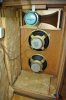
 

Attachments

  • malibuport.jpg
    malibuport.jpg
    49.2 KB · Views: 51
I believe they did a funny trick with the port on the Malibu, and the early Valencia models also...the opening on the front baffle where the horn fits in - where the 'face' of the 811b horn is affixed - is 'too wide' by xx inches per side on the vertical, leaving an opening on each side of the 811b baffle of a couple inches. These two openings, one on each side of the horn face, sum to the appropriate port size for the tuning the Altec engineers wanted. Google images of the Valencia or Malibu, and from the rear, you can see the slot openings on either side of the horn.

There have got to be more knowledgeable people than me around here. Where are you nerds? I just started learning about all this stuff a year or two ago. And I dated my high school math teacher for an 'A' (heh), then took 'formal logic' as the math requirement for my English degree.

Here's a pic where you can see the 'ports' I'm referring to:

Absolutely amazing!!! I noticed that before, but from the front of a Valencia model. Though it now seems obvious, I never put 2 + 2 together and always wondered why it was mounted like that! Thank you so very much!
 
Valveglow,

I would size your enclosures ( according to some Box sims ) to @ 7 cu' and tuned to somewhere between 35 hz. to 40hz. This size is for the two woofers in a single box.

Tuning should ultimately depend on what sort of LF room-gain ( cabin gain ) you get from your listening space and also, where you place the cabinets ( backed into corners increases LF ).

The range of tunings are from (2), 3" id round tubes, varying anywhere between 1.25" long - 2.25" deep.
- id = inside diameter
- the longer the port/ducts, the lower tuning.

:)
 
Last edited:
Back
Top Bottom
