• The move to the new server is done. There are some software and database maintenance updates in process. This has us passing the hat around to help out. We appreciate any donations. Seriously, even a dollar helps. The payment page may be found here - https://www.audiokarma.org/support.html

Amateur Hour? How screwed am I?

Richard Zoll

New Member
Greetings. Im pretty well new to tubes except for the old days and never had to really consider maint. issues etc. So don't laugh but here is what I did... I have a pretty nice Magnavox 9302 sounding excellent when using my Mitsubishi P20 Pre-Amp. Sounded pretty good. Anyway, I bought a Fisher 100-T and took the guys word for it being as good as it looks which was excellent and local so I wasn't too worried. The P20 is a spare and I have an entire system of those Mitsubishi separates and a speaker switch. The speaker switch was set for the Japanese system and I hooked my new pre up to my Magnavox. I didn't hear any sound and the speakers were close so I leaned in and turned it up. And up. The next thing I heard was crackling and smell of burning wires. I thought I was going to go force feed the guy his Fisher but then hooked it to a different amp and it works and sounds phenomenal. (after I figured out the speakers were switched to the other system) ... Now the Maggie just hums. The power tranny wires underneath look toasted at least. So A) First and foremost Can it be fixed and is it worth it? B) can a Preamp push too much for such an amp to burn up or is it the speakers being shut off as I suspect? C) I now use the Fisher with a dual mono Mitsubishi and my small room sounds good with SDA-2Bs, (Only Heresy 2s were hooked up when I connected) but I want to have complete SS and Tube systems. How bad did I screw up?
 
Register to hide this ad
Worst case, you'll need to get replacement output transformers. Some rebuilders of Maggie do that anyway. Check out the threads here.
 
Well, what ever you did doesn't sound good. You need to test it to be sure.
If you have a variac is the easiest way since you can set the voltage to about 70% which should energize the tubes but keep the voltages low enough to not further endanger your amp. You can also measure voltages without the tubes, except the rectifier, but i prefer to leave the tubes in as a load. You need to check the voltage at the OPT CT, output trans center tap, and at the plates or anodes of the 2 el84. the voltages should be about 10 to 20 volts lower at the plates and almost the same for both tubes and in the other channel. I would guess for a PP EL84 amp that would be around 250vdc at around 70vac. If it is low or different between channels and different between tubes in the same channel you have a problem. If everything seems ok, voltage wise you need to do further checks.
 
Last edited:
Those amps are pretty much bullet proof. Usually if you forget to connect speakers, the output transformers will just sing but to have them both go at the same time with no speakers connected, is certainly a stretch. Check the output transformers with a meter.

You have not mentioned if it has been recapped? Was the can capacitor on top of the chassis warm or very warm to the touch after said event?
 
It sounds like you are looking at a power transformer failure if the wires coming from the power transformer are toast. Give the transformer the sniff test to check for burnt insulation. If it smells burnt, then you have found the bad part, but you have to determine what caused the transformer to fail as not finding the cause of the failure will most likely lead to another transformer failure in the near future. As was suggested, check both of the output transformers for continuity on both the primary and secondary windings. Usually a power transformer failure is caused by leaking filter caps which put an extra load on the transformer.
 
How about some pictures before we condemn too much here. Before you know it collectively we'll have you replacing everything between the breaker box and the speakers.
 
You can also remove the 5U4 rectifier tube and power up the amp to check for overheating and low secondary voltage on the power transformer. With the 5U4 removed check to see if the rest of the tube filaments light and you don't smell anything cooking. I also agree that you don't want to replace anything until you know for sure what part or parts failed and what caused the failure.
 
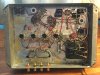
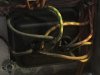
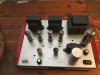
This place and you guys are the best First of all. It is the power transformer without any doubt. Roasted. I just hope it didn't do any more damage beyond that. I cranked the Fisher and listened for any hiss to tell me things were working and the crackle was definitely the power tranny. See photos. We have a good shop here in Syracuse I think I will attain a Transformer and take it in and have him go through it when he swaps them out?
 

Attachments

  • IMG_0023.JPG
    IMG_0023.JPG
    400.9 KB · Views: 109
  • IMG_0024.JPG
    IMG_0024.JPG
    294.9 KB · Views: 110
  • IMG_0022.JPG
    IMG_0022.JPG
    334.2 KB · Views: 105
From what I can see in your pictures, the amplifier has already been recapped so you shouldn't need to have that done. Have you done the sniff test and checked the voltages available at the transformer with the 5U4 removed to be sure that the power transformer is positively the problem? Also is there anything leaking out of the transformer such as tar or wax as those are an indication of a failing or already failed transformer. The transformer could be overloaded by a shorted filter cap too causing it to overheat and has the fuse blown and had to be replaced as that is also an indication of overloaded transformer secondary either from a short after the 5U4 or shorted winding.
 
Looks like the PT red wires are burned,,, they would be the HV winding leads... bad PS caps or a bad/shorted rectifier tube could cause that... looks like newer PS caps, so I'd test the 5U4, it could be shorted... With the 5U4 pulled, you can power up the amp with a variac or DBT, and check voltages across the red wires... Also check from red wire to PT core for a short circuit...
If the PT reads bad/shorted, you need to find the cause before replacing it...
 
Yes the sniff test was done and the wires are burnt from the PT. My plan was to take it in as is with a new or at least good used PT to my local technician. Whatever caused it the PT will need to be replaced and a thorough go through of the rest of the amp, correct? And where would one buy such a transformer? There are no numbers on the transformer itself. Cranking the Fisher 100-T preamp volume while there was no speakers on the amplifier seems to be a bad idea. It had wires to a switch but the switch was set to a different amplifier, so in reality there was no output? After closely looking I see that the PT is really the only place that melted and the fuse never did blow. The OPTs and connections are all minty. Only that darn power transformer. Also to be clear, the amp worked superbly prior to this, the day it happened was the first day I ever owned the Fisher and when I got no sound out of it I thought I might have purchased a lemon, so I cranked it of course up and down rolling the tuner knobs trying to hear a hiss from my speakers. As I said, amateur hour.
 
I'm not quite sure how you'd lose a power transformer by running this at full output with no load. Output transformer maybe, but unless one of those shorted to ground I don't see why the power transformer would be bothered. also possible the rectifier arced and shorted. Both actually would be worth checking.

Its possible the power trafo is fine. It may have gotten hot but that doesn't always mean its destroyed. Removing the rectifier tube would let the transformer run with no high voltage load. If it doesn't get hot and if you can confirm voltages at the rectifier socket I'd wager the transformer is just fine. The next step would be to find out what caused it to get hot in the first place. usually running a tube amp at high levels with no load is only likely to take out the outputs. Basically the voltage swing gets beyond what the insulation is rated for and it shorts to ground.

I would check the fuse size though, it might be too large. I usually use a 2 amp slow-blow, it shouldn't need more than that.
 
As the year comes to a close, and seeing this amp's troubles I must lament our loss of Kegger. That gentleman knew these beasties inside and out, and could have offered the quickest way to the solution. He was also quite skilled at communicating this Way. I miss him....
cheers,
Douglas
 
+1,,, communication on the forums is a gift,,, its pretty difficult to picture the instruction given by even the most knowledgeable, sometimes... There are some guys I can understand immediately,, others I just can't get...
Its all good tho, someone picks up the info given...
 
I would recommend taking the amp to a tech you trust to have the amplifier's problems diagnosed before looking for a replacement power transformer. In the 50+, years I've been servicing and restoring electronics equipment I've rarely had to replace a power transformer.
 
I would run a voltage test on the transformer. Nowhere is there any mention of you doing that. Pull ALL the tubes, including the rectifier and apply 60 volts with your variac. Measure the voltages of each of the outputs. They should be a bit over half of what they should be. If the transformer is really toast this will find that out. If it did go belly up, I would suspect the filter caps, the large aluminum can on the top of the amp.

Good Luck

Shelly_D
 
Are the 6EU7's the same or do you have a clear top and another type? The one on the left looks like a clear top. Or has it lost it's vacuum? Any chance it has failed and could be related to the problem?
 
I would run a voltage test on the transformer. Nowhere is there any mention of you doing that. Pull ALL the tubes, including the rectifier and apply 60 volts with your variac. Measure the voltages of each of the outputs. They should be a bit over half of what they should be. If the transformer is really toast this will find that out. If it did go belly up, I would suspect the filter caps, the large aluminum can on the top of the amp.

Good Luck

Shelly_D

Having once taken out a properly fused variac on a shorted PT, I would be hesitant to try on a suspected bad one without a DBT in-between.

/does not like putting fingers in fan
 
Back
Top Bottom