• The move to the new server is done. There are some software and database maintenance updates in process. This has us passing the hat around to help out. We appreciate any donations. Seriously, even a dollar helps. The payment page may be found here - https://www.audiokarma.org/support.html

Amp square wave testing question, or Ignorance is Bliss

I use one very similar to this, I think it's just have a different brand on the same generator:https://www.amazon.com/KKmoon-Preci...d=1504489511&sr=8-3&keywords=signal+generator
https://www.amazon.com/KKmoon-Preci...d=1504489511&sr=8-3&keywords=signal+generator
This is similar to mine except mine is 20MHz, don't know the condition, just something to think about:http://www.ebay.com/itm/Wavetek-Mod...537209?hash=item33d5d067f9:g:LjAAAOSwdjNZEJd2
http://www.ebay.com/itm/Wavetek-Mod...537209?hash=item33d5d067f9:g:LjAAAOSwdjNZEJd2
These are the two I use, one to trigger the other. I like the Wavetek because I can run the frequency up really fast to trigger any instability, I put on the 1MHz setting and swing the rotating knob from 50KHz to 20MHz with a spin, then back. Do it a few times, if there is any marginal instability, it might burst into oscillation!!!

You have to make it oscillate and then fix it.
 
Spent the day with the amp, first I cleaned up a very small distortion i found in the output of the drive tube in one channel by relocating the coupling capacitors and resoldering everything. That didn’t fix the initial issue, but it did improved symmetry of the signal going into the power section. Then mostly I adjusted the NFB resister/capacitor until I got rid of the distortion. It ended up at the original schematic value of 2200 ohms, with 1220 pF across it. Closed loop gain ended up 1 volt in 5.3 volts out. Until I lay my hands on a proper signal generator I wont worry about tweaking anything further, it sounds like one hell of a good Magnavox 8802 6V6 push pull amp as it stands.
 
Random thought, whats the square wave output from your scope look like? Most of them have a calibration terminal meant for tuning the x10 probes. Typically its 1kc at something like 0.1 volt out. No adjustment and not a lot of amplitude but if its clean it might serve to verify what the 1kc squares look like on the output.
 
It is incredibly simple to make a good variable frequency squarewave-only generator --- usually with a single logic chip or 555 timer chip. Google Images will show you dozens of schematics for something like this. I would just kludge it together on a scrap of unetched PCB, dead-bug style, and use it until I rounded up the funds for a good sine/square audio generater.
 
Fear not fellows I will get a signal generator at some point and continue the refining of this amp. Thanks for encouraging me to deal with that 30hz snivet.
 
Random thought, whats the square wave output from your scope look like? Most of them have a calibration terminal meant for tuning the x10 probes. Typically its 1kc at something like 0.1 volt out. No adjustment and not a lot of amplitude but if its clean it might serve to verify what the 1kc squares look like on the output.
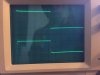
An excellent suggestion Gadget73. 1Khz from scope calibration top, amp out below.
DFA3F216-1406-4132-9EFD-0BA1C859BC14.jpeg
Just out of curiosity, what does the sine wave out of the Mac mini look like at low frequency?
100Hz from Mac mini
2E977456-638F-4AB0-929B-78C0A20D1DFE.jpeg
 
well, the output looks like the input, so it doesn't seem to indicate any gross faults.

with output like that from the Mac, it makes you wonder what it does to sound. Does it help any if you reduce the level?
 
Not perfect, but ok. Don't worry about the slant as I explained before. There's a little kink in the 1KHz, but I won't worry about it.
 
Not really. BinaryMike explained it further up as typical of the dac used. The Mac actually sounds pretty good with music, comparable to other devices with similar dac. I am contemplating getting a Raspberry Pi 3 and DAC hifi + pro soon.
 
Checked scope and it was set for AC coupling, tomorrow I will take a little capacitance out and re-measure using DC coupling.
 
The amp is AC couple inside, transformer is AC coupled, it does look like this. My amp looks like this too because I have a 1uF DC blocking cap at the input and input impedance is 20Kohm. I was surprised first and traced it down. I calculated the -3dB frequency is about 10Hz and it tested out correct. Particularly the tube amps, you want to block any frequency below 20Hz to avoid distortion of the output transformer.

I always on DC coupling, never even use AC coupling. That's the reason I feel square wave is not the end all method. I use sweep sine wave to look for frequency response. Square for testing stability.
 
Last edited:
Did two things this morning after some pointed research. I determined that one mod I had made in hindsight was not good for the type of paraphase front end this amp uses and likely was causing the instability I was seeing, now restored back to as designed. I had lowered the front end grid stopper to 1k from original 47k, I credit Dave “dcgillespi” for his excellent understanding of these Magnavox console amps and then sharing his knowledge on here for hobbyists like me to take advantage of. The 47k grid stopper in this case is the primary means of maintaining stability in this amp design. I also tried dialing in the square wave without removing to much. I decided some overshoot is preferable if dampened quickly. I really should try the balanced paraphase Dave discusses in his “getting more from the 9300” topic.
02C67609-AAE5-43CD-9539-0FF34945ED84.jpeg
30Hz now at full strength
E06DE0A8-25AB-431D-902F-070929A98AB9.jpeg
 
The floating paraphase does help a fair bit. Its still not a perfect inverter design but the floating setup does make the imbalance at different frequencies less.
 
For all it’s short comings the little Maggie 8802 has a considerable fan base, me included. Have read more than a few times it has risen quite high in gathering blind shoot outs against some very prestigious competition. It’s reputation was made on being a cheap, easy to convert to stand alone amp, with mods by the score. As I said some of the mods being iffy, while others though more plausible in the end also not a real improvement, like my grid stopper mess. For me the good solid state power supply, and the better output transformers, coupled with some tried and true circuit tweaking gave the biggest improvements.
 
Back
Top Bottom