• The move to the new server is done. There are some software and database maintenance updates in process. This has us passing the hat around to help out. We appreciate any donations. Seriously, even a dollar helps. The payment page may be found here - https://www.audiokarma.org/support.html

Amplified Antenna On 4100

I greatly appreciate your detailed OCD answers to my questions. I just don't know all the answers to some of your detailed OCD questions :D

I'm glad you mentioned FM Fool. I plugged in my zip and you are correct the stations are all around the compass. It will be useful though if there is a particular station I'm trying to tune in, I can at least see what direction it is coming from. Awesome :thmbsp:

The funny part is I don't even have my receiver yet. It should be here next week though. I have never really used a tuner in my 2 channel rig. I was just kicking some ideas around to see what others are doing and try to incorporate them to maximize my tuner. It all started with Antenna Amp or No Amp? But you given my alot to think about. Thank you! There is always the internet if I really need a station tuned in.

I don't imagine it will be for critical listening, just a nice added feature, catching some live music on PBS. I don't even know enough about tuners/receivers to know if it even sounds better than internet streaming through my DAC/Apple TV. I will find out and It will be fun to play with though:music:
 
This is a great thread witnessed from my perspective. I've been using rabbit ears inside 1st level garage for my Mac1900. I bought an antenna today that is Yagi style that I will put up in the attic space above the garage. My preference is to increase signal strength for stations on left end of the dial in the greater DC area 88.5, 89.3, 90.9 I am about 20-25 miles out from the broadcast antenna with some terrain in between. My antenna will be at approx. 350 ft above sea level. I may also split the signal for to TVs currently managed by fios stbs.


Excellent let us know how it works out for you. They are a cheap investment really when you look at how much we spend on our gear. I may even invest in an attic antenna just for my rig if the current antenna I have dosen't work well. So I would be interested in seeing how the brand you bought fairs.
 
For a time I had used the non-amplified version of the Radio Shack FM/VHF/UHF antenna you have shown and it worked fairly well given my challenging reception area.

Its main shortcoming was that it needed to be re-oriented for different stations which was not always convenient with the 3' masts fully extended making placement difficult at times, moving it here and there to keep from bumping into the damn thing knocking to the floor. Of course this was an unpowered unit; if it needed AC power, inconvenience would have been multiplied!

Finally had enough and had an outdoor Magnum Dynalab ST-2 mounted outdoors, at the roof peak and it provides FM signal to both my systems. Signal reception is far better than it ever had been with indoor antennas while killing two birds with one stone. Best damn thing I ever did.

I could see that being a total pain in the ass, I'm hoping since Iowa is as flat as a board I may get lucky to set it and forget it. But they are ugly and one out of site would be optimum. If I end up doing something like you have I will look into the Magnum Dynalab ST-2.

So do some of these antenna's provide 360 degrees reception?
 
Yes the ST-2 in an omni-directional antenna, it should receive equally well from all directions, given that it is installed in the open and clear away from other wires or metal conductors.

The ST-2 is a good working antenna. Since it is a end fed half wave antenna with a very high feed point impedance that is changed to the 75 Ohm feed point impedance suitable for coaxial cable it does not have as much a need for a ground plane radial system to decouple the outside of the shield of the coaxial cable (common mode RFI issues) as a simple quarter wave ground plane antenna would.

I have found improvement when installing this antenna in very electrically noisy environments by using common mode ferrite RF chokes right at the base of the antenna to combat common mode RF noise currents that might lead to increased noise in the received signal.

And since outside antennas have been mentioned, it is never a bad idea to use a product like Coax Seal (no affiliation) to help weather proof any connections that are outside, including the connection to the antenna and the the grounding block. Remember to ground any outside antenna per the NEC, and to use a drip loop where the coaxial cable enters the building.

And always be nice to your Aunt Enna.:D
 
So do some of these antenna's provide 360 degrees reception?

The MD ST-2 does.

I would imagine you would experience even better results than me with the ST-2 as there is a lot of terrain in my neck of the woods resulting both weakened signal as well as multipath. Chances are, most of this will be considerably less in IA.

A rotator-mounted directional will provide the very finest reception but that obviously entails an extra measure of commitment.
 
Last edited:
Inquiring OCD minds would like to know.:D:D:D To be clear I mean no disrespect with my little poke of fun about my OCD. I am mostly just like Monk on the old TV series.:yes::yes:

I'll bet you must tweak your antenna 50 times a day to make sure the signal strength meter is right at the peak.
 
Oh, I do not stop at 50 of anything!:D:D:D

You know the old saying about cutting a length of lumber, measure twice and cut once.

When I use a DMM, I measure until the battery goes dead.:yikes::yikes::D:D

Actually I live in a broadcast band (both AM and FM) black hole. There is one local AM station and one local FM station, the next closest stations of interest are at least fifty miles away and on the other side of a high ridge.

These stations are even hard to receive in my minivan at my house with the engine off for the lowest possible noise floor. If I drive about 5 miles due north on the main highway to the top of the ridge, the reception is great.

Due to my health I have not been able to install an outside antenna, which would help by moving the antenna away from all of my unwanted sources of electrical noise, and I am sure that I would see some increase in signal strength, but there is not much out there to capture at my location, location, location. I have the entire main business district of my town due north of me and higher than me, so unless I can get my outside antenna close to as high as the downtown buildings, I am kinda, sorta, mostly out of luck.
 
A little wind blown but you get the idea. I think it's about 5' long. Maybe 6'. It's been up there about 15 years.

HDTV, FM and HDFM. Works all the time with no multi-path problems like I had with an omni antenna before this one.

U1O3im3.jpg
 
Thanks for the pic. You have an ideal setup, it would be nice if all the transmitters were in the same direction where I live. Looking at FM Fool I think if I go that route I will have to get an omni directional for FM.
 
Thanks for the pic. You have an ideal setup, it would be nice if all the transmitters were in the same direction where I live. Looking at FM Fool I think if I go that route I will have to get an omni directional for FM.
Does anyone still make rotors? I would think hams still use them.
 
A rotor would take a whole new level of commitment. I am no electrician and it would need 110v.

What are you using with your MR78 JLOVDA?
 
A rotor would take a whole new level of commitment. I am no electrician and it would need 110v.

What are you using with your MR78 JLOVDA?
Nothing but a vertically oriented half-wave dipole tuned to 98 MHz (about 4 ft total length, guessing from my computer) in my living room on the first floor. It's made from a long wood dowel with wires taped to it with a 300>75 ohm balun in the middle. Reception is poor, lots of multipath. Gets better in the evening. I a few local, strong stations of no interest to me. Cleveland is 50 miles away, Akron 25 miles. My home is in a "bowl" about a half mile across with low hills around three sides. Of course the forth side faces east with nothing for at least 60-80 miles. The tuner just looks nice turned on while I listen to CDs. I started a long thread here awhile back explaining why my antenna doesn't have more elements or is higher.

By the way, I am 99% sure there is low voltage (12v ?) going up the tower to the rotor itself.
 
Last edited:
Nothing but a vertically oriented half-wave dipole tuned to 98 MHz (about 4 ft total length, guessing from my computer) in my living room on the first floor. It's made from a long wood dowel with wires taped to it with a 300>75 ohm balun in the middle. Reception is poor, lots of multipath. Gets better in the evening. I a few local, strong stations of no interest to me. Cleveland is 50 miles away, Akron 25 miles. My home is in a "bowl" about a half mile across with low hills around three sides. Of course the forth side faces east with nothing for at least 60-80 miles. The tuner just looks nice turned on while I listen to CDs. I started a long thread here awhile back explaining why my antenna doesn't have more elements or is higher.

By the way, I am 99% sure there is low voltage (12v ?) going up the tower to the rotor itself.
Yes, I believe that all of the commonly available rotators are low voltage like 12 - 18v. Plug transformer in, drill hole in wall and string wire over to motor.

Murray
 
I installed the antenna in the picture in the attic space above my garage on Saturday. Previously I was using rabbit ears in the garage for my Mac1900 as indicated in my previous post. Signal strength meter was 8 or so for many stations w/ears. When I hooked up the Yagi style I had to orient it carefully to get the clarity I wanted to hear on my favorite stations. I noticed the signal strength was now below 6 or so but there seemed to be less noise......I'll need more time to adjust and might go outside and up. More to come.
 

Attachments

  • yagi.jpg
    yagi.jpg
    32.1 KB · Views: 12
Nothing but a vertically oriented half-wave dipole tuned to 98 MHz (about 4 ft total length, guessing from my computer) in my living room on the first floor. It's made from a long wood dowel with wires taped to it with a 300>75 ohm balun in the middle. Reception is poor, lots of multipath. Gets better in the evening. I a few local, strong stations of no interest to me. Cleveland is 50 miles away, Akron 25 miles. My home is in a "bowl" about a half mile across with low hills around three sides. Of course the forth side faces east with nothing for at least 60-80 miles. The tuner just looks nice turned on while I listen to CDs. I started a long thread here awhile back explaining why my antenna doesn't have more elements or is higher.

By the way, I am 99% sure there is low voltage (12v ?) going up the tower to the rotor itself.

It sure is a nice looking tuner. :thmbsp: Thanks for letting me know only 12v is required for the rotor, I could definitely handle that if needed. A sky hook is the best bet but more work than Im wanting to get into. I'm hoping to be ok with my proximity the transmitters going with something basic. I hope to get my 4100 from A/C soon. Its been on the bench for a week and a half, eagerly waiting on a call from Ryan. It will no doubt be worth the wait and should be tip top.
 
I installed the antenna in the picture in the attic space above my garage on Saturday. Previously I was using rabbit ears in the garage for my Mac1900 as indicated in my previous post. Signal strength meter was 8 or so for many stations w/ears. When I hooked up the Yagi style I had to orient it carefully to get the clarity I wanted to hear on my favorite stations. I noticed the signal strength was now below 6 or so but there seemed to be less noise......I'll need more time to adjust and might go outside and up. More to come.


That is interesting, hopefully you find the sweet spot. Glad it is working though. Keeps us posted. If I go that route I would much rather have it in the attic as well.
 
I installed the antenna in the picture in the attic space above my garage on Saturday. Previously I was using rabbit ears in the garage for my Mac1900 as indicated in my previous post. Signal strength meter was 8 or so for many stations w/ears. When I hooked up the Yagi style I had to orient it carefully to get the clarity I wanted to hear on my favorite stations. I noticed the signal strength was now below 6 or so but there seemed to be less noise......I'll need more time to adjust and might go outside and up. More to come.
The elements on the antenna in your picture look awfully short for FM. Half a wavelength at 98 MHz is about 1.5 meters. A chief engineer at a radio station noted that 5/8th wavelength was the "sweet" spot. The multiple elements probably narrow the directivity which would drop surrounding directions but the improper element length would negate the gain you would expect on axis.
 
Last edited:
This is just some general information.

"made from a long wood dowel with wires taped to it with a 300>75 ohm balun in the middle"

It appears that this is just a simple dipole not a folded dipole antenna and if this is correct then the feed point impedance is about 75 Ohms. There is no need for impedance matching (and an impedance matching balun adds unneeded signal loss), but if fed with coaxial cable it is not a bad idea to use some RF common mode ferrite chokes on the feed line right at the antenna to reduce common mode RF current that may flow on the outside of the coaxial cable shield. These common mode currents may allow the ingress of unwanted electrical noise and allow the feed line to act as an antenna, changing or skewing the reception pattern.

If it is 300 Ohm twin lead that is taped to the wooded rod and fed in the center of one of the conductors with the conductors connected together at the far ends, then the use of the 300 Ohm to 75 Ohm balun is correct if the antenna is fed with 75 Ohm coaxial cable.

A 5/8 wave antenna (ground plane or dipole) may exhibit some gain compared to a reference dipole, but the feed point impedance is not a good match for common feed line impedances. It does this by reducing the take off angle (the elevation) of the RF signal, focusing more of the signal at the horizon.

A loading coil (if the antenna is a ground plane antenna) is required to make the antenna appear electrically resonant at the frequency of interest and then this loading coil us usually taped at some point on the windings to provide the correct feed point impedance for the feed line being used.

Other manners of impedance matching are used for 5/8 wave dipole antennas and each type will have it proponents. This type of antenna in my other hobby is commonly referred to as an extended double Zepp (short for Zeppelin) antenna, and it is not uncommon this type of antenna to be non-resonant and fed by the use of an antenna matching device, commonly called an antenna tuner.

For weak signal reception there is no substitute for full size, resonant frequency antennas. It is safe to say that most TV antennas, even the ones that advertise FM reception, will not perform as well as a purpose built directional FM antenna.

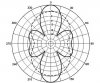
The picture below is a comparison of the radiation (reception) patterns of the ideal 1/2 wave and 5/8 wave dipole antennas. The dotted line pattern is for a 1/2 wave dipole and the solid line is for a 5/8 wave dipole. Note that the 5/8 wave antenna does exhibit some gain, but there are some deep nulls, that might be an issue. The actual radiation pattern may vary depending on a number of unique variables at each location, location, location.
 

Attachments

  • FIVE EIGHTS VS HALF WAVE  DIPOLE RADIATION PATTERN.JPG
    FIVE EIGHTS VS HALF WAVE DIPOLE RADIATION PATTERN.JPG
    30.8 KB · Views: 6
Back
Top Bottom