• The move to the new server is done. There are some software and database maintenance updates in process. This has us passing the hat around to help out. We appreciate any donations. Seriously, even a dollar helps. The payment page may be found here - https://www.audiokarma.org/support.html

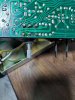
Another bad repair job.

Sglaw461

Member
Yet another fine example of a repair done at a reputable electronics shop, this time on a, Pioneer SX-850. More solder please, that'll fix it. Anyhow, soon it will breathe a sigh of relief.
 

Attachments

  • 16022082951195592087170632314693.jpg
    16022082951195592087170632314693.jpg
    141.5 KB · Views: 185
Register to hide this ad
While its clearly not a nice solder flow.
I've seen boards where you don't get the flow you want. If you know the traces are iffy and lift and you tried to get it to flow more than once and it didn't. Sometimes you're better off not forcing the issue.
No idea why that looks like that. If it works fine its less than butcher work IMO
 
Seen and done worse myself. As above, sometimes it just won't flow cleanly. Usually its contamination on something but I have had issues mixing leaded and unleaded solder. Probably not the issue here though.
 
It wouldn't be so bad if it worked but 5 out of 6 tracks were cracked. I have also done this but I at least scrape the track down to bare copper for 1/4" so the solder can extend across the bad area. I agree about the "unleaded" silver solder, seems to me to be more of an issue in Yamaha though.
 
When a PCB is assembled, they use a method called "wave, or flow, soldering. That turns out a very pretty solder joint which is difficult, if not impossible to recreate when servicing the equipment. They employed this stuff in a facility I worked at in the mid 70's.

When repairing the boards, one runs the risk of destroying or lifting the runs with too much heat. If it works, be happy.

https://www.pcbway.com/blog/Engineering_Technical/Wave_Flow_Soldering_Process.html

 
Last edited:
No idea why that looks like that

Lots of possible reasons.

Solder heated too long, without additional flux. Solder has gone 'pasty', rather than flowing nicely.

Too much solder applied (either they didn't remove the original, or they just added too much).

Too small or too cold/low power an iron.

Mixing lead and lead free solders.

But, judging by the (overheating) discolouration of the pcb, I'd go for the first option.
 
When a PCB is assembled, they use a method called "wave, or flow, soldering. That turns out a very pretty solder joint which is difficult, if not impossible to recreate when servicing the equipment. They employed this stuff in a facility I worked at in the mid 70's.

When repairing the boards, one runs the risk of destroying or lifting the runs with too much heat. If it works, be happy.

https://www.pcbway.com/blog/Engineering_Technical/Wave_Flow_Soldering_Process.html


Thanks for the link
About 40 years ago (feels like longer) i worked for a company that we did assembly , then send boards out to be wave soldered then we did final assembly with finished boards.:thumbsup:

I never actually saw the process.
 
When a PCB is assembled, they use a method called "wave, or flow, soldering. That turns out a very pretty solder joint which is difficult, if not impossible to recreate when servicing the equipment. They employed this stuff in a facility I worked at in the mid 70's.
Hmm, I didn't know they used wave soldering that far back. ISTR seeing pictures back when this receiver was new (1978) of a Pioneer factory (or similar) showing assembly line workers using soldering irons to assemble the equipment.
 
Hmm, I didn't know they used wave soldering that far back. ISTR seeing pictures back when this receiver was new (1978) of a Pioneer factory (or similar) showing assembly line workers using soldering irons to assemble the equipment.
They might have there. I worked for an American company in '77 when I was exposed to this.

But, some assembly still had to be done by hand, such as wiring the sub assemblies together with wiring harness' and the components were still placed on the circuit boards by hand.
 
Back
Top Bottom