• The move to the new server is done. There are some software and database maintenance updates in process. This has us passing the hat around to help out. We appreciate any donations. Seriously, even a dollar helps. The payment page may be found here - https://www.audiokarma.org/support.html

Anti Skating Calibration on Dual 1229Q

Well ... there are choices for replacement cams.

For the DYI 3D-printing crowd there is this (and isn't it pretty?):

2024-07-26 08.56.39 www.thingiverse.com 018ce2926cef.jpg​


In North America, there is this:


And in Europe, there is this (seeming on back order status at present):
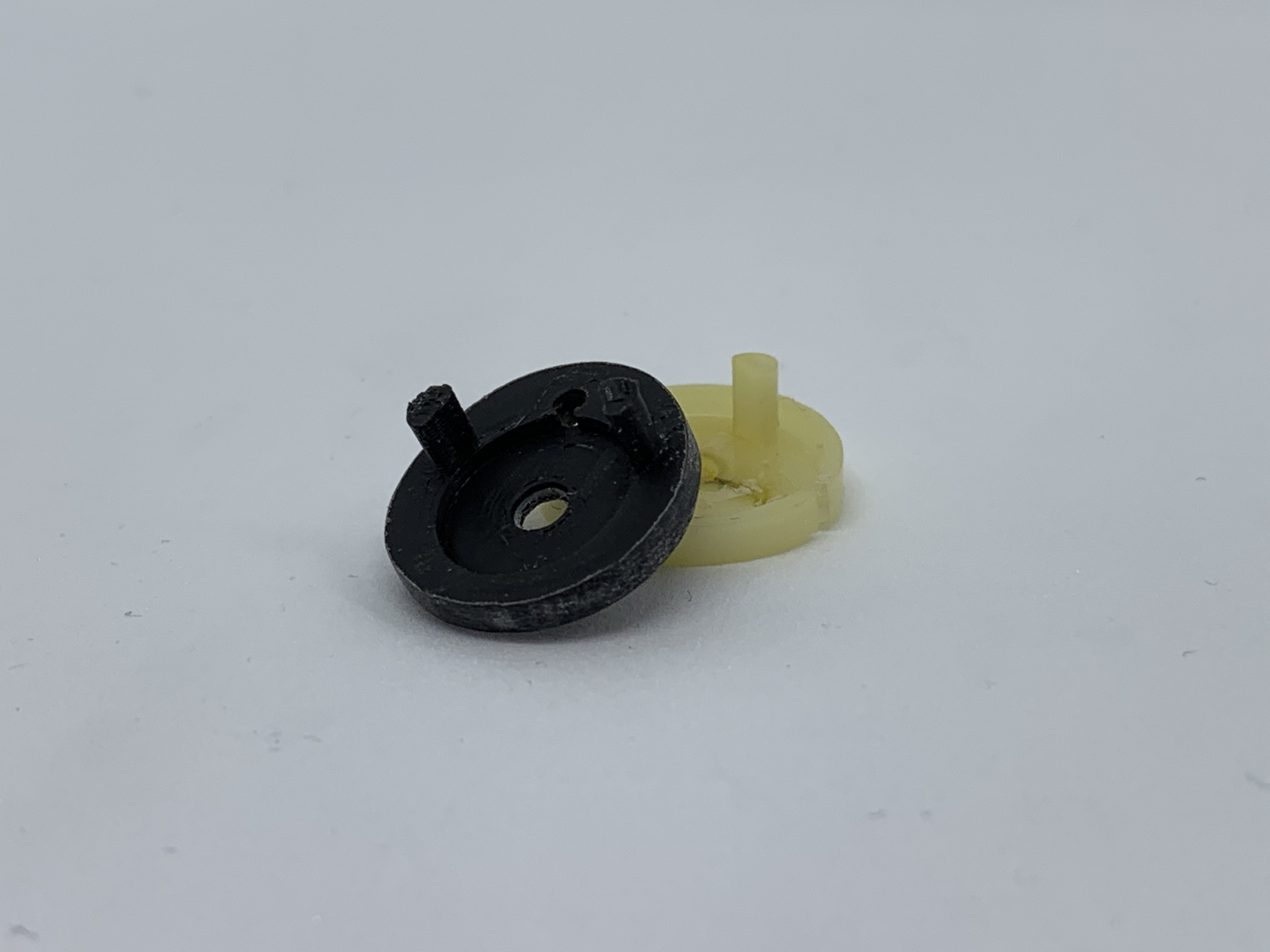

Apart from DYI item, the nicest and most robust looking one is the European one.

There is an extremely knowlegeable guy named Klaus, going by the handle Dualcan at VinylEngine and Dual-Board.de. In the middle of thread at VinylEngine, he made an excellent post, something tangential to the main topic of the thread, about how to replace the cam. I did not bookmark it and am having trouble finding it again. But I will find it.

My gut feeling that this all is not entirely straightforward--there is a fair degree of art and alchemy involved. If the anti-skating spring and its factory set half-washer have displaced (and there is a good chance of this since somebody incompetent worked on this machine before it came to me), this aspect of the project, setting the anti-skating back to factory settings, is going nowhere fast. The only way the spring can be correctly re-set is with special tools from Dual.

f there were someone I could trust here, I would take the turntable to them, but the only person I know of here who was actually a trained Dual service technician and who had all the Dual tools and bench jigs is long retired and maybe even dead now. The only reason tou pay people to do things because they can do these things better than you can. Hey, bungling I can do myself.
 
Please do follow up. The AS cam on my 721 cracked/split at the hole, which is quite common, such that the cam follwer would fall in to the split. I simply removed it and melted it all together using a soldering iron, and smoothed it out. It works. But nice new one would be worth the effort if they are good quality. I probably would have just spun yours around until 0 AS on the dial was 0 AS observed and gone from there. I will not be surprised if your new 3d printed one is pretty much the same as what you’ve already got.
 
Please do follow up. The AS cam on my 721 cracked/split at the hole, which is quite common, such that the cam follwer would fall in to the split. I simply removed it and melted it all together using a soldering iron, and smoothed it out. It works. But nice new one would be worth the effort if they are good quality. I probably would have just spun yours around until 0 AS on the dial was 0 AS observed and gone from there. I will not be surprised if your new 3d printed one is pretty much the same as what you’ve already got.

Well ... the cam that is in my machine has been identified as entirely the wrong cam for the 1229Q by a very knowledgeable German expert--it will never work properly however much spinning I were to do with it. So I am hoping that installing the right cam (or a 3D printed approximation thereof) will resolve the problems.

If it doesn't work, then there is bigger problem, that of the calibration of the anti-skating spring. I am hoping that whoever "serviced" this machine before it came to me did not mess with the spring.

The cam is in transit somewhere.

I will post a follow up once it is installed.
 
I had a 1229 way back when they were being produced new. I would set mine by using the next lowest track band on Shure's 103 test record. Its important to have an accurate electronic weight scale for the TT. They are reasonably priced and can be tested by weighing either a dime or penny. I use a dime. 2.8 Grams. a penny as I remember from Chemistry lab using a balanced beam to weigh a penny is 3 grams. Then once you have the proper pressure, the cartridge is mounted correctly on the arm resting on the record then you can set the anti skating. When new I always set the skating about a 1/4 gram less than indicated on the dial making sure the cantilever of the cartridge was being displaced from normal while tracking the LP. If the cantilever is displaced from the at rest position you are using to much bias compensation.
 
I had a 1229 way back when they were being produced new. I would set mine by using the next lowest track band on Shure's 103 test record. Its important to have an accurate electronic weight scale for the TT. They are reasonably priced and can be tested by weighing either a dime or penny. I use a dime. 2.8 Grams. a penny as I remember from Chemistry lab using a balanced beam to weigh a penny is 3 grams. Then once you have the proper pressure, the cartridge is mounted correctly on the arm resting on the record then you can set the anti skating. When new I always set the skating about a 1/4 gram less than indicated on the dial making sure the cantilever of the cartridge was being displaced from normal while tracking the LP. If the cantilever is displaced from the at rest position you are using to much bias compensation.
Thanks.

There are two issues here.

The first is the calibrating of the anti-skating mechanism itself so that Zero is Zero. At present, there is way too much anti-skating force with the dial set to zero. Doing a minor adjustment of the slightly out of line cam is not going to alter this all that much. The cam in the machine is the one for a 1209, and it is very wrong. Once the replacement cam is in, the hole in the cam and the shaft of the cam aligned at 90 degrees to the edge of chassis, the end of the anti-skating arm then needs to be set directly over top of the end of the tone arm shaft using the adjustment screw. This then should produce a Zero tracking force which can be tested with the zero balance weight tonearm float test. However, if someone has messed with the anti-skating spring and its factory set adjustment half washer, all bets are off. Special tools are required to reset this. People sometimes trial and error work around this problem, sometimes actually bending the anti-skating arm.

The second issue is setting the record play anti-skating force. This cannot be done until the first calibration is done.
 
I wish you the best of luck in getting this resolved. I'm following with interest as I'm new to turntables.
 
I think the second issue is no issue at all. I always use a test record. And not one stylus of a given geometry needs the same amount of compensation as another with nominally the same or at least a similar geometry. To the contrary: Some styli like e.g. the Audio Technica ATN13 (the original, nude one) need almost no compensation at all. The same applies to the better Ortofons like the M20E (NOS original).
 
Last edited:
I have a new and correct reproduction cam installed, and by following the instructions in the service manual, I have things where Zero anti-skating force is now Zero with the end of the anti-skating arm directly over the tone arm pivot. However, “directly” wasn’t close enough. There are degrees of “directness”it seems. Adjustment of the screw in the anti-skating arm is very delicate. 1/8 of a turn can change things quite a bit. There was some trial and error adjustment and readjustment until the tonearm would float motionless. And yet within that range of adjustment and readjustment, the position of the anti-skating arm over the tonearm pivot did not change appreciably in terms of human perception. All that remains to be done here now, I think, is to reseal the cam nut and anti-skating arm screw.

453309947_1215000466191077_2994962985696972003_n.jpg

The anomaly of the mismatch between the service manual illustrations of the cam hole at various settings and the actual position of the hole persists. Strange. Oh well. I am not likely to pay too much attention to the numbers on the dial, not any more than a rough guideline anyway, when I set up anti-skating with a cartridge.
 
The part seems to fit well?

I think the numbers are best used as a rough starting point, but for the less tech savvy will get you pretty close.
 
The part seems to fit well?

I think the numbers are best used as a rough starting point, but for the less tech savvy will get you pretty close.

Yes. The part fits quite well. I bought the cam from Josse at The Art of Vinyl in the Netherlands. He has a video demonstrating the replacement. The job, however, was not as quick and easy as his practiced hand would suggest. :D
 
The anomaly of the mismatch between the service manual illustrations of the cam hole at various settings and the actual position of the hole persists. Strange. Oh well. I am not likely to pay too much attention to the numbers on the dial, not any more than a rough guideline anyway, when I set up anti-skating with a cartridge.
On Dual-board.de I gave the following possible explanation:

Well, this discrepancy between "fact and fiction" could stem in the observation that the drawing used in the service manual is exactly the same in a lot of different manuals. So it seems to be more an explanation of the principle than a real depiction of the situation in the according device. It can be that Dual relied in the technicians ability to abstract the drawing to the arrangement at hand.
 
On Dual-board.de I gave the following possible explanation:

Well, this discrepancy between "fact and fiction" could stem in the observation that the drawing used in the service manual is exactly the same in a lot of different manuals. So it seems to be more an explanation of the principle than a real depiction of the situation in the according device. It can be that Dual relied in the technicians ability to abstract the drawing to the arrangement at hand.
Hello again, Thorsten.

You are probably correct here.

The illustraton of the anti-skating mechanism in the 1229Q service manual has only a functional similarity to the actual mechanism under the 1229Q chassis.

Engineering principles are absolutely identical, but the two are far from identical in appearance.
 
Well, I have had time to pay some attention to the 1229Q and its new anti-skating cam.

Zero is now zero when the dial is set to zero.

Beyond this the numbers on the dial are not entirely reliable (no surprises here--many have said this already).

I do not yet have anything like the Ortofon test record, which the helpful Torsten R. has recommened either here or at Dual Board De. But I do have records with one side blank, and I can do the blank record drift test where the anti-skating force should be set so that the arm drifts very slowly towards the centre of the spinning blank record. Generally I have to set the dial to less than half of the tracking force.

Curiously, my 1210, which has no adjustable anti-skating, does not fare too badly on the blank record test. Perhaps there is some anti-skating built into its design?

Most everything works OK now on the 1229Q.

78s can still be a bit problematic with auto start and auto shut-off sometimes, but then 78s are also problematic on my 1210. An automatic turntable expects standardized records within a certain error tolerance. 78s are anything but standard, particularly before the 1950s.
 
Last edited:
Back
Top Bottom