• The move to the new server is done. There are some software and database maintenance updates in process. This has us passing the hat around to help out. We appreciate any donations. Seriously, even a dollar helps. The payment page may be found here - https://www.audiokarma.org/support.html

Any Carbon filament lamp fans in this forum??

Well, speaking for myself... the Paulmann bulbs don't get at the need for originals. They are cool and all in their own right, but I now am demanding authenticity for myself... when I can. Thanks for the link spartan! They are worth exploring.

Smile!
Tyler


I agree on the originality but for daily drivers these might be worth checking out. I have a few vintage lamps that would be fun to have vintage style bulbs in them.
 
This is a nice feedback, thanks to all.

One of my audio rooms is my "tube chamber". In this chamber there are my finest tube gear and vintage speakers - and two vintage carbon filament lights.

When it's evening, I switch the lights on and they put their sunset-like glow upon the old amps and receivers and everything around, which looks overwhelming. I choose a fine record, perhaps Wes Montgomery:music:, open a bottle of german black beer:beer:, sit into my chair and let go, just let go.

Precious moments in my life...


:)
 
This is a nice feedback, thanks to all.

One of my audio rooms is my "tube chamber". In this chamber there are my finest tube gear and vintage speakers - and two vintage carbon filament lights.

When it's evening, I switch the lights on and they put their sunset-like glow upon the old amps and receivers and everything around, which looks overwhelming. I choose a fine record, perhaps Wes Montgomery:music:, open a bottle of german black beer:beer:, sit into my chair and let go, just let go.

Precious moments in my life...


:)
Me too, minus the music choice and black beer.

All the best,
Tyler
 
Has anyone here tried to MAKE their own vintage-style bulbs, carefully crafting the filaments, pumping out the air with vintage pumps, sealing off the glass with a torch, etc...?
 
I think this is impossible. The vacuum has to be perfect, otherwise the filament will be destroyed instantly.

By the way - the Livermore Centennial bulb is still living (see website)

INCREDIBLE!!!!!
 
Last edited:
Thank you my friend for the interesting link!

@custerdock

The most beautiful light (apart from natural light of course) is the light produced by carbon filament lamps!
 
Last edited:
I love old-fashioned lightbulbs. They're hard to come by, but I've managed to find a couple of them at flea markets. My one vintage carbon filament bulb is by an unknown manufacturer, of unknown wattage, and has very nice red glass. The guy I bought it from claimed it was sold as a 'black-out' bulb during WWII, but judging by the filament shape, it dates to the early 1900s. Here are some pictures I've taken of it:

Unlit
Half voltage
Full voltage

I also have a nice 25W drawn tungsten (aka "squirrel cage" filament) bulb made by Edison Mazda in the early-mid 1910s. It's not particularly rare, but glows nicely regardless. Here are some pictures of it:
Unlit
Half voltage
Full voltage
Filament detail

In addition to these, I also have some modern reproductions, made by Ferrowatt and Feit Electric. They're not quite as awesome as the originals, but still very nice, and I don't have to worry as much when applying power to them (I use a variac to apply voltage to the old bulbs slowly).
-Adam
 
Thank you AdamAnt316 for your contribution, very fine pictures, I know that is difficult to capture the elegant smooth character of our beloved special lamps. :yes:

I also refuse the WWII assumption, I have a carbon filament bulb with dark red glass and even one with dark blue glass, this one looks violet when switched one, and I even have the 90 years old lamp that belongs to those two coloured bulbs.

I think that lamp and the bulbs got medical purpose, apparently for rheumatism therapy or something like that.
 
Old thread on very old bulbs.

It is such a pity that my camera can't capture the beautiful colour of the light of this bulb which has been produced around 1910.

Consider a light which has immersed in honey... ;)

ca 002.JPG
 
Hi Chris

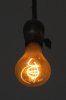
Have you heard of the Centennial Light? Its located at the Livermore-Pleasanton Fire House on East Avenue in Livermore California. It has been lighted almost continuously since 1901, and has moved several times. Hand blown with a carbon filament, it provides a lot less light than when new, but its still beautiful. :)

Livermore_Centennial_Light_Bulb.jpg
 
Of course I am a huge fan of the Centennial Bulb.

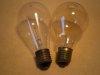
Here you see again the simple inner structure of these bulbs. The right one is the one from above.

002.JPG
 
An era appropriate lamp and whicker/steel frame shade to burn them in. We call it the Mermaid, a bronze cast lamp sculpture from the turn of the century, early electric lighting era.
She's a wee bit dusty as we don't want to rub off the patina.
The bulb itself,... a modern knockoff.
DSCN4477.jpg
 
My understanding is that some of those old bulbs lasted so long because the filaments are larger than they would be in a modern incandescent, making them less efficient and also run at a lower color temp. It feels odd to say 'modern incandescent' as everything is going LED now. At least we finally have alternatives to those awful compact fluorescents.
 
Found an intact tip sealed working example of one wiith the double loop carpet beater filament partly buried in someone's back yard when i was a kid. Dunno what happened to it later but dont have it now.
 
I thought you would probably already know about the Centennial Bulb Chris, but maybe some others who look here will find something "new". I have a few early lamps, but alas, no early bulbs. Now you have me thinking I need to do something about this. :idea:

I'll take a photo or two when time and proper lighting conditions allow.
 
I think this is impossible. The vacuum has to be perfect, otherwise the filament will be destroyed instantly.


No- modern incandescents are not perfect vacuums- they have millitorr pressure of an inert gas (Argon for most). Oxidation of the filament is what kills it. You could run an unenclosed filament fine either on the moon or on Venus or a number of atmospheric planets.

By the way, I liked your description of light dipped in honey. :smoke:
 
Back
Top Bottom