

You are using an out of date browser. It may not display this or other websites correctly.
You should upgrade or use an alternative browser.
You should upgrade or use an alternative browser.
Any Carbon filament lamp fans in this forum??
- Thread starter harman/kardon
- Start date


I'd sooner have those than some of the recent offerings I've been using in my house. Since it's no longer possible to buy regular incandescent bulbs, I've been using those "halogen bulbs inside a regular glass envelope". Lucky if I get nine months out of them. I did buy some LED bulbs, but it says right there on the box not to use them in enclosed fixtures. So now I had to rob the regular bulbs out of whatever bedside or table lamps I have, and replace these with an LED. 
Lee.
Lee.

Old-fashioned incandescent bulbs are still very much available at stores. Real 60W, 75W and even 100W bulbs can still be purchased as "rough service" types. I've seen them at various stores alongside the LED, CFL and halogen bulbs; Dollar Tree sells them in three packs for a buck, though I have yet to test their longevity.I'd sooner have those than some of the recent offerings I've been using in my house. Since it's no longer possible to buy regular incandescent bulbs, I've been using those "halogen bulbs inside a regular glass envelope". Lucky if I get nine months out of them. I did buy some LED bulbs, but it says right there on the box not to use them in enclosed fixtures. So now I had to rob the regular bulbs out of whatever bedside or table lamps I have, and replace these with an LED.
Lee.
Anyway, I've still been collecting the cool old-fashioned bulbs. Even bought a carbon filament bulb whose shape vaguely resembles that of the Centennial Bulb, though I don't think it was actually made by Shelby Electric (or that it would last anywhere near a century if lit continuously). Anyway, in my previous post, I linked to a funky red-colored carbon filament bulb I found at a flea market:
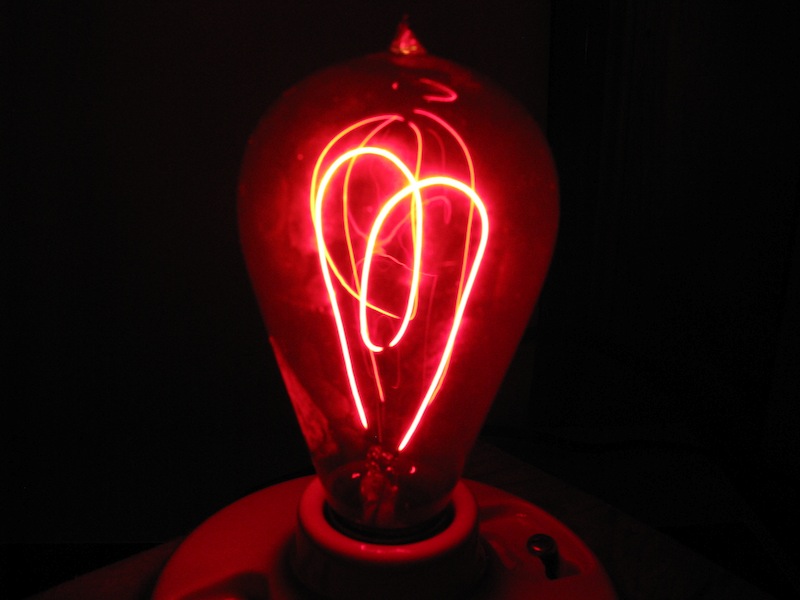
Well, as luck would have it, I happened to find an identical-looking bulb at another flea market! This prompted me to put together...THIS!!!
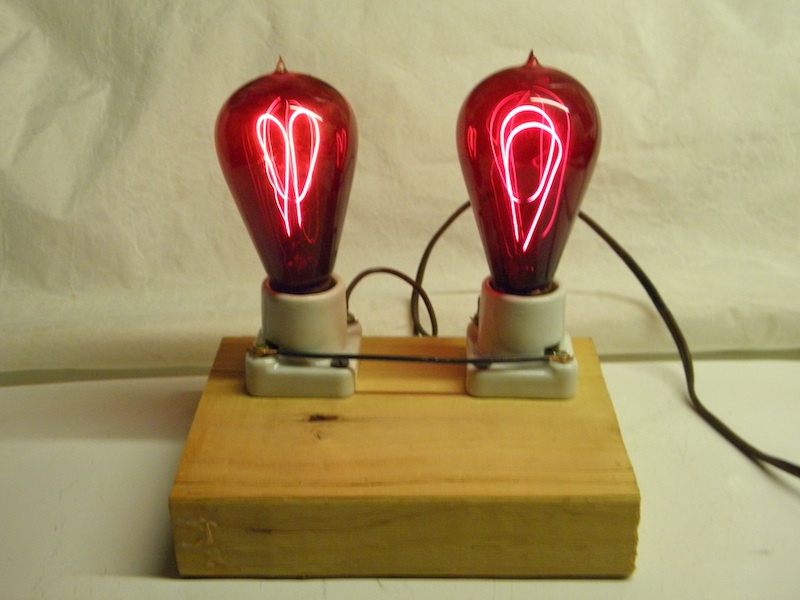
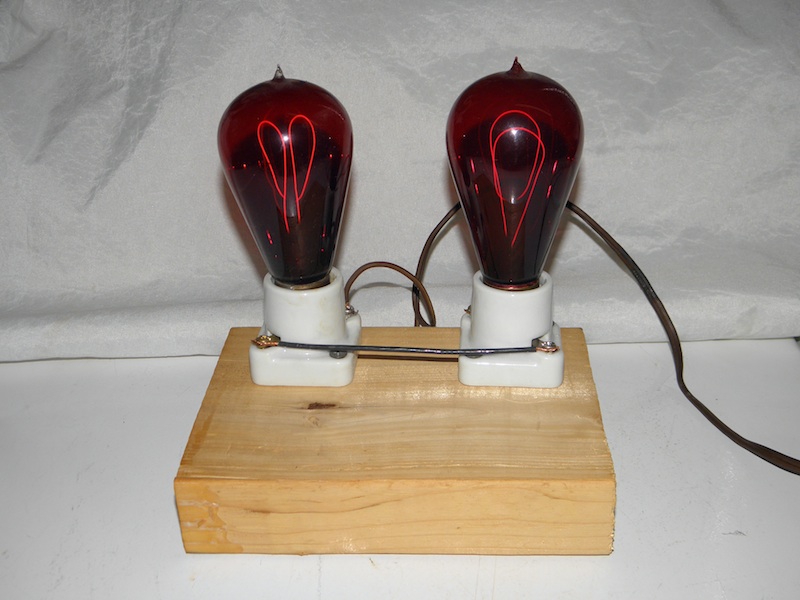
I have dubbed it the "Incredible Illumindescent Indicator Mk1 (beta)". Yes, it's just two old light sockets wired in series. Yes, it's incredibly dangerous (haven't figured out a good way to cover the terminals on the sockets without hiding them). Yes, it's attached to a random piece of wood I found in the basement (hoping to find something a bit more suitable at some point). But it looks so cool lit up, especially in the dark. Here is an example:
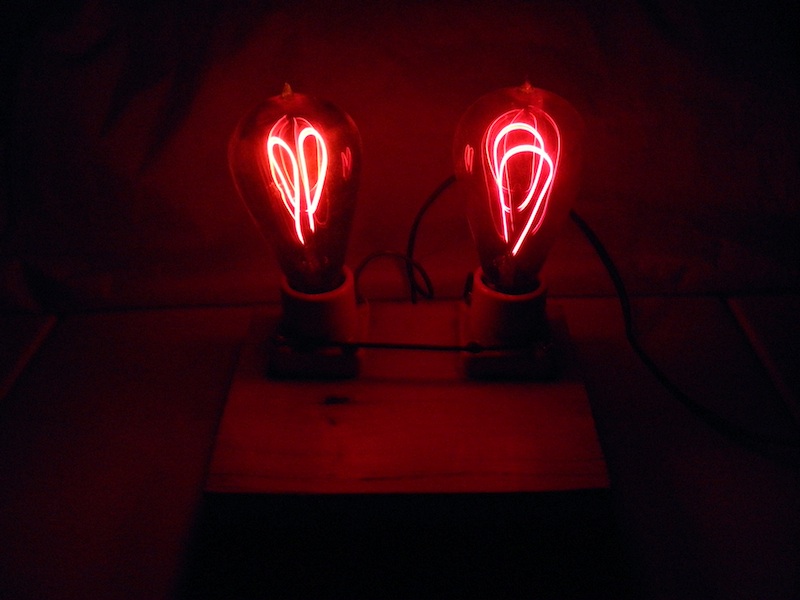
And I got a cool 'infinity effect' when I put a plexiglass monitor stand (I think) behind it:
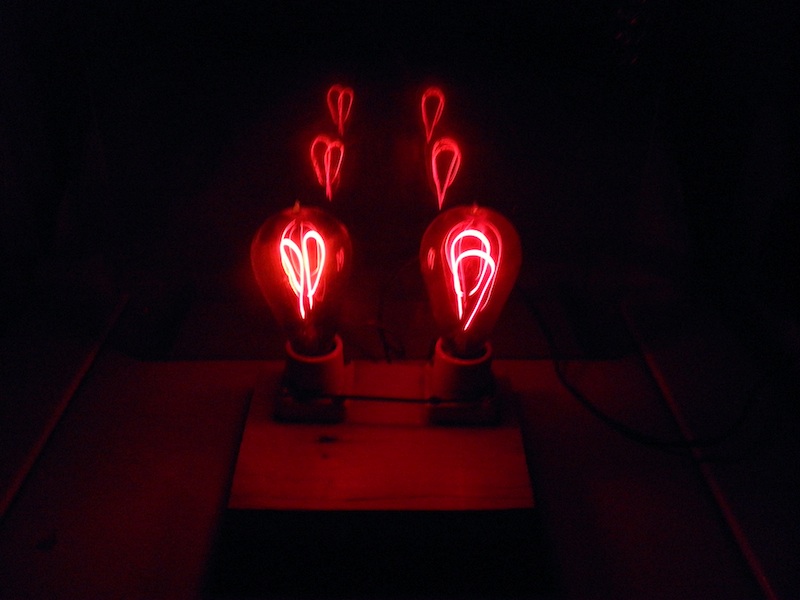
Like the other red bulb, I have no idea who made the 'new' one, as it's missing the ID sticker. Even so, they seem to be damn near identical, almost down to the power draw (one of them has ~54 volts on it, the other around ~62V, with 116V input). Dunno exactly what I'm gonna do with this contraption, but it looks pretty cool, so stay tuned.

-Adam
Last edited:


My Grandmother's old desk lamp, still sitting on her desk. You can't see it very well in this photo, but the shade has a scene of a blue lake with a dark mountain in the distance and forest trees in the right foreground. You really wouldn't see a carbon filament bulb because of the shade, but that is probably what would have been in it originally. I might have to look for something appropriate to replace the modern bulb in it currently.

Yep, those are known as "Balafire" bulbs, and you can still get them. The originals were created in the '60s by a company called "Kyp-Go", and made popular in a 7-Up commercial which showed one of the bulbs sitting atop a 7-Up can. I have such a lamp, which I have fitted with a green Balafire bulb purchased from Palm Bulbs, which was not cheap (around $30 with shipping!). I will post some photos (and a short video) of said lamp later, but for now, enjoy the commercial I mentioned above:I remember seeing novelty carpetbeater lamps with a magnet on a support in the filament loops. When energized, the lit filament would rapidly swing.
Last edited:

Great posts, Adam, thank you so much.
I have an old hand lamp, maybe 80 or 90 years old, for probably medical purpose. I found it in the original box at the flea market and it came with three carbon filament bulbs, two or them are red, one is blue.
Don't quite dare to switch it on. But perhaps I will take a picture of it.
I have an old hand lamp, maybe 80 or 90 years old, for probably medical purpose. I found it in the original box at the flea market and it came with three carbon filament bulbs, two or them are red, one is blue.
Don't quite dare to switch it on. But perhaps I will take a picture of it.
Last edited:
My Grandmother's old desk lamp, still sitting on her desk. You can't see it very well in this photo, but the shade has a scene of a blue lake with a dark mountain in the distance and forest trees in the right foreground. You really wouldn't see a carbon filament bulb because of the shade, but that is probably what would have been in it originally. I might have to look for something appropriate to replace the modern bulb in it currently.
View attachment 1095846
The socket is E27? Voltage most likely 110?
The socket is E27? Voltage most likely 110?
Yes Chris, except here we call it an E26 socket. Basically same size and rated for 120.
I finally managed to take some pictures of the 7-Up lamp I mentioned above!
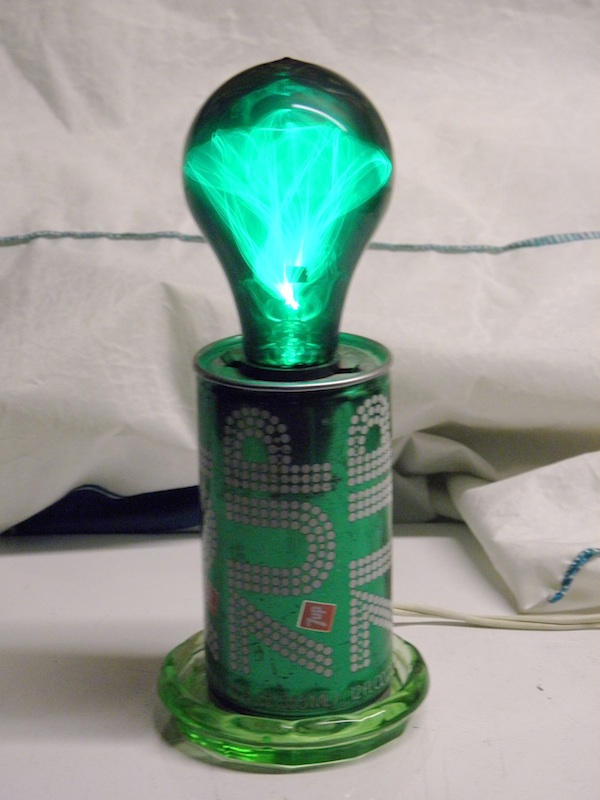
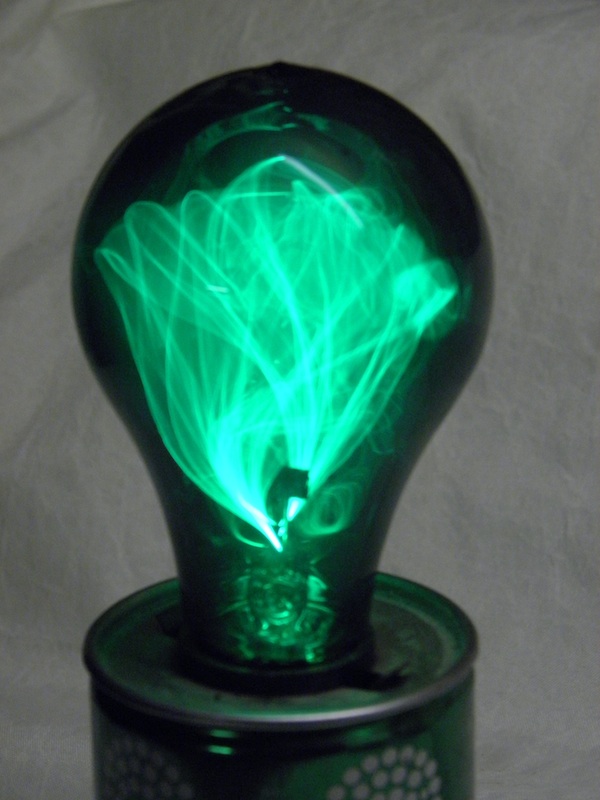
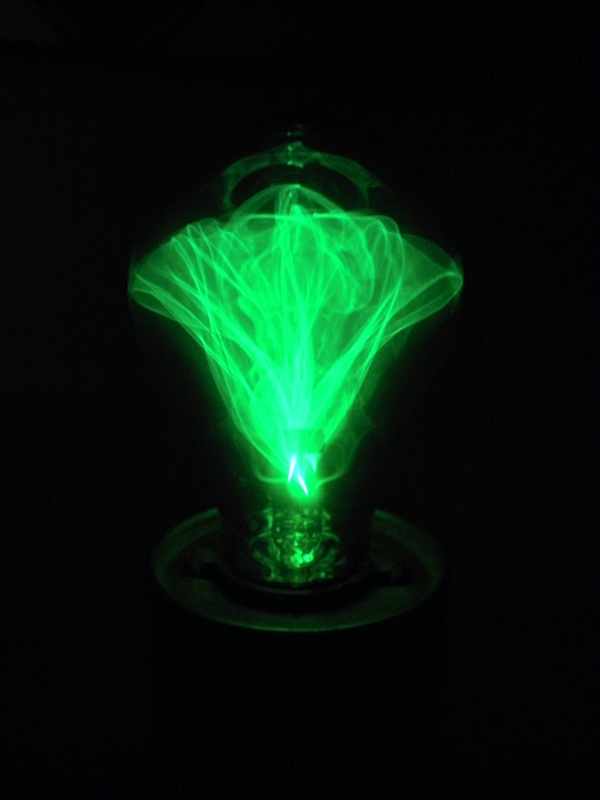
(Click the above picture for a short video of the bulb in action; if it doesn't work, click here)
These "Balafire" lamps are a real pain in the ass to take a good photo of, especially when they're doing their thing. I don't think the lamp I have is an "official" example; it doesn't have the "winding key" on the side (which, in 'official' lamps, doubles as an on/off switch), and has a sticker on the bottom which says it was made by "Fleco Industries", whoever that is/was. As acquired, the can was empty, which made me fear for the safety of the rather expensive bulb; I've filled as much of the can as I could with glass marbles, and have it perched on a Depression glass-looking ashtray for extra added traction.
-Adam
(Click the above picture for a short video of the bulb in action; if it doesn't work, click here)
These "Balafire" lamps are a real pain in the ass to take a good photo of, especially when they're doing their thing. I don't think the lamp I have is an "official" example; it doesn't have the "winding key" on the side (which, in 'official' lamps, doubles as an on/off switch), and has a sticker on the bottom which says it was made by "Fleco Industries", whoever that is/was. As acquired, the can was empty, which made me fear for the safety of the rather expensive bulb; I've filled as much of the can as I could with glass marbles, and have it perched on a Depression glass-looking ashtray for extra added traction.
-Adam
Thanks for posting - very impressive. Video works! 
Mr. and Mrs. Munster have such a lamp in their bedroom for sure!
Mr. and Mrs. Munster have such a lamp in their bedroom for sure!
Now I got a camera that captures the colour of the light better...

Mystic
We're all born mad
Well, my camera tried it's best with this bulb from 1915. Imagine a very soft smooth honey-orange-like light. Can't describe it with words anyway, pity.
Looks like a few of the bulbs still hooked up and running in our basement (ahem: caves). Don't illuminate so very well but the warm glow/colours they cast inspire serenity. I like them.
In Europe it is always very important to check out if a step down converter is necessary. In my case it is.
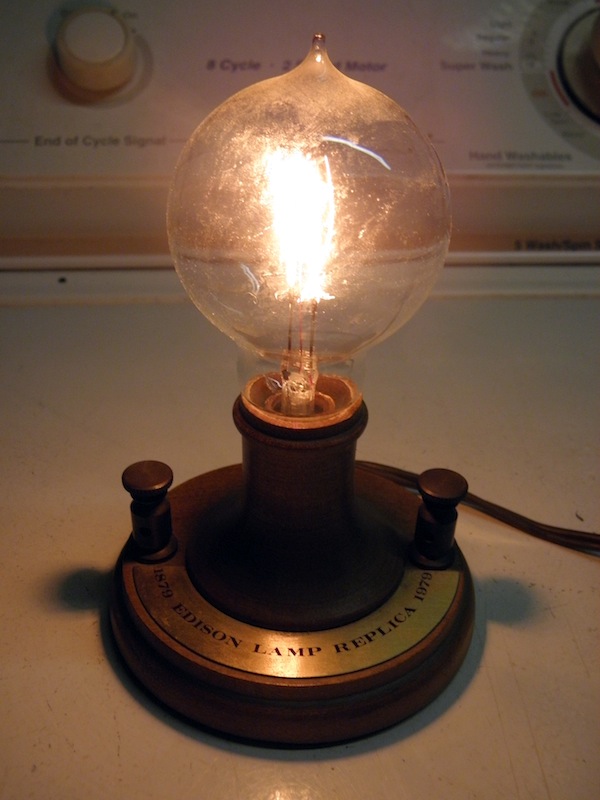
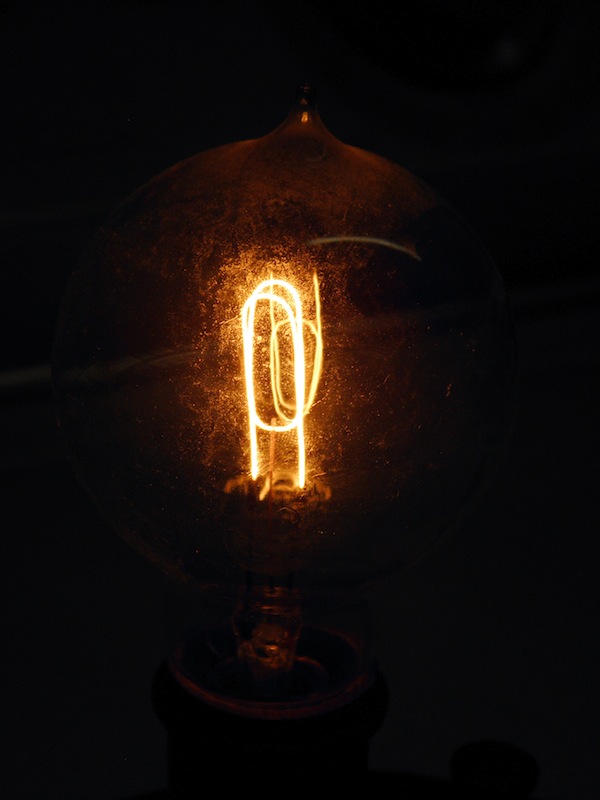
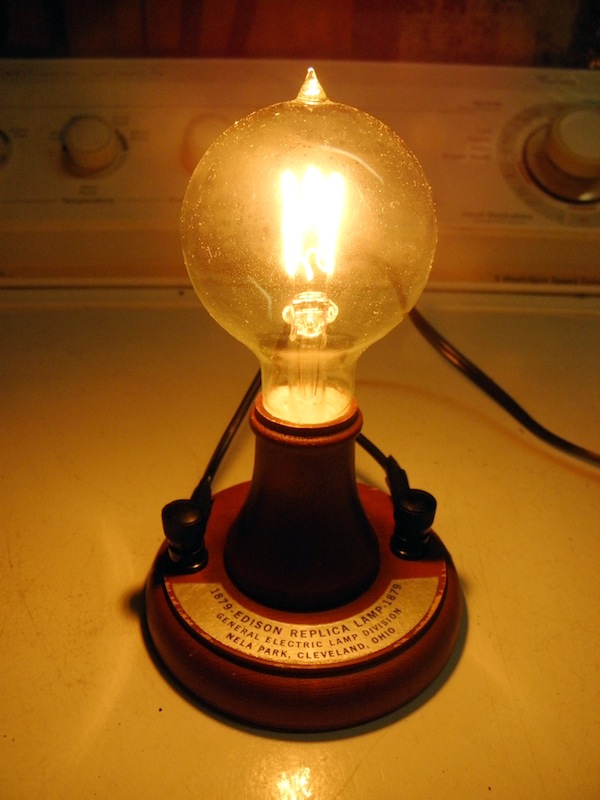
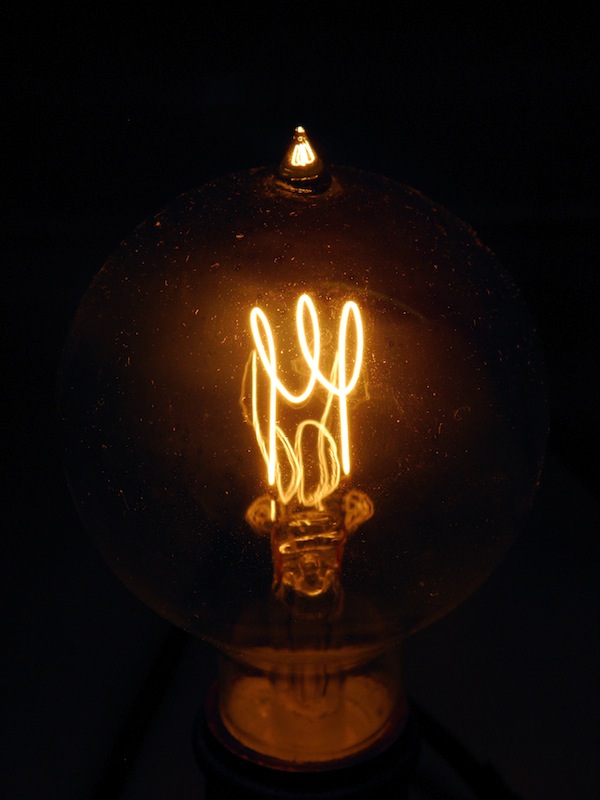
I recently picked up a 1979 replica of Edison's original 1879 carbon filament light bulb. Here are a couple of pictures of it:
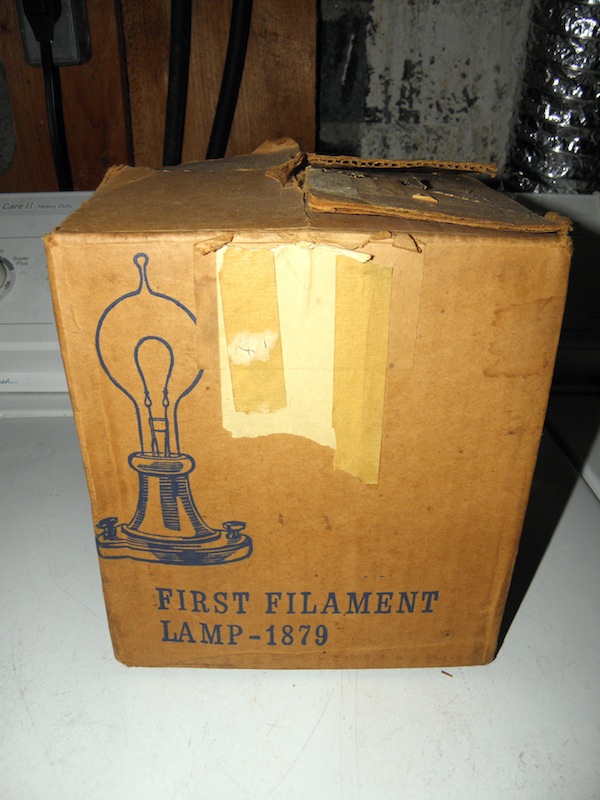
This prompted me to dig out a 1959 replica Edison bulb I've had for a long time, along with its original box, and take some pictures:
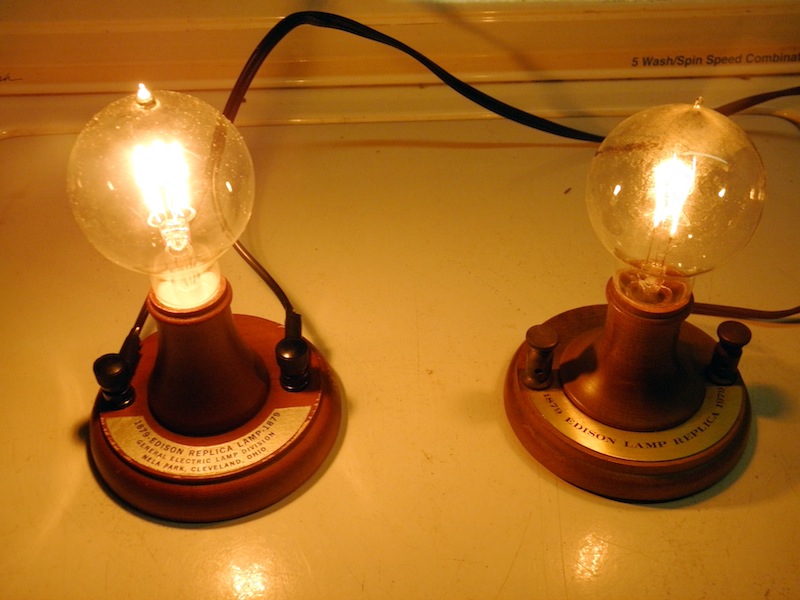
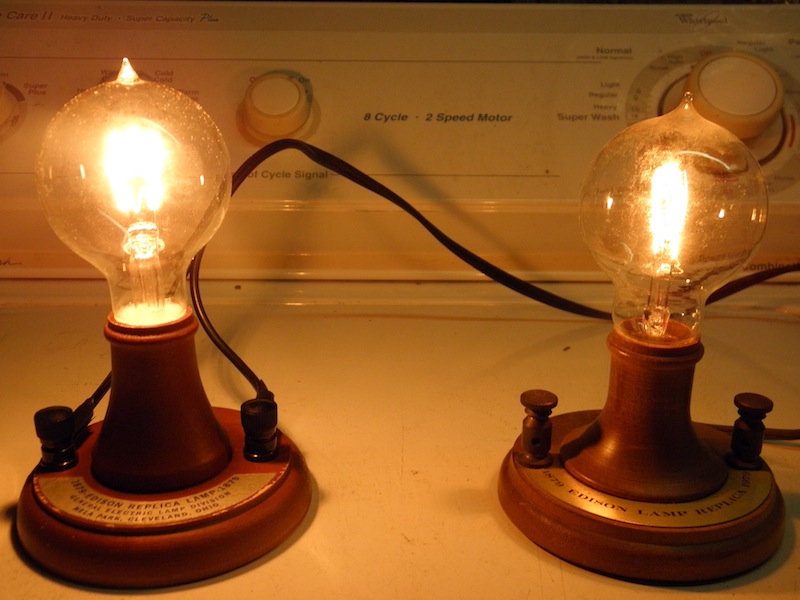
And for good measure, the two replicas side-by-side:
This prompted me to dig out a 1959 replica Edison bulb I've had for a long time, along with its original box, and take some pictures:
And for good measure, the two replicas side-by-side:

Telecolor 3007
I love old stuff
I wish I had such old bulbs... but it's easier to strike gold than a light bulb like this in Romania. Maybe because electricity was scarse before the '50's.

gslikker
Super Member
True story: there is a topic about carbon filament lamps (even connected to a variac) in the room making the sound of your system better, on a Dutch audio forum.
There is a topic critisizing the other topic, too.
I just think it is pulling down the whole forums credibility. Some people.......I have a strong impression one or more of its members "fled" to AK.
There is a topic critisizing the other topic, too.
I just think it is pulling down the whole forums credibility. Some people.......I have a strong impression one or more of its members "fled" to AK.
I recently picked up a 1979 replica of Edison's original 1879 carbon filament light bulb. Here are a couple of pictures of it:
This prompted me to dig out a 1959 replica Edison bulb I've had for a long time, along with its original box, and take some pictures:
And for good measure, the two replicas side-by-side:
Thank you so much for your impressive, rich contribution to my thread, Sir!
Glad you liked it!Thank you so much for your impressive, rich contribution to my thread, Sir!
 I love this sort of stuff, especially given the historical context. There were numerous other replicas of Edison's first bulb over the years, some examples of which are mentioned on this page. Note the differences between the two bulbs pictured; the 1959 replica is actually powered by those dangerous-looking (plastic) binding posts, while the (metal) binding posts on the 1979 replica (originally sourced from the "Thomas Alva Edison Foundation", BTW) are fakes, with its switched cord entering through a hole in the back of the wooden base. Also, the bulb in the 1959 replica seems to be glued in place, while the 1979 bulb may be socketed.
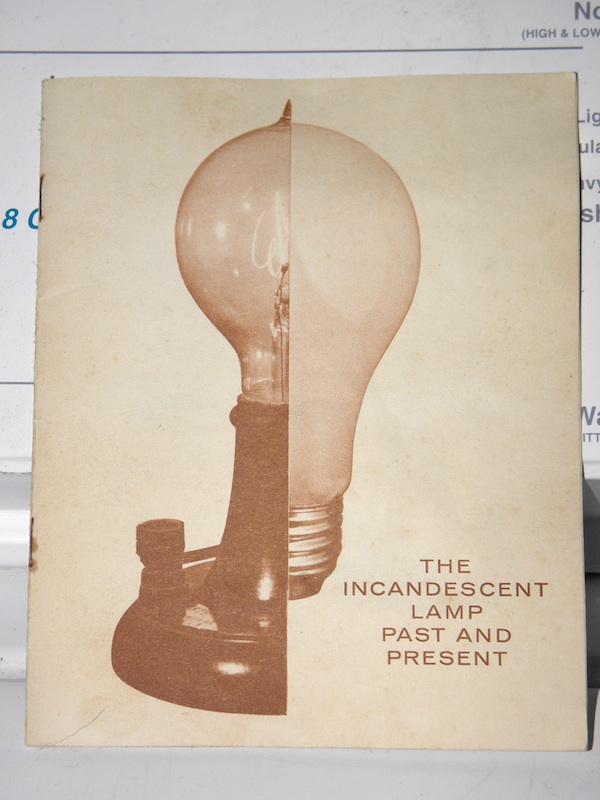
The 1959 replica I have was originally part of some sort of General Electric educational kit, containing things like a sundial, apparently. All I have are the original box, the bulb itself and an included booklet, as seen here:
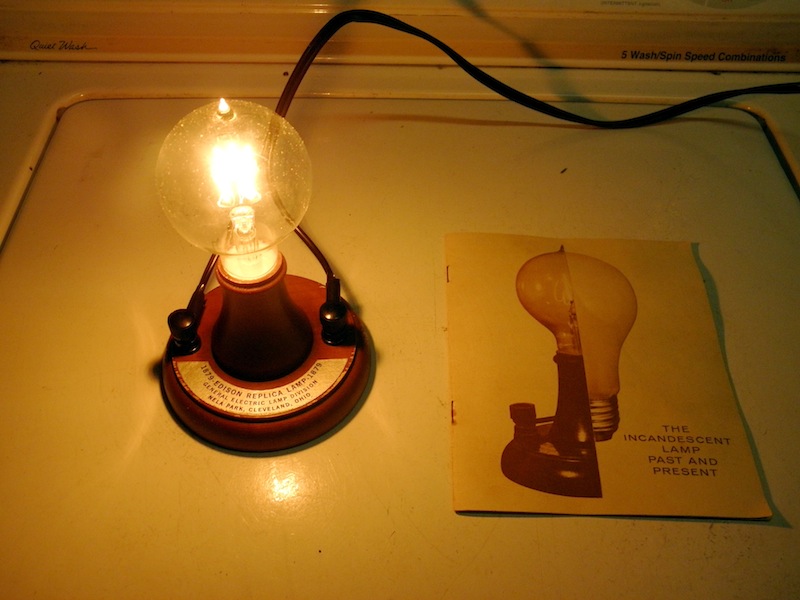
It offers a nice history of the incandescent lamp up to that point, plus some curriculum material. Here are the pages of said booklet:
Cover (shown above)
Pages 2-3
Pages 4-5
Pages 6-7
Pages 8-9
Page 10
Back cover (don't think this counts as a 'large lamp', but whatever)

A couple of curiosity items:Glad you liked it!
The 1959 replica I have was originally part of some sort of General Electric educational kit, containing things like a sundial, apparently. All I have are the original box, the bulb itself and an included booklet, as seen here:...
Do these replicas actually have carbon filaments, or are they low-temp tungsten?
Are they vacuum bulbs or inert gas filled?