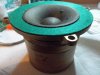
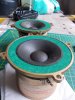
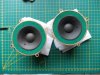
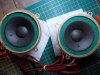
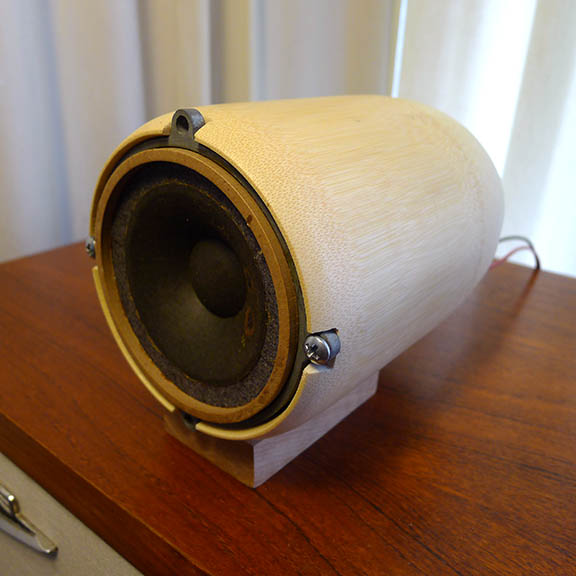
Thank you again for your comments on my website. No need to apologise for the lengthy read, as the following is anything but brief. Please don't consider the following as absolute; it is open to/for discussion. I won't be satisfied until you are and that means those little fellas are working. I've spent weeks with two fellas through PMs, one to repair a a pair of Super 3's and another to find the source of a buzz in his speakers which happened only on one particular piece of music. It turned out to be a lot of low frequency energy in the music coupled with his not realising that the loudness compensation was ON. Another fella shipped 4 Super 3s from the east coast and I fixed them, no charge. Two weren't working and one of those two had an open coil. He insisted I keep those two as payment. They now work and are, in fact, in use, at the bottom piccy in this page.
http://www.ln271828.net/coaxial12.html
Yes, Super 3's can be repaired. In fact, I once used a pair of Super 3's in a mid-range horn I designed going down to 400 hz.
http://www.ln271828.net/horn-h.htm
After reading subsequent posts, I got the feeling you have the tweeter repair solved. That felt pad looks good; why I didn't think of that is beyond me. I guess it has something to do with keeping certain things as original as possible. It's that nostalgia thing.
I posted the following just because I wrote it and promised the info. As for voice coil temperature, I wouldn't think that coil is going to get very warm unless one plays very loud and for long periods. Since I have the necessary equipment to monitor voice coil temperature, I'll do that using that original aluminum speech coil from a Super 3. Also, as the VC temp rises, resistance and impedance follow, reducing the current drawn and thus the power applied. The result(s) of the aforementioned will be posted in my website and a note to that effect placed here, just fer schitts 'n giggles.
That 3mm foam was used for the center spider; it is, as you say, too thick for the annulus. It not only would raise the cone but also make application of the gasket very difficult. The felt is a much better alternative. I'll try to stick to metric as that seems to be your preference. I've been using both for decades, in whichever situation it's convenient. That brings to mind a
7 UP commercial from waaaay back when the company introduced their one litre bottle. Since the litre is just under 34 US ounces, their slogan was, "It's a quart and a litre bit more." Some young Harvard Business School grad on Madison Ave, N.Y.C. probably got a bonus for that one.
From those photos, they did have a foam (inner) spider that was fixed to the pole piece with an adhesive; earlier models used a foam disk sandwiched between two phenolic washers and a brass screw. If you cut those green felt annuli, you did a nice job. Looking at photo #1379, that unit appears to have a half roll annulus, something I've never seen until now.
The foam disc inside the coil is/was the spider. Cutting one into a circle may be the easier part but getting the right diameter may be a little more difficult, not to mention its centering on the pole piece. However, it isn't impossible. If you prefer that route and can cut a close to circular disc, do so. Make the disc 27.0mm to 27.5mm in diameter and it should fit snugly into the coil. It should overlap the pole piece such that the circumference of the foam disk is midway over the gap. Looking straight down at it while it's on the pole piece, you should see a little of the gap.
An alternative method is to use those spiders you cut to size. Here's a way to center the coil. Make two or three shims using 20 pound paper as it's about 0.003" (0.0762mm) thick. Two such shims will give 0.006" (0.1524mm). The shim width should be at least the width of the inside height of the coil (12mm), a little wider may be preferred (15mm-18mm). The length should be about 79mm; this should fit inside the coil with a 1mm to 2mm gap.
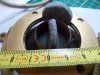
The felt annulus should be fixed to the cone. Now, with the shims inside the coil and the spider one the cone/coil assembly (NOT glued), wiggle the coil onto the pole piece. This can be done with the braided wires still connected to the terminal on the basket but may be easier with them de-soldered from the terminal strip on the basket. If removing these braids, use a small (1 inch) alligator clip as a heat sink. The spider should also be flat, not concave. Once this is achieved, replace two of the screws to hold the basket to the top plate. They don't have to be torqued tight, just enough to lock the basket in place. Once this has been achieved, a couple of drops of glue can be applied to the junction of the spider to the cone/coil junction. Once this glue has set, the assembly can be removed and more glue applied to the spider/apex junction. Once that has set, and with the shims removed, the basket and cone can be replaced with the 4 screws. First apply glue to the place where the spider will join the basket. Glue can now be applied to the outer circumference of the green annulus, fixing it to the basket. The coil should now be centered in the gap.
I've used a similar method to replace diaphragm/coil assemblies in very early Electro-Voice T35 tweeters before the diaphragm assemblies were precision cut to fit inside a ring in the head. SEE
http://www.ln271828.net/T35-T350.html
A felt inner spider wouldn't work as it has no horizontal rigidity, not that it needs much but in time, it could allow the coil to drop and touch the pole piece and top plate. (Never considered a thicker piece of felt than that used for the annulus) That is, if the Super 3 is front firing. Upward firing, that wouldn't be a problem. It was suggested by Wharfedale in the 50's that with the foam surround W15FS, the speaker be rotated 180 degrees every several months as the heavy cone would drop in front, tilting the coil and causing it to rub inside the gap.
That coil appears to be aluminum despite the enamel coating. First, if I'm correct, ALL Super 3s had aluminum coils and if that was changed, it probably didn't happen until the mid to late 60's, maybe later. The two piccies attached are of an original Super 3 coil and a Super 8 FS/AL. The white can be seen as being aluminum coated with a silk type insulation. How that was done on such a delicate wire is beyond me. My half brother, back in 1957, jokingly told me that Wharfedale had well trained spiders on the payroll. The darker one came from a Super 8 FS/AL and is enamel coated aluminum. At the time, I couldn't solder aluminum by conventional methods as per copper so I hand wound coils and kept the aluminum wire, just in case of ......... whatever. I now have aluminum solder and flux.
Robert