Follow along with the video below to see how to install our site as a web app on your home screen.
Note: This feature may not be available in some browsers.
The move to the new server is done. There are some software and database maintenance updates in process. This has us passing the hat around to help out. We appreciate any donations. Seriously, even a dollar helps. The payment page may be found here - https://www.audiokarma.org/support.html
Jack, this is an interesting observation, thank you so much. but may I ask what Scott volume control you modeled? if it was a 130 model I posted previously, does it mean that linear pots + law faking theory is correct and Mark Oppat is wrong saying that in most cases the pots were log? and I (and many others I think) can forget any doubts and assemble a linear pot?
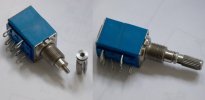
here are some pics of the pots with 2 taps, they have nothing to do with anything I posted earlier, them are just to have an idea how do they look like. taken from ebay, I hope the sellers to whom they belong won't be too upset seeing them here.
I can't speak for "most cases." only this one. It's a 99.9% chance of being a linear pot. Problems like this are one reason I don't restore older preamps and receivers. There are better and less frustrating ways to build an audio system. In any event, I would solve this problem in the Scott 130 by installing a 500K log pot and applying the Steve Bench "reasonably well-compensated" loudness circuit to the switch. Even if the loudness circuit this creates isn't identical to the original, at least the switch won't be dead, plus you'll have a brand new, good quality volume control.
Jack, your help and good will is truly incredible.
you are absolutely right about "better and less frustrating ways", but it is more of collector`s question than audio, and a matter of principle to finish the rebuilding project I already spent 2 years on (selecting caps, resistors etc.), and despite that I replaced 90% parts in it, the cirquit itself remains original and I won`t change anything in it. for example: surely you`ll recognize very good Bourns cermet pots, but they don`t manufacture them with ribbed shafts, so I made it myself for Grommes-209 bass and treble, fortunately there are no extra taps in originals.
but in general yes, the best way to obtain the best preamp is to build it yourself using parts and tubes whatever your heart desires.
Nice work, very clever! This technique could also be used for Alpha pots with shafts that are too short, or to convert control shafts between 6mm and 1/4". Using a setscrew as a splice produces a great final result!
Oh, I stand corrected. I would not have guessed that. I feel like I’ve not seen that before. I supposed it would have helped me to look at the schematic!! Ha!