• The move to the new server is done. There are some software and database maintenance updates in process. This has us passing the hat around to help out. We appreciate any donations. Seriously, even a dollar helps. The payment page may be found here - https://www.audiokarma.org/support.html

Any Interest In DIY Braided Interconnects?

Rob-F

Likes Vintage Gear and DIY
I made myself a couple of pairs of tri-braided interconnects. They turned out well enough that I use them in my system. In fact, I tried one of them as a video cable, and I got a better picture than I was getting with coax. For my first efforts I just used some stranded hookup wire and whatever RCA plugs I had on hand. I'm thinking of ordering some teflon insulated wire and some nice connectors. (It should be a good winter project.)

I notice that on some models, Kimber uses two strands for the ground plane, and one for the signal. On another model, they use one for the ground, and two for the signal. So: why not use four wires--two for each? A little Google research shows that it's possible to braid four wires. It's not very hard, once your fingers learn the pattern. I wonder: has anyone tried this? I can't be the only one who has thought of it. How did it sound? Is it worth doing?
 
Register to hide this ad
I was looking into it a couple of months ago.
I looked up braiding 4 strands but haven't gone any further with it.
I need to do lengths approximately 5 to 6 meters per cable so will need about 72 meters of wire to complete both sets
 
I've also been thinking of trying my hand at some braided interconnect's. I also thought about the number of conductors I use a couple of kimber power cables in my system were they braid 8 conductors around a centre earth cable.
 
I wonder if the Kimber "gyroquadratic" cable they use in the "Hero" cable is a four-strand braid? They put a covering over it, so you can't see what it is.

Edit: I found a website that says it is a four wire cable.
 
Last edited:
I was looking into it a couple of months ago.
I looked up braiding 4 strands but haven't gone any further with it.
I need to do lengths approximately 5 to 6 meters per cable so will need about 72 meters of wire to complete both sets

Trying to follow the math: One 6 meter 4-wire cable calls for 24 meters, so 48 meters for a pair; then there is some shrinkage from the braiding. So you are expecting a shrinkage of 48/72, or 2/3 of the original length?
 
I thought l read that you can lose a third of the length in the braid so lve added a bit extra just to be on the safe side.
I don't want to get to the end of hours of braiding to find that I'm short 5 cm:whip:
Trying to follow the math: One 6 meter 4-wire cable calls for 24 meters, so 48 meters for a pair; then there is some shrinkage from the braiding. So you are expecting a shrinkage of 48/72, or 2/3 of the original length?
 
I thought l read that you can lose a third of the length in the braid so lve added a bit extra just to be on the safe side.
I don't want to get to the end of hours of braiding to find that I'm short 5 cm:whip:

I didn't realize it was quite that much. I didn't think I lost that much when I made the tri-braids, but I didn't think to measure or keep a record. Now it occurs to me that we will probably lose more with a quad-braid than with a tri-braid. A 2/3 rule might very well be the case.

So braiding causes the wires to be longer, and a quad might consume more wire than a tri-braid. The longer wires will add resistance. I'm thinking there could be a "no free lunch" effect where we gain in one area, and lose in another, as we increase the complexity of the braid. I notice Kimber even has a six-braid cable model, the KS1016!
 
Personally I recommend screened cable, particularly for low level signals or where the impedance might be on the high side. What's the rationale behind braided interconnects? They tend to have lower capacitance than screened cables but for one or two meters the capacitance probably isn't significant anyway. So what's the advantage of braided cable?
 
Personally I recommend screened cable, particularly for low level signals or where the impedance might be on the high side. What's the rationale behind braided interconnects? They tend to have lower capacitance than screened cables but for one or two meters the capacitance probably isn't significant anyway. So what's the advantage of braided cable?

I'm pretty sure that "screened" cable must be the same as what some of us refer to as shielded cable. Most audio interconnects are shielded, with a single center conductor, in my experience. Then there is microphone cable, with two insulated conductors inside a shield. I have some Mogami cables that are also marked, "Neglex 2534 microphone cable." Mogami supplies it as audio interconnect cable with RCA plugs. Shielded cable, microphone cable, and braided Kimber Kable all sound a little different. The latter sounds more detailed and slightly brighter to my ears; and the sound stage sounds more holographic in height and depth.

The rationale? I don't think Kimber, for one, offers a technical explanation.** They do make specific claims about the sound, and the claims become more elaborate with increasing price. The general idea with braided cables is that you don't really need shielded ones unless you are near a strong radio frequency source; so if you can hear something you like with braided cable, and don't really need shielded ones, go for the braid. That, at least, is my rationale.

Here's where I begin to wonder where the rationale is. Take Crystal Cable, for instance. It is very small in diameter, and very expensive. I wonder: what is the point of that? And Audioquest, with their whole stable of cables named after snakes, mountains, rivers. And why name them after snakes? Are they trying to say they are selling snake oil? Hollow air filled insulation tubes between the wires, claiming superior dielectric properties that won't smear the sound by storing and re-releasing energy? Capacitance does that to some extent, no matter what the insulation is made out of.* Can anybody really hear that difference?

Some cable is made from silver, which is a little bit lower in resistance than copper. The slightly lower resistance may not matter, but when the cable surface oxidizes, silver oxide remains a good conductor. Not so for copper oxide, which actually rectifies the signal. This makes a difference at termination points.

No matter which manufacturer it is, I suppose there is at least a little snake oil in all of them, along with some science. I think there is a little less snake oil and a little more science in Kimber's braided cables.

Well, that's enough of my rambling.

*Edit: There is a discussion on YouTube where one of the participants, I believe from MIT Cables, says that he minimizes this effect by using insulation with a dielectric constant of two or less.
**In that same discussion, Ray Kimber says he got into braiding to accomplish noise rejection.

 
Last edited:
Here's a rationale: The twisted pair is a well-known and widely used means of isolating wires from noise pickup. One wire for signal, one for ground. Using two ground wires (and one for signal) can be a way to provide a higher quality ground plane. In fact, I wonder if a quad braid should be wired as three for the ground plane, one for the signal.
 
i take it that these are balanced cables ?

The same cable can be used either way. RCAs for single ended, or XLR for balanced. And Kimber supplies both the tri-braid and the quad types as both single-ended and balanced options.
 
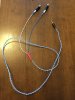
IMG_2481.JPG

I made this from a canare mic cable. It connects an Apple AirPort to an integrated amp. Sounds wonderful. I have no idea how it would match up with a store bought....
 
Want to see how they do it?


But for me, without the benefit if a machine, the longest cable I have tried is 1.5 Meter. Longer than that gets to be too long to manipulate as they change position while braiding. I have a feeling that if I were to try a four strand braid, I would need it shorter yet.
 
Last edited:
I made myself a couple of pairs of tri-braided interconnects. They turned out well enough that I use them in my system. In fact, I tried one of them as a video cable, and I got a better picture than I was getting with coax. For my first efforts I just used some stranded hookup wire and whatever RCA plugs I had on hand. I'm thinking of ordering some teflon insulated wire and some nice connectors. (It should be a good winter project.)

I notice that on some models, Kimber uses two strands for the ground plane, and one for the signal. On another model, they use one for the ground, and two for the signal. So: why not use four wires--two for each? A little Google research shows that it's possible to braid four wires. It's not very hard, once your fingers learn the pattern. I wonder: has anyone tried this? I can't be the only one who has thought of it. How did it sound? Is it worth doing?

This is exactly the question I have - I seem to remember that if you connect 2 wires to ground on ONE end, then that acts as the shield. It drains the RFI etc on that end - and I think the idea was to connect that grounded end "closer" to the music source?
 
Back
Top Bottom