

You are using an out of date browser. It may not display this or other websites correctly.
You should upgrade or use an alternative browser.
You should upgrade or use an alternative browser.
Any new idler wheel turntables available?
- Thread starter Guest101
- Start date

cgutz
AK Member
The bulk of TTs once were idler drive, inexpensive lightweight stamped-out plinth-and-platter rim-ringing rumble generators.
A good description of my first and only idler TT, a BSR...it also had lively wow and flutter...
2 DD and 1 belt drive table over the last 30 years later... I admit I'm a DD fan!
What is the theoretical advantage of a high quality idler drive?
Last edited:

dnewma04
The Healer
Have you ever built an idler drive?
I haven't built one from the ground up, from raw materials; but I have redesigned one from its stock configuration, to that with a new motor and new driveline, and it was an intensive effort that took most of a year to accomplish (in my free time). Its not a job that was easy, nor would it be so cheap.
New bearings for Lencos run from $350.00'ish to $1k.
That would be retail prices, sometimes with considerable markup. I've investigated having local machine shops produce copies of the Teres bearing and also copies of the TD124 bearings. The Teres copy was quoted at 150.00 each when ordering 20 or more. The TD124 bearing copy was roughly 120.00. They are expensive to buy, they simply aren't that expensive to produce.
I also have a brother who teaches machine shop with access to very nice CNC equipment. If I provided a CAD drawing, I could probably have a finished bearing within a couple of days. Realistically, most people wouldn't have this sort of access, so I didn't mention it.
In mine, my new DC motor ran me around $400 for the motor and controller board (precision 24v DC motor and card). I used the existing platter, bearing, and top plate, and an aluminum Lenco idler wheel in a Presto deck. Details, here: http://www.audiokarma.org/forums/showthread.php?t=380100
I think what you are running into with your costs is that you purchased items where I was suggesting a mfg engineering/manufacturing the bits.
What sort of motor did you use? A Maxon EC motor can be had pretty cheaply and building a high quality controller for it could be done for roughly 200-250.00.
Again, it's not that it's necessarily cheap or easy to build for you and I, but the complexity is greatly exaggerated from an engineering standpoint, IMO.
These are complex engineering feats:


This is not:


OvenMaster
Baby, you're my winterblue
That sure doesn't look at all like the AT-60 I had. :lmao: But... no auto spindle? No sale!I do not see what the Big Deal is...They made these Things 50 years Ago, very Nicely...It's only an AC Motor turning a Rubber Wheel on the Inside of a Platter, it ain't Rocket Science...As far as Rumble, all you have to do is Isolate the Arm. Like on this Garrard AT-60. There is No Rumble at All...And, being an Unipivot Arm might Help Too...

Tom

mfrench
Addicted Member
That would be retail prices, sometimes with considerable markup. I've investigated having local machine shops produce copies of the Teres bearing and also copies of the TD124 bearings. The Teres copy was quoted at 150.00 each when ordering 20 or more. The TD124 bearing copy was roughly 120.00. They are expensive to buy, they simply aren't that expensive to produce.
I also have a brother who teaches machine shop with access to very nice CNC equipment. If I provided a CAD drawing, I could probably have a finished bearing within a couple of days. Realistically, most people wouldn't have this sort of access, so I didn't mention it.
I think what you are running into with your costs is that you purchased items where I was suggesting a mfg engineering/manufacturing the bits.
What sort of motor did you use? A Maxon EC motor can be had pretty cheaply and building a high quality controller for it could be done for roughly 200-250.00.
Again, it's not that it's necessarily cheap or easy to build for you and I, but the complexity is greatly exaggerated from an engineering standpoint, IMO.
These are complex engineering feats:
8< images
As with any mechanical endeavor,... the parts are not that expensive - its the R&D time and labor in developing the product that gets really expensive (not to mention a marketing plan).
It took a long time, and many tries to develop just the idler arm for the build I did, and it finally got down to measures of .005" between make-or-break for proper contact between the platter and wheel.
I have a reasonable amount of DIY experience and drafting skills. The drafting got me in the ballpark, but was still out in left field until the real trial and error began.
mfrench
Addicted Member
Oh yeah - to your question about the motor/driver source,...
I got them from a local to me company that designed the motor here stateside, but outsourced the build to china. They also designed and built the driver(s) here in california (not chinese built). I tried as hard as I could to keep the funding local to me, made in the USA. The company is called Anaheim Automation, of Anaheim Ca.
I got them from a local to me company that designed the motor here stateside, but outsourced the build to china. They also designed and built the driver(s) here in california (not chinese built). I tried as hard as I could to keep the funding local to me, made in the USA. The company is called Anaheim Automation, of Anaheim Ca.

musichal
poet emeritus
It took a long time, and many tries to develop just the idler arm for the build I did, and it finally got down to measures of .005" between make-or-break for proper contact between the platter and wheel.
I have a reasonable amount of DIY experience and drafting skills. The drafting got me in the ballpark, but was still out in left field until the real trial and error began.
Exactly the kind of thing I had in mind when I said the devil in the details.
mfrench
Addicted Member
Exactly the kind of thing I had in mind when I said the devil in the details.
It absolutely is.
An acquaintance of mine, and many others on this forum, and in Lencoheaven, has stated that it took him somewhere around 17 individual setup steps to build a Lenco idler wheel from raw materials. He's a highly qualified machinist and engineer.

marc mc
Super Member
There is 2 areas where my opinion has been completely out to lunch in audio. The first was bass distribution. I was running multiple systems that all had stereo subs and thought the idea of adding more was unnecessary. Once I finally tried it I realized I was hopelessly wrong.
The second was the buzz about Lenco GL-75 idler drives. I had heard one in it's stock form and could not get my head around one of these things rivaling the big boys.
I had heard many legendary TT's at Arthur Salvatore's store in the 80's and like many was more than a little shocked when he revealed that a reference GL-75 had dethroned his Air Forsell TT. No small feet with its air bearings and flywheel for inertia. I in fact almost sold the farm to buy one when a buddy called me up saying he was selling his. It is a legendary table that Arthur had felt had very few rivals for years. It was at that point I called some friends to get my hands on a Lenco.
I read the entire Lenco Heaven site, took the entire thing apart, cleaned and checked everything, put it into an 80lb plinth, added a spare RB300/Clearaudio Beta S and gave it a whirl.
IMO if anyone thinks that Oracles, VPI's, LP-12's etc are a match for one of these things they have never heard one. I have heard those tables and others like them for 25 years and the GL sounds clearly different and clearly better IMO.
Marc mc
The second was the buzz about Lenco GL-75 idler drives. I had heard one in it's stock form and could not get my head around one of these things rivaling the big boys.
I had heard many legendary TT's at Arthur Salvatore's store in the 80's and like many was more than a little shocked when he revealed that a reference GL-75 had dethroned his Air Forsell TT. No small feet with its air bearings and flywheel for inertia. I in fact almost sold the farm to buy one when a buddy called me up saying he was selling his. It is a legendary table that Arthur had felt had very few rivals for years. It was at that point I called some friends to get my hands on a Lenco.
I read the entire Lenco Heaven site, took the entire thing apart, cleaned and checked everything, put it into an 80lb plinth, added a spare RB300/Clearaudio Beta S and gave it a whirl.
IMO if anyone thinks that Oracles, VPI's, LP-12's etc are a match for one of these things they have never heard one. I have heard those tables and others like them for 25 years and the GL sounds clearly different and clearly better IMO.
Marc mc
Last edited:
dnewma04
The Healer
I suppose it's all a matter of perspective, it may be easy to very difficult depending on experience and resources. In the grand scheme of things, most experienced engineers that I know wouldn't have a difficult time compared to the things they work on on a day to day basis. There is no doubt that I would run into similar details that you did but I'm also not going to be dedicated full time. A full time week of work would exceed my total free time for a year, so I'd anticipate a project like this would take me over a year, too.

leepal
Active Member
I read the entire Lenco Heaven site, took the entire thing apart, cleaned and checked everything, put it into an 80lb plinth, added a spare RB300/Clearaudio Beta S and gave it a whirl.
IMO if anyone thinks that Oracles, VPI's, LP-12's etc are a match for one of these things they have never heard one. I have heard those tables and others like them for 25 years and the GL sounds clearly different and clearly better IMO.
Marc mc
Did you drill a new hole for the RB300 or just used the existing aperture?
marc mc
Super Member
Did you drill a new hole for the RB300 or just used the existing aperture?
The original distance was wrong for a drop in. I filled all the original holes and turned the top plate.
I made about 20 different plates out of different materials for the the arm board. My goal now is to get a far better arm and cart because I am at the total limit of fidelity this combo can produce, I simply had them on a shelf doing nothing at the start of the project and was still just testing the waters. I will be looking in the 2K bracket for both. But have actually been working on other systems and turning my garage into an killer listening room over this winter.
Here is a shot of mine as it is now. You can tell by the arm board that I left myself options.

As far as time for finishing projects goes. I only sleep about 5-6 hours a night and besides the NFL I don't watch a minute of TV in any given month.
Marc mc
Last edited:
mfrench
Addicted Member
I suppose it's all a matter of perspective, it may be easy to very difficult depending on experience and resources. In the grand scheme of things, most experienced engineers that I know wouldn't have a difficult time compared to the things they work on on a day to day basis. There is no doubt that I would run into similar details that you did but I'm also not going to be dedicated full time. A full time week of work would exceed my total free time for a year, so I'd anticipate a project like this would take me over a year, too.
Actually, if you think about it, they do have severe problems with what they do.
You referenced the space shuttle program. How many billions of dollars went into that?
In the end, now that we can tally the results, two of them were taken out in catastrophic fashion by failures of .50¢ parts; one from an o-ring, the other taken out by a shard of polyurethane spray foam insulation, similar to what you can buy at any home improvement store, or hardware store. You just never know until you try, and then shizz happens that sends you back to the drawing board.
Last edited:
mfrench
Addicted Member
I've enjoyed the exchange with you.
In truth, the tolerances of a quality idler drive have to be extremely tight. Far tighter than one would expect on casual perusal under the hood. If they're not within a "mil spec" tolerance, you get rumble, and W&F. The slightest variation from dead-on true in an idler wheel can create scrubbing of the wheel which causes a chattering or whining noise, and also possible rumble. A capstan that is bored even slightly to large can cause it to spin off-center, creating rumble. An idler wheel with even the slightest blip of a bump in it causes rumble. Though they appear simple, the engineering in them is no less tight than what would be referred to as mil spec, to the minute thousandth of an inch in their tolerances.
Now if you're having someone spin a platter for you, the smallest variance from gnats hiner tight tolerances will be amplified many many times
In truth, the tolerances of a quality idler drive have to be extremely tight. Far tighter than one would expect on casual perusal under the hood. If they're not within a "mil spec" tolerance, you get rumble, and W&F. The slightest variation from dead-on true in an idler wheel can create scrubbing of the wheel which causes a chattering or whining noise, and also possible rumble. A capstan that is bored even slightly to large can cause it to spin off-center, creating rumble. An idler wheel with even the slightest blip of a bump in it causes rumble. Though they appear simple, the engineering in them is no less tight than what would be referred to as mil spec, to the minute thousandth of an inch in their tolerances.
Now if you're having someone spin a platter for you, the smallest variance from gnats hiner tight tolerances will be amplified many many times
marc mc
Super Member
Hrmm...I agree completely. They work on far more complex projects than turntables and in comparison, a turntable would be "easy".
At the risk of hyperbole the Lenco has taught me that there is a very wide margin of error associated with very talented engineers and this seemingly "easy" idea. And that spinning a record perfectly while dealing with the variables that a stylus dragging through a constantly changing groove resistance without smearing the harmonics on a micronic level has proven to be a handful.
Marc mc
dnewma04
The Healer
I would expect nothing less than mil spec tolerances. Coming from a family of machinists with shops full of modern equipment, attaining those tolerances simply isn't as difficult as it would have been back in the 1950s.
Just taking a look at the bottom of the 301, I don't see anything that would worry me about attempting to build this:
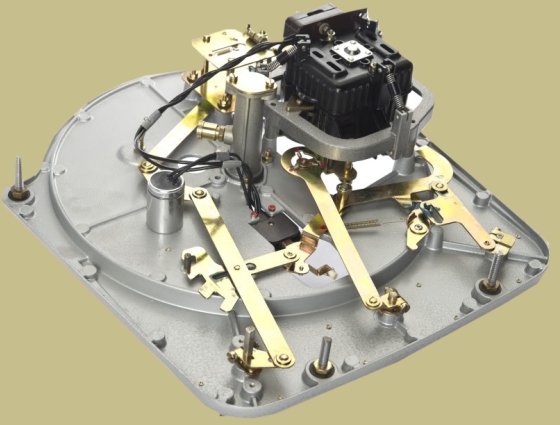
And that is more complex that one built today would need to be. You can get a bearing with better precision than anything available in the 50s/60s for under 200 today. If you looked at ebay and looked at what a new TD-124 bearing sells for, it's astonishing, but they are marking those bearings up 50-75% compared to what you could get them machined for. Not that there is anything wrong with that, BTW. You can buy parts off the shelves at mcmaster carr with 4-6 micron finishes for 15-40.00 that you could use as the basis for a shaft with precision that couldn't be matched in any vintage turntable.
To make something the equivalent of a 301 today, it would certainly have a retail price in the 3k range. Which isn't insignificant by any stretch. I just felt like it was suggested that the reason there weren't more idlers being mfg today, was because of complexity and cost. The same mfgs are selling turntables for the same prices and higher, so I don't buy the argument that they aren't being made for those reasons. I'd suggest there aren't more idlers on the market because their existence was originally due to the rugged nature of their build that allowed them to perform 24/7 in radio stations without having to worry about them breaking down, coupled with very fast start/stop times. By the mid-late 70s, most were replaced the Technics SP series for teh same qualities of rugged build and maintenance free operation and fast start/stop times. Since their primary market is mostly non-existent, manufacturers most likely set their sites on the high fidelity consumer market and probably determined there were better directions to go.
Just taking a look at the bottom of the 301, I don't see anything that would worry me about attempting to build this:
And that is more complex that one built today would need to be. You can get a bearing with better precision than anything available in the 50s/60s for under 200 today. If you looked at ebay and looked at what a new TD-124 bearing sells for, it's astonishing, but they are marking those bearings up 50-75% compared to what you could get them machined for. Not that there is anything wrong with that, BTW. You can buy parts off the shelves at mcmaster carr with 4-6 micron finishes for 15-40.00 that you could use as the basis for a shaft with precision that couldn't be matched in any vintage turntable.
To make something the equivalent of a 301 today, it would certainly have a retail price in the 3k range. Which isn't insignificant by any stretch. I just felt like it was suggested that the reason there weren't more idlers being mfg today, was because of complexity and cost. The same mfgs are selling turntables for the same prices and higher, so I don't buy the argument that they aren't being made for those reasons. I'd suggest there aren't more idlers on the market because their existence was originally due to the rugged nature of their build that allowed them to perform 24/7 in radio stations without having to worry about them breaking down, coupled with very fast start/stop times. By the mid-late 70s, most were replaced the Technics SP series for teh same qualities of rugged build and maintenance free operation and fast start/stop times. Since their primary market is mostly non-existent, manufacturers most likely set their sites on the high fidelity consumer market and probably determined there were better directions to go.
dnewma04
The Healer
At the risk of hyperbole the Lenco has taught me that there is a very wide margin of error associated with very talented engineers and this seemingly "easy" idea. And that spinning a record perfectly while dealing with the variables that a stylus dragging through a constantly changing groove resistance without smearing the harmonics on a micronic level has proven to be a handful.
Marc mc
I haven't shared your experience, so I can't comment with anything useful. I'm happy that you found a good turntable, though.