

You are using an out of date browser. It may not display this or other websites correctly.
You should upgrade or use an alternative browser.
You should upgrade or use an alternative browser.
Any Opinions on KLH 17s compared to vintage EPI m100s?

Oops! Sorry for all the confusion regarding the caps in the KLH-17s!!!
To clarify:

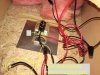
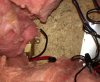
Side-by-side testing conditions against the EPI 100s: When I went to compare them the other day against the EPIs, I found one KLH had no tweeter sound so I could only compare one KLH to one EPI. (Earlier this year when I found the KLHs I opened them to see how they looked inside and to see if I could date them. The above two pictures are from that investigation. In the lower left of those pictures you can see two red wires twisted together and one black wire. The first of those pictures even shows a bit of the "old double" capacitor from which those loose wires come. Inside both speakers, when I found them, were those "old double" capacitors, abandoned, disconnected, but still screwed to the inside back of the cabinets [third pic]. Also shown, however, were what I [mistakenly?] assumed were new caps connected to the switches. But now we are thinking those capacitors shown mounted to the switches are also old and need to be replaced. I can see why I've got everyone confused!) So the other day when I compared the one working KLH to the EPIs, it had one old disconnected cap inside and one old cap in the circuit.
"Blown" tweeter issue (Should I start a new thread?): Independent of any capacitors what-so-ever, I checked the suspect tweeter. To do this I removed the tweeter from the cabinet and disconnected all the wires from the tweeter and completely separated the tweeter from and any and all circuits as shown in this picture:
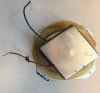
I tested the DC resistance of the tweeter as shown and it read 4.1 ohms. I connected the tweeter as shown without any capacitors to a good working source but it produced no sound. So the tweeter is not shorted and is not open and without any capacitors it doesn't work. So I'm thinking it is "blown?"
I am SO sorry I mucked all this together and apologize for steering you all in circles!
Now I'm trying to weigh the economics of replacing caps and a tweeter just so I can compare the KLHs to the EPIs. Maybe I should look at it more simply: One set is busted and one set is working. Case closed. EPIs win?
To clarify:
Side-by-side testing conditions against the EPI 100s: When I went to compare them the other day against the EPIs, I found one KLH had no tweeter sound so I could only compare one KLH to one EPI. (Earlier this year when I found the KLHs I opened them to see how they looked inside and to see if I could date them. The above two pictures are from that investigation. In the lower left of those pictures you can see two red wires twisted together and one black wire. The first of those pictures even shows a bit of the "old double" capacitor from which those loose wires come. Inside both speakers, when I found them, were those "old double" capacitors, abandoned, disconnected, but still screwed to the inside back of the cabinets [third pic]. Also shown, however, were what I [mistakenly?] assumed were new caps connected to the switches. But now we are thinking those capacitors shown mounted to the switches are also old and need to be replaced. I can see why I've got everyone confused!) So the other day when I compared the one working KLH to the EPIs, it had one old disconnected cap inside and one old cap in the circuit.
"Blown" tweeter issue (Should I start a new thread?): Independent of any capacitors what-so-ever, I checked the suspect tweeter. To do this I removed the tweeter from the cabinet and disconnected all the wires from the tweeter and completely separated the tweeter from and any and all circuits as shown in this picture:
I tested the DC resistance of the tweeter as shown and it read 4.1 ohms. I connected the tweeter as shown without any capacitors to a good working source but it produced no sound. So the tweeter is not shorted and is not open and without any capacitors it doesn't work. So I'm thinking it is "blown?"
I am SO sorry I mucked all this together and apologize for steering you all in circles!
Now I'm trying to weigh the economics of replacing caps and a tweeter just so I can compare the KLHs to the EPIs. Maybe I should look at it more simply: One set is busted and one set is working. Case closed. EPIs win?


Can't remember the model number, but I think it was the 20, which had the normal crossover panel, and then a surprise extra cap in line with the tweeter where the wire from the crossover was connected to the wire from the tweeter. Something to check for if everything else seems okay and they still don't work.
Update...
This is what the inside of a KLH 17 tweeter looks like:
http://audiokarma.org/forums/index.php?threads/klh-17-tweeter-exploded-view.840266/
This is what the inside of a KLH 17 tweeter looks like:
http://audiokarma.org/forums/index.php?threads/klh-17-tweeter-exploded-view.840266/

bigx5murf
Super Member
Having just restored a pair of EPI 100v myself (I got 3rd rev, with red ring tweeters). I'd have to say they were surprisingly easy to work on. The crossover is only one cap, and there's plenty of room to solder in a replacement to the cut leads of the original from the woofer hole. The tweeters almost seemed like they were designed to be taken apart, making cleaning and replacing ferro fluid extremely simple.I don't know how the KLH sound, but I really like the sound of the EPI, especially the very detailed tweeter, and the punchy bass (needs power to make bass). But compared to the rest of my current collection of speakers, I find the EPI lacking in the mid range, although the recap did help it noticeably in the mids.
From the early days of EPI I thought they had a distinctive sound - generally very good for the genre, but a bit dim or flat sounding - maybe recessed in the mids? - and dry- not a lot of sweetness or warmth. On the other hand, I have heard recapped versions that sounded different from my expectations (which if justified, doesn't speak well for electrolytics) .
I don't know that I listened to KLH 17s when they were current, but I picked up a pair recently and was quite impressed. Involving and sweet, even if a little frequency limited (what do you want from an 8 inch two way?). I was suprised, because I've run into so many KLHs with bad caps, but these seemed to be fine. I'm going to recap, but there are a lot of projects going on.
I don't know that I listened to KLH 17s when they were current, but I picked up a pair recently and was quite impressed. Involving and sweet, even if a little frequency limited (what do you want from an 8 inch two way?). I was suprised, because I've run into so many KLHs with bad caps, but these seemed to be fine. I'm going to recap, but there are a lot of projects going on.