• The move to the new server is done. There are some software and database maintenance updates in process. This has us passing the hat around to help out. We appreciate any donations. Seriously, even a dollar helps. The payment page may be found here - https://www.audiokarma.org/support.html

Anyone build external L-Pad enclosure?

PaperBoy007

Hanging out at the 49th
Subscriber
I'm thinking about putting two L-Pads in separate enclosures (project boxes) that I can connect one each to my external super tweeters. Something similar to what really good stuffs sells (reallygoodstuffs.com/L-PAD%20Enclosure.htm) that allow incoming signal from the speaker then out to the super tweeter using binding posts. Anyone know how the L-Pads, which I have, would be wired up. I've looked at a few diagrams about how to wire L-Pads that are inside the speaker cabinets, but clueless about when they are outside the cabinets. The external super tweeters have crossovers installed. These aren't the expensive super tweets like the Fostex pictured, but I would like to be able to have some control over their use depending on what I'm listening to.
 
Last edited:
Register to hide this ad
i found a set of the good realistic ones [ reportedly they are fostex ]
no cabs no x-over
i found a sight [ posted here some where] that said what value caps to use
got some pvc pipe to ft the tweeter
took l-pads from an old set of speakers
cut the back of those speakers L-pad and terminals to fit the pcv pipe
and mounted those in the back of the pvc pipe
coat of paint and they look like the old realistics as they were sold
 
index.php
index.php


these are at the almost done stage
cleaned up with steel wool
painted with textured paint ... dont have a pic of them done
 
Last edited:
If the super tweeters have their own cross-over, all you have to do is tap the incoming signal at the external speaker connections. No need to go inside the cabinet.

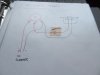
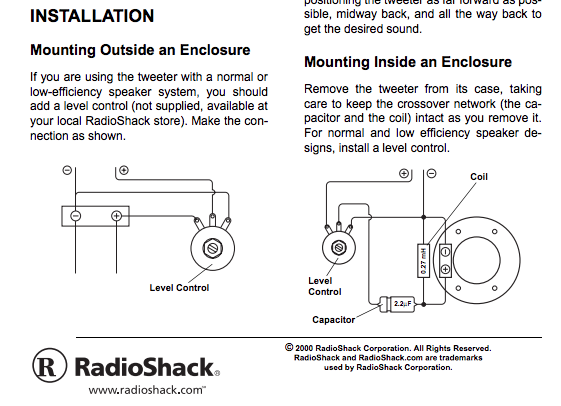
L pads have 3 terminals. Terminal 1 usually gets a wire from the common and also another wire that goes to the (-) of the super tweeter. Terminal number 2 gets a wire to go to the (+) of the super tweeter. Terminal 1 gets the signal from the (+) of the incoming signal. In your case, the L pad would go before the cross over for the tweeter.

The L pad puts resistance across the coils of the tweeter and resistance in series to the coil. This is how the impedance is maintained.

IMG_2111.JPG
 
Thanks for the replies. I have the old, made in Japan RS Realistic tweeters, in the pods with the built in crossovers. I've done the upgrades to the crossovers and put in better binding posts. Just thought it might be nice to have L-Pads in the mix, like you see for some of the newer Fostex. In the diagram is the item to the upper left the signal source, the amp? I see the lines going to the tweeter. If so, then the positive goes to connection 2 or the middle post on the L-Pad, then positive from number 3 on the L-Pad to a binding post on the outside of the project box. Then black is the negative to post 1 and and straight on to a negative binding post. So I could have a set of input binding posts and output binding posts similar to the reallygoodstuff box (I fixed the link in the original post). What is the value of the capacitor? My L-Pads are rated 8 ohms like the super tweeters and 50 watts. Just trying to make sure I have things straight.
 
in adding a soft dome tweeter to a set of Bozak Symponies I used cigar boxes to mount the tweeter, L-pad, and terminal posts:
20C1CD98-AD65-4461-887A-59C31E3C3F5B.jpeg

'good quality box with mitered joints, available in a variety of sizes, available at the local stogie shop for a buck a piece (w/o the stogies of course). 'Paint or stain to match and bingo, 'decent looking external tweeter with level control (hide the cap in there too if what you are using doesn't have a high pass). Look pretty good, no harm done to the base speaker & quite flexible.
26FFC9A7-5B7A-4164-89E2-444D5800C19C.jpeg
 
Mark and everyone, thanks a lot. I think I have the wiring figured out, especially with your photos Mark. Just not sure if I need to add a capacitor or not and if so, which one. Do the Fostex have built in crossovers?
 
Mark, thanks. That clears that up for me. I would connect everything the way it is in your photo, sans the capacitor. Again, thanks everyone for taking the time to help me with this.
 
Oh, I flipped the 1 and the three terminals. It will just run the other way. As the wiper position changes, the resistive value of one side will go up, the other side will go down. They are inversely proportional.

Also, do not run the tweeter without a cap. You should find out what its operating frequencies are and what the resonant frequency is.

So, will this info help determine what size cap I would need?
SPECIFICATIONS
Magnet Weight ................................. 2.85 oz (81 g)
Speaker Weight ............................ 14.46 oz (410 g)
Power Handling Capacity ....................... 50W RMS 100W maximum music power
Frequency Response .................... 5 kHz to 40 kHz
Impedance ................................................. 8 ohms
 
Well, you'll have to decide where to cross-over to the super tweeter, obviously it should be higher the 5K. If you use just a capacitor, it will only give you a 6db/octave slope, which would be OK if you go high enough. If you use a cap and an inductor (cap in series, inductor across the coils, it will give you a 12db/octave slope

Assuming your speakers finish strong at 20k, you may choose to use that number as a starting point. A 6db slope (Butterworth 1st order) would require a 1.00uf cap. A 12db slope (Linkwitz-Riley 2nd order) would require a .5uf cap and .13mh inductor.
 
The old rule of thumb is XO at not less than twice Fs (resonant frequency); the OP's Fs is ("apparently", or "probably"!) 5kHz.
Were it me, I'd go with a 10 kHz XO, first order. 2 uF for 8 ohms; 1 uF for 16 ohm; 4 uF for 4 ohm.
XO calculators abound; here's one :)
http://www.erseaudio.com/CrossoverCalculators

A second order XO is "probably" a better choice; but I'd start with first order unless the amplifier is quite powerful relative to the power rating of the driver in question. With 3.5 watts here, I don't worry too much about overdriving tweeters. :cool:

Use the best quality capacitor you can rationalize spending $$$ on (again, IMO) :)

FWIW, I actually use a nominal XO of 20 kHz with my supertweeters. This isn't as nutty as it might sound; the supertweeters are very sensitive (I need to pad them down considerably) -- they're down only 6 dB at 10 kHz, and 6 dB for every octave below that (i.e., 12 dB at 5 kHz, etc.), so, in practice, they supertweet perfectly well.

Currently using the rather nice B&C DE-35 instead of the considerably pricier Fostex T90A. The latter are very good, but a little polite: I like the snap that the B&C's bring. De gustibus non est disputandum, though, of course.

DSC_9984 (3) by Mark Hardy, on Flickr

https://www.parts-express.com/bc-de35-neodymium-mylar-bullet-tweeter--294-580
 
I'm thinking about putting two L-Pads in separate enclosures (project boxes) that I can connect one each to my external super tweeters. Something similar to what really good stuffs sells (reallygoodstuffs.com/L-PAD%20Enclosure.htm) that allow incoming signal from the speaker then out to the super tweeter using binding posts. Anyone know how the L-Pads, which I have, would be wired up. I've looked at a few diagrams about how to wire L-Pads that are inside the speaker cabinets, but clueless about when they are outside the cabinets. The external super tweeters have crossovers installed. These aren't the expensive super tweets like the Fostex pictured, but I would like to be able to have some control over their use depending on what I'm listening to.
I have a project box with 3 l-pads I made a while back, but not for tweeters but rather because my Altec speakers were louder than my Jensens so I used 2 of them to balance the relative volumes. (All 4 speakers in same room). The 3rd l-pad I use to adjust volume of a center channel speaker I also have, but rarely use. You wire them up the same way you would a tweeter l-pad, to wit amp positive to tap 3, speaker positive to tap 2, and both negatives to tap 1. I think it best to solder a short wire to each tap, then used wire nuts to connect to amp and speakers. Now the $64 question.... which is tap 1 and which is tap 3?? It depends on your perspective. If you are looking from the rear, with the taps on top, it is 3-2-1. That is, IIRC. Oh, and be sure l-pads are same impedance as speakers. You can get 8 and 16 ohm l-pads at Parts Express.
 
Back
Top Bottom