

You are using an out of date browser. It may not display this or other websites correctly.
You should upgrade or use an alternative browser.
You should upgrade or use an alternative browser.
Anyone doing a garden?
- Thread starter spartanmanor
- Start date
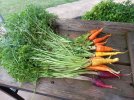

Smokin' day today. I'm doing four separate batches...the two Italian peppers, the two paprika's, the Guajillo's and the Spanish Paquillo. The Paquillo's probably wont make it to being powdered...they are too good the way they are so I'll vac seal them. Gonna smell good in here tonight when they hit the dehydrator! 
The beginning...but I added some more this morning I had ripening in a bag...
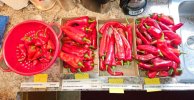
Ready for the smoker....
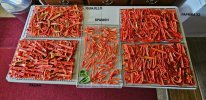
And currently after a two hour rotation...

To be continued.........................
The beginning...but I added some more this morning I had ripening in a bag...
Ready for the smoker....
And currently after a two hour rotation...
To be continued.........................
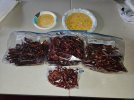
..........and finally...1 1/2 lbs of smoked and dried peppers out of 10 1/2 lbs fresh. So considering store bought smoked paprika that is about $7-8 for 1.62 ozs...this haul makes about 15 of those bottles that saves me over $100. But the difference is dramatic...the store bought is just so bland in comparison and you can taste the anti-caking crap they put in it.
The Spanish and Italian peppers were combined as they were a sweet smokey flavor. The Paprika's and Guajillo's were combined as they had a kind of bitter-sweet smokey flavor with a little more bite to them.
Powdered and vac sealed some in jars and vac sealed the rest and froze for later.
Also saved some Spanish Piquillo and Boldog Paprika seeds....


The Spanish and Italian peppers were combined as they were a sweet smokey flavor. The Paprika's and Guajillo's were combined as they had a kind of bitter-sweet smokey flavor with a little more bite to them.
Powdered and vac sealed some in jars and vac sealed the rest and froze for later.
Also saved some Spanish Piquillo and Boldog Paprika seeds....

See post #2310 @CT Jim is the go to guy on growing Garlic.Hey all. I have a small garden and try to grow Garlic every year. I never get huge heads but decent. My issue is I never seem to get full Husks around the heads or several cloves grow outside the husk. Any pointers? Thanks!
Last edited:
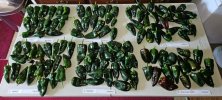
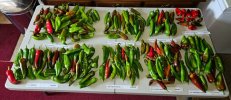
With today's pickin's I have found the maximum volume my fridge can withstand. That would be 51 lbs of peppers. Got my first chocolate colored Mulato pepper too so I'm trying that one out tonight. The plants still have a lot of small peppers on them...hopefully the weather will hold out for them to grow. Had two nights last week where the temps dropped down to 47°F... and now we're in the 90's for a week. 

Plus these were already in there...

Plus these were already in there...

Eywadude
Lunatic Member
With today's pickin's I have found the maximum volume my fridge can withstand. That would be 51 lbs of peppers. Got my first chocolate colored Mulato pepper too so I'm trying that one out tonight. The plants still have a lot of small peppers on them...hopefully the weather will hold out for them to grow. Had two nights last week where the temps dropped down to 47°F... and now we're in the 90's for a week.
View attachment 2977772
View attachment 2977774
View attachment 2977776
Plus these were already in there...
View attachment 2977779
Sounds like what happened here in southern Ontario. We had a night drop down to 49F last week, our coolest night in over 3 months, and now it's been in the 90s since Sunday here. Although, El Niño years are usually a little wacky around the lower Great Lakes though. We typically don't get the kind of heat that the rest of the continent gets during an El Niño, and we haven't had much heat this year. Mostly just average to slightly below average at times. But it's not uncommon for us to have a warm fall during El Niño years also. Just the fact that we've had our longest heatwave of the year in September could be an indicator...but not always. Hopefully we get an extended growing season up here.
Your peppers are lookin' good! My pepper plants produced nothing this year, and my tomato plants were an absolute disaster as well. Seems like I'm in a slowly collapsing ecosystem. No more pollinators.
 Birds have also disappeared at an utterly alarming rate, and even things like cicadas and mosquitos, which were as synonymous with summer days and nights as anything you can think of, are almost non-existent anymore. Things have only gotten progressively worse over the last 10-15 years, and in the last 5 years especially. Things are starting to get really scary.
Last edited:

RickeyM
Addicted Member
I got a very late start with my tomatoes this year. Finally I got something to harvest from two of my plants. One, a Beefsteak variety, I feared would split if I left it on the plant . Two more, Sunny Boy hybrids, were starting to blush. Plenty more still growing. My transplanted kale is doing well despite the heat. My pepper plants while small are starting to produce. I erected a kind of lean-to using shade cloth to shield the tomatoes in their pots. Blazing sun and high temps are kind of hard on tomato plants.
Next year I'm going to get things going a lot earlier and use what I've learned to really get the garden going.

Next year I'm going to get things going a lot earlier and use what I've learned to really get the garden going.
RickeyM
Addicted Member
Where are you located?Container garden here. 2 varieties of tomatoes, cucumbers, banana peppers, and Japanese Eggplant. The tomatoes were really bad, skins were tough as leather, cukes were bitter, eggplant and peppers were fine.

JoseHH
Super Member
Did you know that tomatoes can easily polinized by hand?. While your plants are there, try the following things to improve production (all this information gathered over the web, with lots of excellent channels in you tube explaining this.Your peppers are lookin' good! My pepper plants produced nothing this year, and my tomato plants were an absolute disaster as well. Seems like I'm in a slowly collapsing ecosystem. No more pollinators.
1- polinize. This is done by shaking the flowers of the tomato plant by tickling them with your finger for a few seconds. This is done as soon as blooms open. For a garden this is perfectly realizable. I normally grow about 40 plants per year and I have got 65 kg of tomatoes on my best summer.
2-Apply posassium rich fertilizer. Tomato plants are demanding in potassium and react vigorously to it. You can use ashes, of other sources. I use potassium sulfate which i dissolve in water about 10g/l and apply at the foot of each plant. Sometimes i use anout 1g/l and shower the entire plants with it.
3- Trim the plant during growth and make sure it is well supported such that no leave becomes in contact with the soil. The plants are to be well aereated.
4-In hot and very dry weather the red mite (Arachnida: Acari) can decimate your plans in a couple of weeks. Combat it by sprinking fine sulfur powder on the entire plants before the red mite hits. Do this on late in the evening as soon as dry hot weather arrives. Sulfur is non toxic to humans and it does not scare polinizers like bees.
I hope this helps

jcamero
Who are you people anyway?
Southern WisconsinWhere are you located?
Eywadude
Lunatic Member
Did you know that tomatoes can easily polinized by hand?. While your plants are there, try the following things to improve production (all this information gathered over the web, with lots of excellent channels in you tube explaining this.
1- polinize. This is done by shaking the flowers of the tomato plant by tickling them with your finger for a few seconds. This is done as soon as blooms open. For a garden this is perfectly realizable. I normally grow about 40 plants per year and I have got 65 kg of tomatoes on my best summer.
2-Apply posassium rich fertilizer. Tomato plants are demanding in potassium and react vigorously to it. You can use ashes, of other sources. I use potassium sulfate which i dissolve in water about 10g/l and apply at the foot of each plant. Sometimes i use anout 1g/l and shower the entire plants with it.
3- Trim the plant during growth and make sure it is well supported such that no leave becomes in contact with the soil. The plants are to be well aereated.
4-In hot and very dry weather the red mite (Arachnida: Acari) can decimate your plans in a couple of weeks. Combat it by sprinking fine sulfur powder on the entire plants before the red mite hits. Do this on late in the evening as soon as dry hot weather arrives. Sulfur is non toxic to humans and it does not scare polinizers like bees.
I hope this helps
Sorry for such a long reply, but yep, I do all those things...
1. I've tried manual pollination, "plant tapping", using an electric toothbrush on the blossoms to simulate the vibrations of pollinating insects (bees in particular), etc.
2. My plants always get a good diet of potassium, magnesium and calcium for good blossom and fruit production, to prevent blossom end rot, and to promote overall good plant health.
3. I always trim excess growth to keep the plant's energy going into the fruits and blossoms instead of unneeded excess foliage. I also remove suckers in a timely fashion and limit the main stalks to only three at the most (again, too many is too much). But I never take too many stalks or branches so that it compromises the plant's ability to take up its required amount of sun for proper photosynthesis and overall plant health and vigour. I also remove the bottom 18-20 inches of all branches and foliage to prevent any contact with the soil, and I also use a good layer of mulch to reduce rain splash back as well.
4. Red mites have never been an issue for me since I do companion planting that repels literally all pest insects away from my plants. I used to have issues with tomato hornworms and other pests, but ever since I started companion planting I have never had an issue with any pest at all. The difference is like night and day, all without the use of any sprays, powders or other chemicals of any kind, which is ideal.
I also keep my plants regularly watered throughout the season and never allow the watering to fluctuate too much, or let them get dry. I also don't allow the foliage to get wet while watering (only during regular rains), and apply water to the soil only. I use high quality soil with a healthy amount of well-composted organic matter for most of the nutrients they need, but also not too much nitrogen, which can limit and stunt blossom production if there's too much. There are several other things I do to assure good, healthy plants, and I could go on, but I digress.
Every year my plants get hoards of blossoms, but despite all my efforts to help them get pollinated and to give them the right balance of all the nutrients they need to form and grow into healthy fruits, it's all been, well...very unfruitful. The issues I have been having have directly coincided with the severe loss of pollinating insects in my area. I can try to assist the blossoms to pollinate in every which way possible, but there's just something about the way insects do it, as nature intended, that just can't be replicated. I never used to have these issues.
Ten to fifteen years ago there were more bees, species of bees, and pollinating insects of all kinds than you could even count. At any given time of day there were literally dozens of them flying around all of my various plants and during that time my tomato plants grew fantastically. But over the last 10-15 years there has not only been a slow decline of bees in particular, but all pollinators too, and over the last 5 years the decline has been STARTLINGLY scary. Now, I'm lucky to see one bee in a day, if that, and insects of all kinds are disappearing as well. Even crickets and other nighttime insects have disappeared.
As mentioned, birds have all but disappeared in my area too. Every year I used to get TONS of sparrows, robins, chickadees, gold finches, wood thrushes, cardinals, blue jays, mourning doves, Baltimore orioles, orchard orioles, grackles, catbirds, mockingbirds, starlings, redwing blackbirds...the list goes on. From before dawn to dusk, everyday it was a constant cacophony of birds and cicadas. Now, from July onward in particular, I can go outside at any point during the day and hear hardly a single sound except for the wind and the rush of cars going by on a nearby street. There's nothing out there anymore. Most times it's literally sheer silence other than human activity. The only birds that haven't disappeared completely are a few cardinals and blue jays, and maybe a chickadee or two (the blue jays only call early in the morning, and that's it). I can only assume the birds are disappearing because there are no insects for them to eat. This is the fourth summer in a row like this and it's eerily scary.
Even in my grocery store, local Ontario produce from June all the way through to October is as reliable as the sun coming up every morning, but this year I'm seeing less and less Ontario produce in the stores, as well as the amount being advertised. I even bought a cantaloupe the other day without even thinking of where it came from, just assuming it would be an Ontario cantaloupe as they ALWAYS are this time of year, and before cutting it open I saw the sticker on it looked different (it was on the underside), and it was from Guatemala! That's just unheard of here while the local ones are in season. Again, I digress.
Something is WAY wrong in my area and things are getting dire. It's not just me either. I've been hearing about other people having all kinds of mysterious issues with plants of all kinds in recent years, and I have also been reading anecdotal incidences of other gardeners having sporadic issues they never had in the surround area, and even surround states to where I am. I really hope this isn't the beginning signs of some kind of ecological collapse, but with what I have been witnessing in my area, it's hard to call it anything else.
Last edited:
JoseHH
Super Member
it is the Hollocene...Something is WAY wrong in my area and things are getting dire. It's not just me either. I've been hearing about other people having all kinds of mysterious issues with plants of all kinds in recent years, and I have also been reading anecdotal incidences of other gardeners having sporadic issues they never had in the surround area, and even surround states to where I am. I really hope this isn't the beginning signs of some kind of ecological collapse, but with what I have been witnessing in my area, it's hard to call it anything else.
Bees decline everywhere. I am in Buenos Aires, and travel to Bangkok every year to reunite with my family and I noted the insects decline at both places. Here too bees declined. I am afraid we are living in a time of massive extinction of life species.
Besides this, You are definetly taking care of your crops much better than I am. In fact I have not yet tried companion crops. I simpli don't know which species here will work for that. I will appreciate your advice on that.
Have you tried changing the seed sources?. Some of the genetically modified variants fail to produce mora than one single generation of plants that yield proper fruits.
May be try with some native variant or get seeds from somebody who got a good yield of fruits.
For me what worked best are the locally addapted tomatoes here called "Platense tomato"
It also helped me to prepare the seeds by fermenting the tomato pulp extracted from the tomato, just the jelly part contaning the seeds. ( i also learned this and lots more from a you tube channel called "mi jardin en el desierto" run by a brazilian Biologist. She knows a lot about gardening but channel is in Spanish though. ) I collect all of the pulp from 1/2 a tomato and put it in a clean glass jar (from marmolade or similar) , and i keep it in a fresh location for a week. After that i go outside, and open the jar and add water to suspend the seads, let them decant and then drain the water. Most of the roten pulp floats. Then i add water again, resuspend the seeds, and let them decat and drain again. Repeating this 5 or 6 times gets rid of all the pulp. I carefully drain all the remaining water, and I colect the seeds with a plastic spoon and lay them out separately on a cardboard to let them dry for two days on a dry and not illuminated area. Once dry i scrap the seeds out of the cardboard with a plastic spatula (credit card plastic works well) and collect the seeds in a zip bag untill time comes for planting them.
Sounds like what happened here in southern Ontario. We had a night drop down to 49F last week, our coolest night in over 3 months, and now it's been in the 90s since Sunday here. Although, El Niño years are usually a little wacky around the lower Great Lakes though. We typically don't get the kind of heat that the rest of the continent gets during an El Niño, and we haven't had much heat this year. Mostly just average to slightly below average at times. But it's not uncommon for us to have a warm fall during El Niño years also. Just the fact that we've had our longest heatwave of the year in September could be an indicator...but not always. Hopefully we get an extended growing season up here.
Your peppers are lookin' good! My pepper plants produced nothing this year, and my tomato plants were an absolute disaster as well. Seems like I'm in a slowly collapsing ecosystem. No more pollinators.
That sucks that your plants aren't producing. I wonder if all the wildfires this year have caused issues with the pollinators as well. I dont know what to tell you as I've only been growing for three years now...well except for the early years growing up on farms.
Eywadude
Lunatic Member
it is the Hollocene...
Bees decline everywhere. I am in Buenos Aires, and travel to Bangkok every year to reunite with my family and I noted the insects decline at both places. Here too bees declined. I am afraid we are living in a time of massive extinction of life species.
Besides this, You are definetly taking care of your crops much better than I am. In fact I have not yet tried companion crops. I simpli don't know which species here will work for that. I will appreciate your advice on that.
Have you tried changing the seed sources?. Some of the genetically modified variants fail to produce mora than one single generation of plants that yield proper fruits.
May be try with some native variant or get seeds from somebody who got a good yield of fruits.
For me what worked best are the locally addapted tomatoes here called "Platense tomato"
It also helped me to prepare the seeds by fermenting the tomato pulp extracted from the tomato, just the jelly part contaning the seeds. ( i also learned this and lots more from a you tube channel called "mi jardin en el desierto" run by a brazilian Biologist. She knows a lot about gardening but channel is in Spanish though. ) I collect all of the pulp from 1/2 a tomato and put it in a clean glass jar (from marmolade or similar) , and i keep it in a fresh location for a week. After that i go outside, and open the jar and add water to suspend the seads, let them decant and then drain the water. Most of the roten pulp floats. Then i add water again, resuspend the seeds, and let them decat and drain again. Repeating this 5 or 6 times gets rid of all the pulp. I carefully drain all the remaining water, and I colect the seeds with a plastic spoon and lay them out separately on a cardboard to let them dry for two days on a dry and not illuminated area. Once dry i scrap the seeds out of the cardboard with a plastic spatula (credit card plastic works well) and collect the seeds in a zip bag untill time comes for planting them.
That's really concerning you're seeing the same decline in insects on two different continents and in separate hemispheres. The more I hear about things like this, the more I fear for the future. I know there are lots of people who are not seeing these trends yet (or not really taking notice), but this is really scary stuff.
I never use genetically modified or hybrid seeds. I only use untreated seed, open pollinated heirloom varieties. I don't use GMO or hybrid seeds for any of my plants because they are not good for the ecosystem, they can cause cross pollination problems for other plants, and as you mentioned, the seeds from them cannot be collected to be used the next year because the plants will not grow properly, and will bear very little to no fruit. Besides, genetically modified seeds are highly regulated here in Canada, and they are not able to be bought by the genernal public at all.
Also, I do the same fermenting method for any tomato seeds I collect too. Fermenting them not only helps the seed's storage life and viability last longer, it also causes them to germinate more vigorously, and it also helps to produce healthier, more fruit-bearing plants overall compared to non-fermented seeds. It's good you know that technique. It's a very good thing to do when keeping tomato seeds for next year's crop.
As for companion planting, there's just WAY too many combinations of companion plants for each fruit and vegetable to mention here. You'll also have to Google it to see what may work best in your area. Some of the companion plants might be different in Argentina than they are here in North America, but there should be information about it for your region. If not, you can read the charts for companion planting for North America. If you do a Google image search there are charts there to see, as well as on gardening sites that have information about companion planting. Many companion plants here should be compatible with the common fruits and vegetables that are grown on both continents. However, if you grow anything in Thailand, things could be different. Again, you'll have to do your research.
Cheers.
That sucks that your plants aren't producing. I wonder if all the wildfires this year have caused issues with the pollinators as well. I dont know what to tell you as I've only been growing for three years now...well except for the early years growing up on farms.
It really does suck. I love growing tomatoes so much. They are challenging and require a lot of maintenance, but they are so rewarding. There's just nothing like the taste of a fresh tomato right from your own garden. I really enjoy how rewarding that is. But things have gotten so bad that next year I don't even think I'm going to bother growing tomatoes. It's just not worth the hassle anymore. As I mentioned, it's just become so unfruitful...pun intended. Both literally and figuratively. The only thing that seems to grow as it did are leafy plants like kale, as well as chives and other herbs I grow.
Also, it's plausible the wildfires could've had something to do with the amount of insects here, but I've had this issue for the last 4-5 years now and we didn't have smoke issues like that here during those years. Before this year, smoke days were a relatively extreme rarity. I honestly don't know what has led to this so suddenly, but it's really unnerving.
Last edited:
Well this is close to the last of the peppers this year. Picked another 29 lbs. yesterday to add to the 50 lbs. already packed in the fridge. Needless to say Ima gonna be busy for a few days processing peps as there is no room in the fridge for this new harvest.
Temps are dropping into the mid 40's and I found a bunch of stinkbugs on the plants so I decided to pull almost everything big or small.

Temps are dropping into the mid 40's and I found a bunch of stinkbugs on the plants so I decided to pull almost everything big or small.

orsen
Jukebox Hero
Ten to fifteen years ago there were more bees, species of bees, and pollinating insects of all kinds than you could even count. At any given time of day there were literally dozens of them flying around all of my various plants and during that time my tomato plants grew fantastically. But over the last 10-15 years there has not only been a slow decline of bees in particular, but all pollinators too, and over the last 5 years the decline has been STARTLINGLY scary. Now, I'm lucky to see one bee in a day, if that, and insects of all kinds are disappearing as well. Even crickets and other nighttime insects have disappeared.
As mentioned, birds have all but disappeared in my area too. Every year I used to get TONS of sparrows, robins, chickadees, gold finches, wood thrushes, cardinals, blue jays, mourning doves, Baltimore orioles, orchard orioles, grackles, catbirds, mockingbirds, starlings, redwing blackbirds...the list goes on. From before dawn to dusk, everyday it was a constant cacophony of birds and cicadas. Now, from July onward in particular, I can go outside at any point during the day and hear hardly a single sound except for the wind and the rush of cars going by on a nearby street. There's nothing out there anymore. Most times it's literally sheer silence other than human activity. The only birds that haven't disappeared completely are a few cardinals and blue jays, and maybe a chickadee or two (the blue jays only call early in the morning, and that's it). I can only assume the birds are disappearing because there are no insects for them to eat. This is the fourth summer in a row like this and it's eerily scary.
i'm in NW Ont. and it seems the same here, except sparrows and grackles , little buggers eat everything i give and still want more.
i raised and released 10 monarch butterfly's, have not seen a single swallowtail, viceroy, or lady bug, not even one.
no bats around either, but with no mosquito or moths around i guess its to be expected. only seen one blue jay, no woodpeckers, wonder if the resident hawks have anything to do with that.
my yard is intentionally pollinator friendly, just dug 3 new beds to plant for next yr.
.
Last edited:
Eywadude
Lunatic Member
i'm in NW Ont. and it seems the same here, except sparrows and grackles , little buggers eat everything i give and still want more.
i raised and released 10 monarch butterfly's, have not seen a single swallowtail, viceroy, or lady bug, not even one.
no bats around either, but with no mosquito or moths around i guess its to be expected. only seen one blue jay, no woodpeckers, wonder if the resident hawks have anything to do with that.
my yard is intentionally pollinator friendly, just dug 3 new beds to plant for next yr.
.
Ugh. That's really scary. I've actually been considering NW Ontario to do homesteading, and that's very discouraging.
 I had a small flurry of starling activity here last week, but not tons of them. Only a few here and there, but that's more than I've had in months.
I also forgot to mention about the lack of butterflies here too. No Black or Eastern Giant Swallowtails (I used to have their caterpillars in my herbs all the time), no Red Admirals, White Admirals, fritillaries, Banded Hairstreaks, Viceroys and very few Monarchs this year. Even here in the city during late August and into September you could look up into the sky during any time of the day, during the height of their migration, and see 10-15 Monarchs fluttering around. Not anymore.
Very few moths too.We also used to have lots of bats here as well, and I haven't seen any in years. Again, the insects are disappearing and there has also been a very noticeable decrease in insects flying around lights at night too. Mosquitos were literally non-existent this spring and summer. I only got bit once this year, and that was literally the only mosquito I saw. Usually they're all over you in the evenings and at night.
Surprisingly, we actually had lots of woodpeckers and flickers last year (just about the only regular bird I saw that year - I even saw 8 at one time in the trees in my backyard), but this year I only saw one woodpecker. Although, I did hear a few this summer.
But between the rapid disappearance of insects and animals around me, and from what I'm hearing from other people all over the globe, this is DEEPLY concerning.
Good on you for raising 10 Monarchs though. I had the pleasure of raising one when I was about 9 or 10 years old, and on the morning of the first day of school its cocoon opened up and we let it fly away before we left for school that morning.
Spent the past 4 days processing the 80 lbs of peppers....
Poblano's roasted and ready to peel, de-seed and chop...

Anaheim's all done...lots of sweet syrup with these. When roasting some would split open and the juice hitting the grill smelled like burnt sugar.
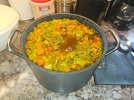
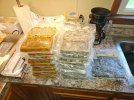
And finally vac sealed and frozen in one pound blocks...two per bag. So 18 lbs of Poblano and 18 lbs of Anaheim exactly. Added to what is already in the freezer and what I used on one batch of chili already...around 56 lbs of processed peppers this year not counting the 19 lbs of paprika peppers. My plants are loving this weather too with more peppers an d flowers but I dont thing they will have time to amount to anything before the really cold temps hit.
And currently in the smoker as we speak...about 9 lbs of peppers for smoked paprika. This batch will be a little spicier than the early season batch. Late season seem to build that heat up in them...my burning fingers and mouth tell me.

To be continued....
Poblano's roasted and ready to peel, de-seed and chop...
Anaheim's all done...lots of sweet syrup with these. When roasting some would split open and the juice hitting the grill smelled like burnt sugar.
And finally vac sealed and frozen in one pound blocks...two per bag. So 18 lbs of Poblano and 18 lbs of Anaheim exactly. Added to what is already in the freezer and what I used on one batch of chili already...around 56 lbs of processed peppers this year not counting the 19 lbs of paprika peppers. My plants are loving this weather too with more peppers an d flowers but I dont thing they will have time to amount to anything before the really cold temps hit.
And currently in the smoker as we speak...about 9 lbs of peppers for smoked paprika. This batch will be a little spicier than the early season batch. Late season seem to build that heat up in them...my burning fingers and mouth tell me.
To be continued....