• The move to the new server is done. There are some software and database maintenance updates in process. This has us passing the hat around to help out. We appreciate any donations. Seriously, even a dollar helps. The payment page may be found here - https://www.audiokarma.org/support.html

Anyone Know How to Fix Stripped Threads?

Ben Rothman

Active Member
Hey everyone,

One of the screw holes on the bottom of my 1010 that holds the bottom cover on is stripped. I don't really want to drill and tap it because that one screw will be a different size. My thought was to melt some solder onto the threads and that should fix the problem. Before I go ahead and do that, does anyone have any suggestions?
 
Register to hide this ad
you could use a nut plate. thats a sheet metal clip with a through hole on one side and a sheet metal upset for a "thread" they come in lots of sizes. and you could also put it together and try not to worry about it
 
Last edited:
I would fill the hole with epoxy, then drill and tap that hole. Not just any epoxy, but one that is intended to be machinable afterwards. In fact, I vaguely recall having seen a product just for this purpose. Alternatively, I would use a glue gun and imbed the screw while the glue is still hot. That glue should have a pretty good friction/mechanical fit with the existing hole, and yet allow the screw to be easily removed. Depending on clearances, you may wish to drill out the existing hole first. My guess is that either one will be a better solution than solder, especially flux core solder.
 
If it's an extruded hole, you could squeeze the metal back together the run a tap or self threading screw in. Post a picture!
 
I forget are the 1010 bottom cover holes a metric thread? Or are they a metric self tap style? I have fixed metric threads by adding a nut on the other side. Once I get it in place I add a little cold weld around the mating surface. Make sure you don't freeze up the screw if you do this. If it's a self tap style then try adding something in to the threads as mentioned, go easy on torquing as it won't be as strong as the real deal.
 
I forget are the 1010 bottom cover holes a metric thread? Or are they a metric self tap style? I have fixed metric threads by adding a nut on the other side. Once I get it in place I add a little cold weld around the mating surface. Make sure you don't freeze up the screw if you do this. If it's a self tap style then try adding something in to the threads as mentioned, go easy on torquing as it won't be as strong as the real deal.
That's a great idea! Adding and glueing a nut to the back would be a permeant fix as I should be able to just remove and install the screws as many times as needed. I really like this idea. And this way I can keep the original screw size.
 
That's a great idea! Adding and glueing a nut to the back would be a permeant fix as I should be able to just remove and install the screws as many times as needed. I really like this idea. And this way I can keep the original screw size.
Yes, but it would be a bear to remove the screw if the glue doesn't hold well on the nut. Try melting a little solder in the hole, then drill and tap using the same size as the original screw.
 
You could drill and tap a piece of sheet metal, maybe chassis thickness, cut it to the width of a nut or chassis flange and cut to 1-1/2” or so in the other direction to allow for more glue area?

Similar to the nut suggestion but enhanced and more difficult, of course!
 
Yes, but it would be a bear to remove the screw if the glue doesn't hold well on the nut. Try melting a little solder in the hole, then drill and tap using the same size as the original screw.
That's very true, I've tried the solder technique before and have had some success. I believe they are sheet metal screws so I don't actually know if they have threads or if the whole just widened over time.
 
You could drill and tap a piece of sheet metal, maybe chassis thickness, cut it to the width of a nut or chassis flange and cut to 1-1/2” or so in the other direction to allow for more glue area?

Similar to the nut suggestion but enhanced and more difficult, of course!
This is also a great idea! I'm wondering if I could squeeze the whole together and make it smaller.
 
I'm not familiar with that exact model, but if it's a tapping screw thread into sheet metal you can "tighten up" the holes if you can get access to the back side.

Take something heavy and metal ( a hammer head will do) and put it against the back of the hole where it comes through the metal. Then tap the other side with a hammer and it will close up the hole a bit, allowing the sheet metal screw to find purchase again.

I've done it many times.
 
Those bottom black sheet metal screws are metric. No threads to speak of in the chassis.
McMaster-Carr has standard size screws slightly larger than the originals. Hopefully the enlarged holes are not bigger than my suggested replacement.
I bought a bag of 100 and was surprised when they looked like factory.
I have to look for the number. Not at home at the moment.
Tidbit of info:
I've been working on a lot of McIntosh equipment and most are Goodwill looking pieces with missing and incorrect hardware (Local flippers). Calling McIntosh will not get you the hardware needed. They are wonderful people but do not have the hardware required for the older equipment. McMaster-Carr does.
By the way. I love rebuilding those Mac's. Very satisfying getting them back in order. The factory is so cool. They will call you back with info and suggestions. Awesome folks!
 
Last edited:
Those bottom black sheet metal screws are metric. No threads to speak of in the chassis.
McMaster-Carr has standard size screws slightly larger than the originals. Hopefully the enlarged holes are not bigger than my suggested replacement.
I bought a bag of 100 and was surprised when they looked like factory.
I have to look for the number. Not at home at the moment.
Tidbit of info:
I've been working on a lot of McIntosh equipment and most are Goodwill looking pieces with missing and incorrect hardware (Local flippers). Calling McIntosh will not get you the hardware needed. They are wonderful people but do not have the hardware required for the older equipment. McMaster-Carr does.
By the way. I love rebuilding those Mac's. Very satisfying getting them back in order. The factory is so cool. They will call you back with info and suggestions. Awesome folks!
That’s great news! I think I can squeeze the metal back to have it fit properly. When you have the time, could you post a link to the proper screws for me to get? That would be amazing!
 
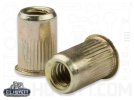
As Oerets suggested. Rivet nuts. You could see examples at McMaster site. Hardware stores may carry. But, MM may be harder to find locally.
I used them to add strong multiple thread engagement to sheet metal surfaces.

Drill a hole for rivet. Then install rivet. Then tighten a screw in rivet. Until back side of rivet is pulled up to expand against back surface, to hold firm. Just like normal rivets. Except this has a female thread. Available in different threads.
Edit: Do some trials in scrap material.
 
Last edited:
As Oerets suggested. Rivet nuts. You could see examples at McMaster site. Hardware stores may carry. But, MM may be harder to find locally.
I used them to add strong multiple thread engagement to sheet metal surfaces.

Drill a hole for rivet. Then install rivet. Then tighten a screw in rivet. Until back side of rivet is pulled up to expand against back surface, to hold firm. Just like normal rivets. Except this has a female thread. Available in different threads.
If the OP plans to use rivnuts, I'd advise to do a sample install on a piece of metal before attempting on the 1010. Reason being is that a bad rivnut install will cause the nut to spin when attempting to remove the screw.
 
If the OP plans to use rivnuts, I'd advise to do a sample install on a piece of metal before attempting on the 1010. Reason being is that a bad rivnut install will cause the nut to spin when attempting to remove the screw.
That's a very good idea. I just assumed he would do some trials.
 
As Oerets suggested. Rivet nuts. You could see examples at McMaster site. Hardware stores may carry. But, MM may be harder to find locally.
I used them to add strong multiple thread engagement to sheet metal surfaces.

Drill a hole for rivet. Then install rivet. Then tighten a screw in rivet. Until back side of rivet is pulled up to expand against back surface, to hold firm. Just like normal rivets. Except this has a female thread. Available in different threads.
Edit: Do some trials in scrap material.
I think the idea of shrinking the metal down or getting different sheet metal screws is the way to go. I didn't know there were no threads so I don't think I need a rivet.
 
As Oerets suggested. Rivet nuts. You could see examples at McMaster site. Hardware stores may carry. But, MM may be harder to find locally.
I used them to add strong multiple thread engagement to sheet metal surfaces.

Drill a hole for rivet. Then install rivet. Then tighten a screw in rivet. Until back side of rivet is pulled up to expand against back surface, to hold firm. Just like normal rivets. Except this has a female thread. Available in different threads.
Edit: Do some trials in scrap material.
This is a good idea, but now that I know I can shrink the original sheet metal, I think this would be a bit overkill. If the bottom had threads, I think this would be go to route to fix these.
 
Back
Top Bottom