• The move to the new server is done. There are some software and database maintenance updates in process. This has us passing the hat around to help out. We appreciate any donations. Seriously, even a dollar helps. The payment page may be found here - https://www.audiokarma.org/support.html

Anyone know what a DLDB Tube is?

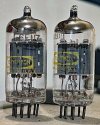
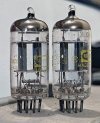
In the unlikely event that anyone ever chances across this discussion again, the tube that prompted the inquiry was probably a 6EU7 branded raytheon, made in the USA, with the funky chalk-like lettering that I formerly associated only with European mfrs (Mullard or Telefunken, I think, but don't hold me to it . . .).

I pulled a pair out of a early 1960's Wollensak T-1980 reel to reel today, which included (4) 6EU7s and (2) 7591s. One of the raytheons had a tube cover and the other did not. The one with the tube cover shows it to be a 6EU7, and both have the DLDB etched into the glass.

The other two 6EU7s were Sylvania-branded, and the lettering does not come off easily.
 
I don't recall what I did with that tube.......but this sure shows how complex the 'naming' of all these tubes got. How many 'different' ways are there to 'ID' a given tube? Pick one? Look at something like the 6BQ5......or, EL84.......or, 6P14:P........or....... probably another. Anyway....... interesting stuff!! TSD
 
Euro tube markings are terrible for durability. I've got a German amp that has absolutely no print on any tube other than the cryptic Phillips codes etched in the bottom. Had to do a bit of research and some reverse engineering to figure out what they are.

I will say that the Euro numbering system has some sense to it though. First letter is voltage, second is tube type, last is just a number.

E - 6.3v heater
L - pentode
84 - the 84th one

ECC83 has two trides, ELL80 has two pentodes, ECL86 has a triode and a pentode.

kinda handy that you can tell more or less what the tube's guts are just by the number.
 
I don't know what the etching was supposed to signify, but it does not seem that it was the type of tube. Mfr? Who knows? (But if someone does, it would be nice to know.)

I am surprised--but pleasantly surprised--that this post is still being monitored.
 
So here we are nearly a decade since the last post to this thread......and guess what: I just came across another DLD8 tube. And, it was in an old Magnavox console amp using 6EU7 tubes. So, perhaps the reference to the 20 volt version wasn't necessarily correct? Not sure.....BUT.....this time I have a 'newer' tube tester in my possession, so, I'm going to go set it up for a 6EU7 tube and then 'test' it and see what the results are, then come back here and finish this post. BTW, I was 'googling' the tube and got linked to this old thread. Oddly, being something I started over 10 years ago. OK.........back in a flash!!

OK, back from testing it. The good news is that it is, in fact, a 6 volt tube, not 20. Further, in testing it against the specs used for a 6EU7, it tested very good on one section, and excellent on the other. I tested 4 other 6EU7s I had, and none of them tested as 'good' as this tube. This makes me a bit suspicious as to whether or not it actually 'IS' a 6EU7 just under another designation...... or, is it actually a different tube altogether. Guess it really doesn't matter. It appears it 'will' sub for a 6EU7, so that's a good thing, particualrly since those are gettin' tougher and tougher to find.

Well........ that's it for a 10-years-later post! Time marches on, and so must I. Best to all, WC
 
So here we are nearly a decade since the last post to this thread......and guess what: I just came across another DLD8 tube. And, it was in an old Magnavox console amp using 6EU7 tubes. So, perhaps the reference to the 20 volt version wasn't necessarily correct? Not sure.....BUT.....this time I have a 'newer' tube tester in my possession, so, I'm going to go set it up for a 6EU7 tube and then 'test' it and see what the results are, then come back here and finish this post. BTW, I was 'googling' the tube and got linked to this old thread. Oddly, being something I started over 10 years ago. OK.........back in a flash!!
The "DLDB" stamping is an early 1960s in-house Raytheon code for the 6EU7. Possibly for a commercial or military subcontractor. :idea:

Raytheon 9-pin minis often test over 100%.

:thumbsup:

Raytheon 6EU7 DLDB  tube (1).jpg

Raytheon 6EU7 DLDB tube.jpg
 
I'd be delighted to have a pair of these! Not sure just how useful having just one in this condition will be, but ya never know. Mine tested exceptionally well considering just how 'lame' my other 6EU7 tested. This would be a great tube for an DG-SE1 still using the original 6EU7 as the driver.
 
I'd be delighted to have a pair of these! Not sure just how useful having just one in this condition will be, but ya never know. Mine tested exceptionally well considering just how 'lame' my other 6EU7 tested. This would be a great tube for an DG-SE1 still using the original 6EU7 as the driver.
My real NOS Raytheon tubes always test very high. And what is nice, they last a very long time (as long as the unit is electrically stable).

TungSol (USA) and CBS-Hytrons, too.
 
I have actually noticed that about Raytheon tubes. I had a few 12AX7s at one point, and all of them tested well above the factory NOS level as per my Hickok tester. So, I'm in full agreement that those tubes must have been built in a particularly well controlled environment and with superior materials!!
 
I have actually noticed that about Raytheon tubes. I had a few 12AX7s at one point, and all of them tested well above the factory NOS level as per my Hickok tester. So, I'm in full agreement that those tubes must have been built in a particularly well controlled environment and with superior materials!!
Yes. Many went into industrial or military applications. So the standards were a bit higher.

I have a Windmill Raytheon 5751 mil-spec tubes in my phono pre-amp. I have three extra NOS sets. I'll probably not get to them in this lifetime.
 
Back
Top Bottom