


Wigwam Jones
Caesar non supra grammati
Update: Recap and Retweet Complete!
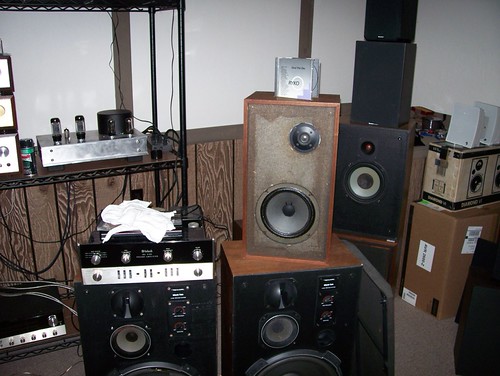
Thanks to Andyman, these speakers have a new lease on life...

100_3096 by Wigwam Jones, on Flickr
Andyman provided me with 8uf caps and a pair of 'oddball' tweeters that just happened to fit nearly exactly in the inset holes that the old CTS cone tweeters came out of. I did as instructed - removed the resister, removed the old 4uf cap and replaced with 8uf cap. Jumped over where the resister had been to complete the circuit.
The tweeters had larger magnets, slightly larger than the smaller inset hole in the cab, so I used a rasp to open the holes up slightly (very slightly, took only a few seconds). I stuffed some paper down the hole first and then used a vacuum cleaner afterwards to get the dust from the particle board out. I also used a keyhole saw to open up two notches to either side of the speakers to clear the terminals. The tweeters Andyman came up with for me are (apparently) Panasonic model EAS-9KH05S, as nearly as I can tell (they are printed EAS-9KH05S on the magnets).
100_3098 by Wigwam Jones, on Flickr
I mounted everything up on one speaker first, then listened in A/B fashion for awhile. I tried every possible permutation of 4.4uf, 8uf, old tweeter, new tweeter, and a pair of EPI tweeters Andyman lent me. I finally decided that the 8uf capacitor with no resister and the Panasonic tweeters sounded best. Then I opened up the second speaker and did the same.
I did notice that someone had been inside these cabs before. The second speaker had a 'Fisher' brand name capacitor (4uf, 25v, NP) that was considerably bigger in diameter than the other (same value) capacitor in the first speaker. Hmmm.
So anyway, both speakers are back together now. I sealed the tweets by making a pair of closed-foam gaskets out of dish-packing foam we used in our recent move. I didn't do a neat job - will be doing it again when I refinish the cabs. But now I know I want to take the time to clean the cabs up real nice.
The sound is the important thing. These speakers sound much, much, better to me. The high end is clear and rings (in a good way). I hear fingers on guitar strings now, breathing, snare and cymbals with tiny drum tips on steel that are now emerging from what was just mud. Clean, not tiring at all. I'm listening with a very good disc:
http://www.discogs.com/Various-Steal-This-Disc/release/1150988
Lots of various music genres, very well recorded, to sample. These speakers like female vocals and guitar strings, that's for sure. "Henry & James," by Dave Stewart and Barbara Gaskin...amazing. Never heard it quite this way before. I'm listening to this CD through my Squidward amp, using a Luxman integrated amp in pre-out mode as a preamp. Very nice; I already know this combination sounds great with my Klipsch KG2's.
I may try some other tweaks in the future; this whets my appetite. The caps Andyman lent me are your basic caps; I might try spending a few bucks on some 'audiophile' caps. I may experiment with other tweeters; but really, these Pannys are so nice and fit so well into the cabs I may just leave them be. Ah who knows?
But this project was quick, effective, low-cost, and thanks to all of you, quite enjoyable. I learned a lot, too.
THANKS!
Thanks to Andyman, these speakers have a new lease on life...
100_3096 by Wigwam Jones, on Flickr
Andyman provided me with 8uf caps and a pair of 'oddball' tweeters that just happened to fit nearly exactly in the inset holes that the old CTS cone tweeters came out of. I did as instructed - removed the resister, removed the old 4uf cap and replaced with 8uf cap. Jumped over where the resister had been to complete the circuit.
The tweeters had larger magnets, slightly larger than the smaller inset hole in the cab, so I used a rasp to open the holes up slightly (very slightly, took only a few seconds). I stuffed some paper down the hole first and then used a vacuum cleaner afterwards to get the dust from the particle board out. I also used a keyhole saw to open up two notches to either side of the speakers to clear the terminals. The tweeters Andyman came up with for me are (apparently) Panasonic model EAS-9KH05S, as nearly as I can tell (they are printed EAS-9KH05S on the magnets).
100_3098 by Wigwam Jones, on Flickr
I mounted everything up on one speaker first, then listened in A/B fashion for awhile. I tried every possible permutation of 4.4uf, 8uf, old tweeter, new tweeter, and a pair of EPI tweeters Andyman lent me. I finally decided that the 8uf capacitor with no resister and the Panasonic tweeters sounded best. Then I opened up the second speaker and did the same.
I did notice that someone had been inside these cabs before. The second speaker had a 'Fisher' brand name capacitor (4uf, 25v, NP) that was considerably bigger in diameter than the other (same value) capacitor in the first speaker. Hmmm.
So anyway, both speakers are back together now. I sealed the tweets by making a pair of closed-foam gaskets out of dish-packing foam we used in our recent move. I didn't do a neat job - will be doing it again when I refinish the cabs. But now I know I want to take the time to clean the cabs up real nice.
The sound is the important thing. These speakers sound much, much, better to me. The high end is clear and rings (in a good way). I hear fingers on guitar strings now, breathing, snare and cymbals with tiny drum tips on steel that are now emerging from what was just mud. Clean, not tiring at all. I'm listening with a very good disc:
http://www.discogs.com/Various-Steal-This-Disc/release/1150988
Lots of various music genres, very well recorded, to sample. These speakers like female vocals and guitar strings, that's for sure. "Henry & James," by Dave Stewart and Barbara Gaskin...amazing. Never heard it quite this way before. I'm listening to this CD through my Squidward amp, using a Luxman integrated amp in pre-out mode as a preamp. Very nice; I already know this combination sounds great with my Klipsch KG2's.
I may try some other tweaks in the future; this whets my appetite. The caps Andyman lent me are your basic caps; I might try spending a few bucks on some 'audiophile' caps. I may experiment with other tweeters; but really, these Pannys are so nice and fit so well into the cabs I may just leave them be. Ah who knows?
But this project was quick, effective, low-cost, and thanks to all of you, quite enjoyable. I learned a lot, too.
THANKS!
