


plbeard
Active Member
More notes on AR 3a grill cloth replacement, with a few notes on sound.
I recently got a pair of 1969 AR 3as. They were original, and in pretty good cosmetic shape. I rehabbed all of the caps and pots (which were shot). I refreshed the finish, which was sunbleached in places, with light steel wool and a light stain.
My first impression on rehab was that the tweeters were weak, but as I have lived with them, I doubt that they are much off spec., if any (they roll off around 11k, but that’s what the owner’s manual also shows, etc.). My experience recapitulated a lot of history reviewed here, and even in the 1970 Consumer Reports review that rated the 3a tweeter too recessed, acoustically, compared to the woofer, etc. (To which AR replied, “yeh, we designed it that way”). After a day or two I rated that the 3a’s I have are likely doing what they are supposed to; my standard of reference was KLH 5’s, which are brighter. For good measure I am getting some rehabbed spare tweeters, but I am not sure when I will put them in. The system as-is sounds very good, especially with orchestral music. That said, a fair amount of rocknroll also sounds great on the ARs. Recording style is more critical than music genre for what the 3a's render well, I think.
The grill cloth was not terrible, but had some holes and stains. I kept the original frames and cloth for sentimental reasons, though, and made some new frames.
Some of what I say here was already covered in an earlier thread I started on KLH 5 grill cloth replacement, here: https://audiokarma.org/forums/index.php?threads/klh-5-grille-cloth.771923/
and this earlier thread with some acoustic charts relative to thread counts:
https://audiokarma.org/forums/index...lle-cloth-measurements-tell-the-story.346706/
My only qualification of these testers' notes is that fabrics of the same thread count may sometimes vary in acoustic transparency due to other weight variables: density of thread/ fuzziness of thread/ intermittent closed areas, etc. As I said in the KLH thread, I am not sure how a 28 ct cloth passed their acoustic tests, but other variables than thread count are in play at all times. (References to thread counts throughout this note refer to threads-per-inch.)
Original AR 3a linen has a somewhat high thread count (something like 24), but, key, the threads are quite thin, and thus there is a lot of space between threads. The threads also were not very fuzzy. The trick they achieved was a cloth that was acoustically transparent (it is almost like nothing-at-all) but which did not show cavity shadows in the speaker (much). In replacing AR cloth, I think the best compromise is to experiment with 18 count linens--with the caveat that the threads themselves should not be too thick. 18 count Aida linen can roll off the high end, but it can be just fine. Other options include some types of burlap, or stuff that looks a bit like burlap, but with thinner threads. Thick, jute burlap is too dense to be acoustically transparent.
Original AR 3a cloth also had subtle oscillations of light and dark (oatmeal and darker) and thicker and thinner threads. These two qualities are key to getting something “vintage” looking.
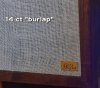
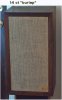
I test various cloths with a bright mid and tweeter (brighter than the 3a) playing white noise. Both of of the cloths pictured here passed this test for almost complete neutrality. The “burlap” (not really burlap, but to distinguish it from the linen) I have was originally fairly pale, and I stained it with coffee. It is about 14 ct.
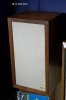
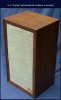
The linen I have looks denser in most photos than when it is when held to light; it has at least 50% space in it, still, and it is acoustically neutral on the 3as.
Both of these look fine in normal room light, but I somewhat prefer the linen. Another cloth that could work here is a lighter version of the polyester linen I used on the KLH 5s (which is is extremely close in appearance to original KLH cloth). It is un-fuzzy, spacious-but-not-translucent on the speaker, and oscillates lighter and darker threads. It is draped to the right of the speakers in the last "outdoor" image.



I recently got a pair of 1969 AR 3as. They were original, and in pretty good cosmetic shape. I rehabbed all of the caps and pots (which were shot). I refreshed the finish, which was sunbleached in places, with light steel wool and a light stain.
My first impression on rehab was that the tweeters were weak, but as I have lived with them, I doubt that they are much off spec., if any (they roll off around 11k, but that’s what the owner’s manual also shows, etc.). My experience recapitulated a lot of history reviewed here, and even in the 1970 Consumer Reports review that rated the 3a tweeter too recessed, acoustically, compared to the woofer, etc. (To which AR replied, “yeh, we designed it that way”). After a day or two I rated that the 3a’s I have are likely doing what they are supposed to; my standard of reference was KLH 5’s, which are brighter. For good measure I am getting some rehabbed spare tweeters, but I am not sure when I will put them in. The system as-is sounds very good, especially with orchestral music. That said, a fair amount of rocknroll also sounds great on the ARs. Recording style is more critical than music genre for what the 3a's render well, I think.
The grill cloth was not terrible, but had some holes and stains. I kept the original frames and cloth for sentimental reasons, though, and made some new frames.
Some of what I say here was already covered in an earlier thread I started on KLH 5 grill cloth replacement, here: https://audiokarma.org/forums/index.php?threads/klh-5-grille-cloth.771923/
and this earlier thread with some acoustic charts relative to thread counts:
https://audiokarma.org/forums/index...lle-cloth-measurements-tell-the-story.346706/
My only qualification of these testers' notes is that fabrics of the same thread count may sometimes vary in acoustic transparency due to other weight variables: density of thread/ fuzziness of thread/ intermittent closed areas, etc. As I said in the KLH thread, I am not sure how a 28 ct cloth passed their acoustic tests, but other variables than thread count are in play at all times. (References to thread counts throughout this note refer to threads-per-inch.)
Original AR 3a linen has a somewhat high thread count (something like 24), but, key, the threads are quite thin, and thus there is a lot of space between threads. The threads also were not very fuzzy. The trick they achieved was a cloth that was acoustically transparent (it is almost like nothing-at-all) but which did not show cavity shadows in the speaker (much). In replacing AR cloth, I think the best compromise is to experiment with 18 count linens--with the caveat that the threads themselves should not be too thick. 18 count Aida linen can roll off the high end, but it can be just fine. Other options include some types of burlap, or stuff that looks a bit like burlap, but with thinner threads. Thick, jute burlap is too dense to be acoustically transparent.
Original AR 3a cloth also had subtle oscillations of light and dark (oatmeal and darker) and thicker and thinner threads. These two qualities are key to getting something “vintage” looking.
I test various cloths with a bright mid and tweeter (brighter than the 3a) playing white noise. Both of of the cloths pictured here passed this test for almost complete neutrality. The “burlap” (not really burlap, but to distinguish it from the linen) I have was originally fairly pale, and I stained it with coffee. It is about 14 ct.
The linen I have looks denser in most photos than when it is when held to light; it has at least 50% space in it, still, and it is acoustically neutral on the 3as.
Both of these look fine in normal room light, but I somewhat prefer the linen. Another cloth that could work here is a lighter version of the polyester linen I used on the KLH 5s (which is is extremely close in appearance to original KLH cloth). It is un-fuzzy, spacious-but-not-translucent on the speaker, and oscillates lighter and darker threads. It is draped to the right of the speakers in the last "outdoor" image.
Last edited: