• The move to the new server is done. There are some software and database maintenance updates in process. This has us passing the hat around to help out. We appreciate any donations. Seriously, even a dollar helps. The payment page may be found here - https://www.audiokarma.org/support.html

AR Restorers, Attention!

baco99

AK Subscriber
Subscriber
For anyone restoring AR speakers with the original wax wrapped caps who is debating whether or not to replace them, the answer is emphatically YES.

Here's an example from a set of AR6 I am working on. The original spec 10uf cap measures a whopping 13.8uf. 38% off spec. A higher value indicates a lower filtering frequency. Lo! and behold! One of the tweeters was blown in this set....Why? Most likely because the filtering caps were ineffective after 50 years. (Luckily, I have replacement AR6 tweeters kicking around.)

I have worked on dozens of AR speakers, every wax cap I have measured is 20-100% out of spec. Toss them in the bin!

Lesson Summary: Replace your caps!

49213928622_4b2e541088_b.jpg
 
Register to hide this ad
That's the reason I always advocate replacing capacitors in vintage speakers. To me, they're a ticking time bomb. Fail now or fail later, it's going to happen. Why preserve them? Why risk irreplaceable drivers?

Good work.
 
For anyone restoring AR speakers with the original wax wrapped caps who is debating whether or not to replace them, the answer is emphatically YES.

Here's an example from a set of AR6 I am working on. The original spec 10uf cap measures a whopping 13.8uf. 38% off spec. A higher value indicates a lower filtering frequency. Lo! and behold! One of the tweeters was blown in this set....Why? Most likely because the filtering caps were ineffective after 50 years. (Luckily, I have replacement AR6 tweeters kicking around.)

I have worked on dozens of AR speakers, every wax cap I have measured is 20-100% out of spec. Toss them in the bin!

Lesson Summary: Replace your caps!

49213928622_4b2e541088_b.jpg
Excellent example Brian. I always replace these as well. Just not worth the risk.
 
Lesson Summary: Replace your caps!
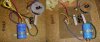
My measurements have yielded similar results. I fully agree regarding the wax block caps, but once again I'll state my exception to this statement, and I'm surprised it's not been mentioned here. We just discussed this the other day somewhere in this forum, and in particular with AR speakers, the Sprague Compulytic can-type caps are very often still measuring good and working fine. I have worked on several pairs of AR-6's and AR-7's using these blue cans, and in almost every instance I have let them stay in place with good results. The pair of AR-6's shown here is more recent than the OP's and a bit different - - - it uses the switch instead of pot control, but the blue cap is doing the same job as the wax block.

crossovers.jpg
 
My measurements have yielded similar results. I fully agree regarding the wax block caps, but once again I'll state my exception to this statement, and I'm surprised it's not been mentioned here. We just discussed this the other day somewhere in this forum, and in particular with AR speakers, the Sprague Compulytic can-type caps are very often still measuring good and working fine. I have worked on several pairs of AR-6's and AR-7's using these blue cans, and in almost every instance I have let them stay in place with good results. The pair of AR-6's shown here is more recent than the OP's and a bit different - - - it uses the switch instead of pot control, but the blue cap is doing the same job as the wax block.

View attachment 1701325
Agree with you Robert, but this thread is focused on wax block caps.
The Spragues, are very good, I left them alone in my LST-2's.
 
Hi Glenn, it's always good to be chirping in the same threads with you. Both Brian and yourself are light-years ahead of me in terms of speaker knowledge, and you'll see that my comments in post #4 from my experiences are in full agreement about these wax caps.

My initial response was simply meant to clarify two points:
1. Citing baco's lesson summary, I wanted to state an exception to the widespread wholesale re-cap frenzy, and point out that not all 50 year-old electrolytic capacitors experience the same aging degradation.
2. Not all original capacitors found in AR-6 crossovers require immediate, unquestioned cap replacement. The wax blocks were very common, and so were the Spragues, but these two cap brands retain very different performance characteristics after several decades of use.

Not trying to stir up rebellion here......am only trying to point out nuanced details.

To the OP - - - please follow up with remainder of AR-6 restoration.
 
Hi Glenn, it's always good to be chirping in the same threads with you. Both Brian and yourself are light-years ahead of me in terms of speaker knowledge, and you'll see that my comments in post #4 from my experiences are in full agreement about these wax caps.

My initial response was simply meant to clarify two points:
1. Citing baco's lesson summary, I wanted to state an exception to the widespread wholesale re-cap frenzy, and point out that not all 50 year-old electrolytic capacitors experience the same aging degradation.
2. Not all original capacitors found in AR-6 crossovers require immediate, unquestioned cap replacement. The wax blocks were very common, and so were the Spragues, but these two cap brands retain very different performance characteristics after several decades of use.

Not trying to stir up rebellion here......am only trying to point out nuanced details.

To the OP - - - please follow up with remainder of AR-6 restoration.
Hi Robert,
I'm in total agreement there. Generally it is a good idea to consider recapping 30+ year old speakers, especially with dead tweeters and possibly mids, regardless of brand. Also if fuses are present, to check they aren't blown first. I was just keeping the focus on the wax cap blocks, which should just be replaced outright on ARs with them. There is the rare occasion old caps are still within reasonable spec.
The wax cap replacement question comes up often, this example is very helpful to those new to vintage ARs.
Cheers, Glenn
 
Last edited:
There is the rare occasion old caps are still within reasonable spec.
The wax cap replacement question comes up often, this example is very helpful to those new to vintage ARs.
Thanks to you both for hearing me out, and Glenn, your two points are both excellent here in support of Brian's initial thread objective. 50 year-old 'lytic caps that still perform with confidence are indeed the rare exception, and I also agree that it is prudent to inform or remind others that these wax caps should really be replaced in almost all cases.
 
What's the deal with the yellow & white tweeters on the early models AR-11? Do they have ferrofluid that dries out like the later all-black tweeters? Is it possible to restore them or best to replace with a modern drop-in equivalent?
 
What's the deal with the yellow & white tweeters on the early models AR-11? Do they have ferrofluid that dries out like the later all-black tweeters? Is it possible to restore them or best to replace with a modern drop-in equivalent?

I believe they do have ferrofluid.

Christian Vorrius can restore them. I'll message you his contact info. (There's nothing in it for me.) Chris does great work. He's fixing 2 sets of 10pi tweeters for me now.
 
Thanks to you both for hearing me out, and Glenn, your two points are both excellent here in support of Brian's initial thread objective. 50 year-old 'lytic caps that still perform with confidence are indeed the rare exception, and I also agree that it is prudent to inform or remind others that these wax caps should really be replaced in almost all cases.

Almost all cases? In what situations would you advise leaving them in place?
 
Last edited:
Given their tendency to degrade with age, and their 40+ year age, I would have thought that replacement of this type of capacitor would always be recommended...as the OP suggested. Even if capacitance and ESR are still good at the moment.
 
Nostalgia.

:)

For the nostalgic, disconnect and leave in place. Take a photo and leave the photo on top of the speaker to demonstrate that it is still in there.

And, of course, install new caps into the crossover circuits.
 
Back
Top Bottom