• The move to the new server is done. There are some software and database maintenance updates in process. This has us passing the hat around to help out. We appreciate any donations. Seriously, even a dollar helps. The payment page may be found here - https://www.audiokarma.org/support.html

Ariston rd-40 board recap

xpycmuk

New Member
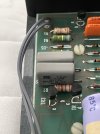
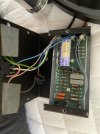
My old Ariston RD-40 (DC motor version) can’t keep the speed up to 33rpm. Maximum it can do 27 rpm on that switch. 45 seems to play fine (but it is another switch - potentiometer). Both potentiometers were changed a few years ago, so it is not a problem. I bought new belt, and it didn’t help. So it is either old caps in a mini board of the turntable or motor. I hope it is just a recap. A few photos are attached on how it looks inside. Original parts are not a available of course, so I tried to find the substitutes. Can you please have a look and let me know I am on right track? Thanks!

1. Smaller orange capacitors (250 MKT 0,033) - I found this substitute 0.033uF 33nF 250V Radial Film Capacitor MKT-HQ Philips. Here is he link
2. Grey color capacitors resistors (?) 0-1uf 63vdc - I found this one Radial Film Capacitor, 10uF, 40VAC, 63VDC, 10%, KEMET. Here is the link
3. Large capacitor 8430 (U) - could not find. A few looks a like but not the same. Any advice on this one?

Thank you.

Rustam
 

Attachments

  • IMG_0056.jpeg
    IMG_0056.jpeg
    109.5 KB · Views: 33
  • IMG_0062.jpeg
    IMG_0062.jpeg
    95.7 KB · Views: 33
Register to hide this ad
Value is printed on the opposite side.. Rotate the cap to read the µf value and voltage.. Search for a like axial cap.
It is tight. I will need to desolder it first. But otherwise two other components I picked up as substitutes are ok? Thank you!
 
DC motors need lube as much as AC motors.

Do you have the schematic? What is printed on the motor? It is probably a motor made in Japan.
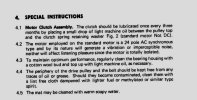
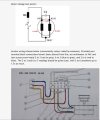
I was referring to manual, it has schematic as well. Will post it. Manual says lube once in a few month if it is AC motor (not DC). I agree that any motor might need oiling but it’s construction is a bit different from the one in manual for AC oiling.
 
That schematic is for the AC motor. Useless in your situation. The lubrification (ref paragraph 4.1) is for the clutch, not the motor itself. If you need to lubricate the clutch once every three months, imagine the motor after 30 or 40 years.......
 
That schematic is for the AC motor. Useless in your situation. The lubrification (ref paragraph 4.1) is for the clutch, not the motor itself. If you need to lubricate the clutch once every three months, imagine the motor after 30 or 40 years.......
Yeah, I know it was for AC. Manual is mum about DC.

Do you think oiling motor (one drop I assume but not sure where yet) may cure slow speed at 33rpm? Thanks
 
Yeah, I know it was for AC. Manual is mum about DC.

Do you think oiling motor (one drop I assume but not sure where yet) may cure slow speed at 33rpm? Thanks
I don't think so because you said 45 seems to play fine, but it certainly doesn't hurt to lube the motor (light oil, like sewing machine oil) after many decades.

Some DC servo motors have their speed controller built inside the motors, some others have their speed controller ouside of the motors. In the best DC servo motors there are coils and magnets inside the motors that generate a signal (pulses) that informs the speed controller about the actual motor speed. That controller then adjust the motor coil current to maintain proper speed. The Technics SL-20 and SL-23 are good examples of this kind of motor-controller set-up. I mention these models because I know (I made the schematic once I had one myself) that the Ariston RD11E was built with these Technics motors. Judging by the board you posted on post#1, I don't think you have this set-up.

In the cheapo DC-servo motors, the speed regulation is based on the back electromotive force (voltage) generated by the motor itself as it gain speed. An external regulated supply provides a voltage (different on 33 or 45) to the motor, that is dependent of the current drawn by the motor. These motors are more common on cassette decks that turntables. For good reasons, because these motors have poor speed regulation by comparaison the the first ones. Judging from your board, I think this is this kind of motor-contoller that you have.

If you can take good resolution pictures of your board, one from the top and one from the copper side, we could possibly make the schematic of this board and find a solution to your speed issue. Maybe by altering the value of a resistor in series with the speed trim pot.

About the capacitors, what I see are good quality capacitors (for the small ones) that usually never need to be replaced. The larger one is the main filter for the DC power supply. Replace that one (2200uF/25V) by a larger one (4700uF/25 or 35V). Axial capacitors are more difficult to find and usually more expensive than radial capacitors. Most of the time I replace them by radial capacitors that I fix on the board with hot glue.
 
When Ariston, or any other maker of the time, said something along the lines that the motor was lubricated for life and didn't need any oil, they were thinking of perhaps 10 years as the life span, not 50 years. I use a Micro Seiki BL61 whose motor started squeaking. A drop of oil cured the problem. I'd lubricate without a moment's hesitation.
 
Back
Top Bottom