• The move to the new server is done. There are some software and database maintenance updates in process. This has us passing the hat around to help out. We appreciate any donations. Seriously, even a dollar helps. The payment page may be found here - https://www.audiokarma.org/support.html

Ariston RD60 tune up...

melofelo

Addicted Member
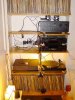
Spent today cleaning and tuning up one of my two main turntables after many months out of action.

It seems the Ariston RD60 and Ariston Enigma Arm ( made by Jelco) are still fairly obscure...so I thought I'd post a few pics..

The RD60 runs through a Nad PP1 with an AT95E into a Sansui AU-719 (recently refreshed to great effect by AK member Hyperion)

A Rega Planar 3 sits to the left for a slightly different presentation.

hope you like..

 

Attachments

  • Ariston RD60-01.jpg
    Ariston RD60-01.jpg
    72.9 KB · Views: 165
  • Ariston RD60 - 03.jpg
    Ariston RD60 - 03.jpg
    70.4 KB · Views: 161
  • Ariston RD60 - 05.jpg
    Ariston RD60 - 05.jpg
    66.6 KB · Views: 156
  • wire up.jpg
    wire up.jpg
    99.8 KB · Views: 147
Register to hide this ad
Cool, thanks for posting. I got an Ariston RD11S last month, and I've been really enjoying it. I'm using a Rega RB300 arm while waiting on my Audiomods kit to arrive. Great table.
 
Sounds like a very nice setup you have there :yes:.

I've always wanted to try the RB300 on an Ariston suspended, perhaps an rd40 or the later rd90s or perhaps an RD11s like yours.

Its always good to see a few Ariston fans on AK :D
Enjoy
 
Spent today cleaning and tuning up one of my two main turntables after many months out of action.

It seems the Ariston RD60 and Ariston Enigma Arm ( made by Jelco) are still fairly obscure...so I thought I'd post a few pics..

The RD60 runs through a Nad PP1 with an AT95E into a Sansui AU-719 (recently refreshed to great effect by AK member Hyperion)

A Rega Planar 3 sits to the left for a slightly different presentation.

hope you like..

Very, very nice!!!

I was watching an Ariston audio RD11(E) for a while.....:D
 
Very, very nice!!!

I was watching an Ariston audio RD11(E) for a while.....

ditto...:D an rd90s rd11s rd11e or rd40 would be a nice score...But Ive yet to bag one within a 150 mile driving radius...can't trust the post this side of the pond.:scratch2:
 
The one I was watching was in Mississauga, ON the Altantic side of Canada.

I am on the Pacific side of Canada. :sigh: :D
 
I'm sure one will come your way eventually ... :thmbsp: try ebay.co.uk if you don't mind the nail biting angst of international postage..they tend to surface from time to time, especially in Scotland although they are probably set up for uk voltage 240 @ 60hz
 
cheers dood..:thmbsp:
...just some cartridge alignment tinkering to complete and i'll give it a spin...
I somehow had the effective length set almost 3mm wrong without realising it...a quick trip to vinyl engine and a ruler will soon put that right methinks..:scratch2:
 
Almost ready...
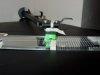
measured tonearm mounting distance..210mm give or take 0.5mm and a bit of squinting..
plugged that into vinyl engine's thingymagic... gives effective length of 228.2mm

(..ariston was hell bent on making the most compact 3 point suspended at the time it seems..:D..no wonder my effective length was out...as i hadn't tried the long way round method on this particular table before...but i'm glad i did now.)

I prefer baerwald..so out came the Ortofon baerwald protractor...
taped up the null point lines to the nearest half mm..
( the protractor's grid isn't as accurate as it looks according to my architectural scale rule..:sigh:)

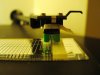
taped up the side and front of the cartridge
(one of the reasons i love the at 95e so much...its cheap..has a long exposed cantilever..and lots of right angles and straight edges to work with)..
found where the effective length is on the headshell using this ad hoc method...

shifted the cartridge to where it should be..(and hasn't been for longer than i realised)...
measured again...
effective length spot on 228 mm give or take a molecule and some tired eyes..

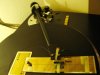
got inner null point spot on 1st go...
got outer null point spot on 3rd go...
got both spot on 6th attempt..(damn you have to 'feel' the cartridge rotation to get it right sometimes...eyesight alone wont work...)

tightened up... inner and outer still looking true...

a quick balance of the arm ..tracking force to my favorite 1.85gm setting..antiskate thereabouts...and i think i'm done fiddling for another year or so..:D
A few more pics ...
 

Attachments

  • tune-up-mounting distance.jpg
    tune-up-mounting distance.jpg
    75.3 KB · Views: 148
  • tune-up effective length.jpg
    tune-up effective length.jpg
    48 KB · Views: 120
  • tune-up-inner null.jpg
    tune-up-inner null.jpg
    61.7 KB · Views: 123
  • tune-up-outer null.jpg
    tune-up-outer null.jpg
    62.9 KB · Views: 111
  • tune-up-protractor.jpg
    tune-up-protractor.jpg
    66.9 KB · Views: 124
Last edited:
Sounds like a very nice setup you have there :yes:.

I've always wanted to try the RB300 on an Ariston suspended, perhaps an rd40 or the later rd90s or perhaps an RD11s like yours.

Its always good to see a few Ariston fans on AK :D
Enjoy

I've become a HUGE Ariston fan since getting my RD11S. As people say about the Linn LP12, it's the most musical table I've heard. The RB300 is very nice with it -- the guy that sold me the Ariston loaned it to me when I told him I was considering an Audiomods arm. He thought I should see how I liked the Rega with the Ariston before buying the Audiomods, which is based on the Rega. It was very nice, considering I found the Ariston on craigslist, and I had just met him. But he recognized another enthusiast I suppose. Plus I've offered to teach him how to use his oscilloscope and signal generator to troubleshoot amps.

The Ariston came with several armboards drilled for different arms, including the Rega geometry. I also have some ebony, rosewood and walnut that I could make into armboards. The ebony is heavy of course, but the density could be good for damping. I like how easy it is to change arms on the Ariston, and that was one of the reasons I was attracted to the RD11S. That and the price...now it's just the sound that has made it my main spinner.

I'm hoping the Audiomods will kick things up another level still. Of course I have to assemble it first, which saves $150.

Nice work on your deck BTW...
 
I've become a HUGE Ariston fan since getting my RD11S. As people say about the Linn LP12, it's the most musical table I've heard. The RB300 is very nice with it -- the guy that sold me the Ariston loaned it to me when I told him I was considering an Audiomods arm. He thought I should see how I liked the Rega with the Ariston before buying the Audiomods, which is based on the Rega. It was very nice, considering I found the Ariston on craigslist, and I had just met him. But he recognized another enthusiast I suppose. Plus I've offered to teach him how to use his oscilloscope and signal generator to troubleshoot amps.

The Ariston came with several armboards drilled for different arms, including the Rega geometry. I also have some ebony, rosewood and walnut that I could make into armboards. The ebony is heavy of course, but the density could be good for damping. I like how easy it is to change arms on the Ariston, and that was one of the reasons I was attracted to the RD11S. That and the price...now it's just the sound that has made it my main spinner.

I'm hoping the Audiomods will kick things up another level still. Of course I have to assemble it first, which saves $150.

Nice work on your deck BTW...

Just a quick note on tonewoods and how they'll affect overall tone. The harder, stiffer the wood the faster the sound (vibrations) will run through them. The denser hard woods will accentuate a brighter tone, the softer less dense woods will accentuate a warmer tone. Some woods just aren't tone woods. (oak hickory,ash etc.) The ebony you have will be the brightest sounding, the walnut, the warmer sounding. Although Walnut would be considered on the neutral side. Cedar, Spruce, Mahogany would be considered very warm sounding wood. A slightly warm to neutral wood would be lacewood. Stacking ebony or rosewood on top of walnut would produce a very neutral sound, and probably best at damping arm/arm bearing vibration.
Or, if you like you can send me a template of the armboard and I can cut you one from lacewood. MDF, or compressed material shuns vibration thus making it useless for a tonearm mount as the arm energy doesn't drain well into the subchassis.
 
I've become a HUGE Ariston fan since getting my RD11S. As people say about the Linn LP12, it's the most musical table I've heard.

they do sound very musical to my ears...even their budget Q-deck had a knack of sounding far better than its original price would suggest.:yes:
 
Just a quick note on tonewoods and how they'll affect overall tone. The harder, stiffer the wood the faster the sound (vibrations) will run through them. The denser hard woods will accentuate a brighter tone, the softer less dense woods will accentuate a warmer tone. Some woods just aren't tone woods. (oak hickory,ash etc.) The ebony you have will be the brightest sounding, the walnut, the warmer sounding. Although Walnut would be considered on the neutral side. Cedar, Spruce, Mahogany would be considered very warm sounding wood. A slightly warm to neutral wood would be lacewood. Stacking ebony or rosewood on top of walnut would produce a very neutral sound, and probably best at damping arm/arm bearing vibration.
Or, if you like you can send me a template of the armboard and I can cut you one from lacewood. MDF, or compressed material shuns vibration thus making it useless for a tonearm mount as the arm energy doesn't drain well into the subchassis.

I find your observations interesting and very apropos. Always believed that armboards were more a part of the sound than the table itself (in most cases) as well as how they are mounted to the subchassis. Which leads me to this question: How ridgidly should the armboard be mounted to the subchassis?
 
Cool pics! ..My Ariston Icon has the very same tonearm. ..Can you answer a question? Looking at my tonearm, the portion of the arm tube aft of the main bearing (the portion that the counter weight is on) appears to droop slightly (perhaps 1/8") when viewed from the side. ..Is this normal?
 
Which leads me to this question: How rigidly should the armboard be mounted to the subchassis

My guess is that the subchassis ,armboard & platter should probably act as a 'single' rigid unit for the suspension to effectively isolate the arm, cartridge and record from unwanted vibration,movement or resonances. :scratch2:
but its just a guess..
 
Can you answer a question? Looking at my tonearm, the portion of the arm tube aft of the main bearing (the portion that the counter weight is on) appears to droop slightly (perhaps 1/8") when viewed from the side. ..Is this normal?

I think you are referring to the rear tonearm stub which the counterweight screws onto ? :scratch2:

I think the stub is decoupled from the main tube and bearing assembly by some rubber type material which over the years will have sagged a bit with the heavy counterweight in place.

Mine has a very slight sag too after 24 years but its nothing to worry about and shouldn't affect the performance of the arm.

You could leave the counterweight off when the turntable is unused for a few weeks and see if the stub straightens out again ?
 
10-4 Thanks. ..I've enjoyed my Ariston for about the same amount of time. ..And it hasn't a scratch!

Thanks for the reply and good luck.
 
I find your observations interesting and very apropos. Always believed that armboards were more a part of the sound than the table itself (in most cases) as well as how they are mounted to the subchassis. Which leads me to this question: How ridgidly should the armboard be mounted to the subchassis?

As rigid, and with as much surface contact that is possible. It needs to be as solid as possible to allow the transfer of energy. Anything "loose" and energy reflects back. Rega went to a much larger arm base for energy transfer. Linn has a very massive arm base. And as another example, taking the rubber mounting washers out of a SME base tightens the sound as well. This was all well established when Edgar Villchur created the single subchassis along with ideas from Mitch Cotter in the lat 50's early 60's.
 
Cool pics! ..My Ariston Icon has the very same tonearm. ..Can you answer a question? Looking at my tonearm, the portion of the arm tube aft of the main bearing (the portion that the counter weight is on) appears to droop slightly (perhaps 1/8") when viewed from the side. ..Is this normal?

Not only normal but intentional. It helps keep the center of gravity more correct. This concept was first introduced on the AR XA arm. It runs 1.5 deg downhill. The further the counter weight from pivot, the more it will affect how the arm reacts to warp. That "sag" reduces those effects.
 
Back
Top Bottom