• The move to the new server is done. There are some software and database maintenance updates in process. This has us passing the hat around to help out. We appreciate any donations. Seriously, even a dollar helps. The payment page may be found here - https://www.audiokarma.org/support.html

Ariston RD60 tune up...

10-4 Thanks. ..I've enjoyed my Ariston for about the same amount of time. ..And it hasn't a scratch!

I think the Icon appeared somehwere between 1989 and 1991 if i remember correctly ?
I think it kept the Enigma arm and Belden wiring but changed the styling of the plinth and platter slightly.:scratch2:

It would be good to see a picture for comparison if you have one :thmbsp:
 
Not only normal but intentional. It helps keep the center of gravity more correct. This concept was first introduced on the AR XA arm. It runs 1.5 deg downhill. The further the counter weight from pivot, the more it will affect how the arm reacts to warp. That "sag" reduces those effects.

Ah! ..So it is intentional. ..The coupler does appear to have been molded this way as opposed to having sagged. ..Thanks to you and the OP for your replies.

A new purchase forces me to put my Ariston Icon up for sale. ..Look for it on audiogon in a few days, if interested.
 
As rigid, and with as much surface contact that is possible. It needs to be as solid as possible to allow the transfer of energy. Anything "loose" and energy reflects back. Rega went to a much larger arm base for energy transfer. Linn has a very massive arm base. And as another example, taking the rubber mounting washers out of a SME base tightens the sound as well. This was all well established when Edgar Villchur created the single subchassis along with ideas from Mitch Cotter in the lat 50's early 60's.

Interesting.... the armboard on my Heybrook TT2 has 2 threaded rods attached to the bottom but only one has a nut (and gasket) which, by the way, was just over finger tight. In addition it also has two wood screws that go through holes in the aluminum subchassis to the armboard but they're semi-stripped. Guess I should put a nut on the other rod. Any idea what thread size these rods are? TT was built in 84' (best guess).
 
I think the Icon appeared somehwere between 1989 and 1991 if i remember correctly ?
I think it kept the Enigma arm and Belden wiring but changed the styling of the plinth and platter slightly.:scratch2:

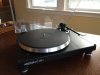
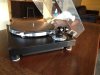
It would be good to see a picture for comparison if you have one :thmbsp:

here you go!
 

Attachments

  • photo.jpg
    photo.jpg
    51.6 KB · Views: 56
  • photo copy 2.jpg
    photo copy 2.jpg
    73.2 KB · Views: 58
Last edited:
My guess is that the subchassis ,armboard & platter should probably act as a 'single' rigid unit for the suspension to effectively isolate the arm, cartridge and record from unwanted vibration,movement or resonances. :scratch2:
but its just a guess


As rigid, and with as much surface contact that is possible. It needs to be as solid as possible to allow the transfer of energy. Anything "loose" and energy reflects back. Rega went to a much larger arm base for energy transfer. Linn has a very massive arm base. And as another example, taking the rubber mounting washers out of a SME base tightens the sound as well. This was all well established when Edgar Villchur created the single subchassis along with ideas from Mitch Cotter in the lat 50's early 60's

Found this posting by "Shane" in theheartofsound.net; appears Shane was at least a co-developer of the TT2 in the late 70's.

"The old-style armboard was fitted with two M4 studs, but only one was fitted with a nut. This introduced a degree of loss into the armoboard/chassis coupling and resulted in a single path between the two for vibrational energy. I was never quite convinced by the theory behind that, but it definitely sounded better. Fitting a second nut killed a lot of the life in the sound"

And that's why my TT 2 has only one nut and two studs.

 
My guess is that the subchassis ,armboard & platter should probably act as a 'single' rigid unit for the suspension to effectively isolate the arm, cartridge and record from unwanted vibration,movement or resonances. :scratch2:
but its just a guess


As rigid, and with as much surface contact that is possible. It needs to be as solid as possible to allow the transfer of energy. Anything "loose" and energy reflects back. Rega went to a much larger arm base for energy transfer. Linn has a very massive arm base. And as another example, taking the rubber mounting washers out of a SME base tightens the sound as well. This was all well established when Edgar Villchur created the single subchassis along with ideas from Mitch Cotter in the lat 50's early 60's

Found this posting by "Shane" in theheartofsound.net; appears Shane was at least a co-developer of the TT2 in the late 70's.

"The old-style armboard was fitted with two M4 studs, but only one was fitted with a nut. This introduced a degree of loss into the armoboard/chassis coupling and resulted in a single path between the two for vibrational energy. I was never quite convinced by the theory behind that, but it definitely sounded better. Fitting a second nut killed a lot of the life in the sound"

And that's why my TT 2 has only one nut and two studs.

I guess this makes sense if what was happening was a seperate energy loop between the two mounting studs. This looks like an area to studied to find out "what and why" was happening. What is the original armboard material?
The reason I ask is (for example) the original armboard on AR The turntable and ES-1 is a hard compressed material that insulates arm energy. The energy collects at the arm base and has no where to go except back into the arm. That presents a pretty muffled soundstage in my experience. I've heard aluminim armboards, and they'll just tear your eyebrows off. I'm guessing the aluminum is bouncing arm vibrations off the subchassis mount back into the arm.
 
Or, if you like you can send me a template of the armboard and I can cut you one from lacewood. MDF, or compressed material shuns vibration thus making it useless for a tonearm mount as the arm energy doesn't drain well into the subchassis.

Thanks for the info, and thanks for the offer -- I may take you up on that. I want to try that walnut/ebony/rosewood combo first though.
 
here you go!
thanks for posting the pics :thmbsp: It looks pretty similar indeed. Differences seem to be a chamfered slope to the edge of the platter and a more traditional box type construction for the plinth.

I think its safe to say that Ariston were constantly experimenting with their turntable designs right up until their withdrawal from the market.

If you compare the rd11, rd11e, rd11s, rd20, rd40 ,forte, forte II, rd50, rd60,rd80,rd90,rd90s,q deck... whew!...their R&D department were certainly kept busy..:D

Found this posting by "Shane" in theheartofsound.net; appears Shane was at least a co-developer of the TT2 in the late 70's.

"The old-style armboard was fitted with two M4 studs, but only one was fitted with a nut. This introduced a degree of loss into the armoboard/chassis coupling and resulted in a single path between the two for vibrational energy. I was never quite convinced by the theory behind that, but it definitely sounded better. Fitting a second nut killed a lot of the life in the sound"

And that's why my TT 2 has only one nut and two studs.
:thmbsp: interesting post ! :yes:
 
Last edited:
I guess this makes sense if what was happening was a seperate energy loop between the two mounting studs. This looks like an area to studied to find out "what and why" was happening. What is the original armboard material?The reason I ask is (for example) the original armboard on AR The turntable and ES-1 is a hard compressed material that insulates arm energy. The energy collects at the arm base and has no where to go except back into the arm. That presents a pretty muffled soundstage in my experience. I've heard aluminim armboards, and they'll just tear your eyebrows off. I'm guessing the aluminum is bouncing arm vibrations off the subchassis mount back into the arm.

I've seen it called 'laminated' or 'sandwiched plywood' but not MDF like the 1" plinth. Armboard is 3/4" thick.
 
Found this posting by "Shane" in theheartofsound.net; appears Shane was at least a co-developer of the TT2 in the late 70's.

That would be me....


Yes, there should only be one nut, and on the alloy chassis version a couple of small wood screws due to the much larger contact area between the chassis and armboard. The thing about energy loss was really an attempt to explain an observed phenomenon, ie that it sounded better with one nut than two! Note that the single nut (which was M4 size) should be done up as tight as is reasonable without stripping the thread. Over the years, the armboard material will have compressed slughtlu, hence the reason why it's now only a little more than finger tight.

The armboard was made from two layers of 9mm birch ply glued and stapled together. The studs were inserted through the bottom layer before glueing.
 
Last edited:
That would be me....


Yes, there should only be one nut, and on the alloy chassis version a couple of small wood screws due to the much larger contact area between the chassis and armboard. The thing about energy loss was really an attempt to explain an observed phenomenon, ie that it sounded better with one nut than two! Note that the single nut (which was M4 size) should be done up as tight as is reasonable without stripping the thread. Over the years, the armboard material will have compressed slughtlu, hence the reason why it's now only a little more than finger tight.

The armboard was made from two layers of 9mm birch ply glued and stapled together. The studs were inserted through the bottom layer before glueing.

Thanks Shane, I've enjoyed your TT for 15 years now (bought used); now that I've tightened up that nut it sounds even better. Serial # on mine is 2957. Maybe you built it?

Wife and I travel quite a bit but rarely to British Isles (too damn expensive), however if I'm ever in your neck of the woods (Plymouth?) I'll be more than happy to share a brewsky with you.... hell, I'll need 2 or 3 just to get my head around this transferring energy through one stud vs. two thing.
 
Back
Top Bottom