• The move to the new server is done. There are some software and database maintenance updates in process. This has us passing the hat around to help out. We appreciate any donations. Seriously, even a dollar helps. The payment page may be found here - https://www.audiokarma.org/support.html

ARXA damping question?

The thrust discs are nylon (delrin doesn't come in transparent or translucent). They can develop dents that increase the bearing contact area and raise the rumble level, and they can be disintegrated by applications of the wrong lubricants (never use WD40 as a bearing oil!). Over the years some of us have found that harder substances can reduce rumble further as well as future wear. One of my TTs has thrust discs made from surplus sapphire optical windows and is slightly quieter than the other that still has the originals, and a poster on VinylEngine has developed some metal replacements that have gotten good feedback.
 
Man, I'll full of questions and getting some great advice here.

I used a magnifying glass to inspect the thrust discs (left in the wells) and they appear to be flat with no indents so I'll leave them alone. How much oil should be used in the wells?

I don't see a set screw on the motor/belt pulley but there are slots on either side of the sleeve that goes on the shaft. Is it pressed on and if so how do I remove it without putting too much stress on the motor?
 
Last edited:
Thanks for the clarification. I don't think I've ever seen them refered to as anything other than Delrin.
 
The pulley may just pull off, if not use two spoons (one on each side) to pry the pulley off. Put a cloth or something under the spoons to prevent marring the paint.
 
Man, I'll full of questions and getting some great advice here.

I don't see a set screw on the motor/belt pulley but there are slots on either side of the sleeve that goes on the shaft. Is it pressed on and if so how do I remove it without putting too much stress on the motor?

I think it is great that you are diving in it. I did as well and found that almost everything I did offered an improvement of some sort, even if it was just in my head.:D
The pulley is just friction fitted. You should be able to just pull it up. Just be careful to not bend the motor shaft. If it is really tight there is a method that uses two spoons to pry it up. Mine removed fine, so I've never tried it.
 
The pulley may just pull off, if not use two spoons (one on each side) to pry the pulley off. Put a cloth or something under the spoons to prevent marring the paint.

That did the trick!

I see three holes in the top plate of the motor housing. Are those for oil and is sewing machine oil OK?
 
Haydon motor? It's been a while since I've seen the top of a motor. Usually just oil down the motor shaft.

Sewing machine oil is fine or any quality light weight machine oil.
 
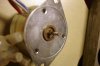
Here's the motor. The three holes are probably vents. There was a little black gunk around the shaft so I cleaned it and oiled there. Not sure if it penetrated but that seemed to only place to apply it.

I think I'm finished except for oiling the platter and arm wells. Not sure how much to put in but probably very little as it would be displaced by the shafts.

I'd like to paint the deck but that will have to be for another time.

Is there anything else that I should look at?
 

Attachments

  • XA motor 001.jpg
    XA motor 001.jpg
    47.5 KB · Views: 61
  • XA motor 002.jpg
    XA motor 002.jpg
    53.8 KB · Views: 59
I won't pretend to be an expert on the motors used in these, hopefully someone will chime in. Is that the Airpax motor? It looks like a Premotec from an old Linn.
 
I don't know what brand it is. The only markings are shown in the pic. It does run pretty quietly. A little vibration but no noise.
 
Last edited:
They're easy to make. I took some sheet plastic sign stock and cut it to size. Cut a V-notch in one end for the tonearm spindle (no more "aiming") and scribe the center line, the spindle line and a 15mm line. Drill out the platter spindle hole and place a piece of split hose over the spindle to raise the gauge up.

picture.php


In case I change my avatar, here's a pic of the gauge in use with a different table that also used a 15mm overhang.

picture.php


Now that, Gary, is a great idea! Hope you don't mind if I borrow that one. I like the modification to the Japanese style S arm on yours, too. Did you just drill out the aluminum block to do that? Sorry, maybe that should be another thread.

Here's the motor. The three holes are probably vents. There was a little black gunk around the shaft so I cleaned it and oiled there. Not sure if it penetrated but that seemed to only place to apply it.

I have the exact same motor in mine. I thought there was a cover missing on the bottom since I could see the tail end of the shaft, but maybe that's the way they are supposed to be. Mine must be from around the same time period because it has the same rough "speckled" finish on the metal part of the plinth, too.
 
To oil the shaft wells I added a few drops at a time, inserted then removed the shafts to see how far up the oil was. I did this until the oil was displaced to the entire shaft. Is this correct or should the oil be only in the bottom of the well?
 
Most single-motor ARs from the classic period used Haydon motors. Hurst and Hansen were alternate suppliers, and Hurst became the primary supplier for the later 80's models made in the US (Airpax motors in the UK-made models). They looked pretty much the same except for different mounting hole patterns.

The older dual-motor models used main motors from GE and starter motors from Synchron.
 
Last edited:
I want to thank everyone for the help. Where else but here on AK can one get such prompt and useful info. Especially in the turntable forum. I get a lot of help in the other forums too but you TT guys really step up! :thmbsp:

John
 
I want to thank everyone for the help. Where else but here on AK can one get such prompt and useful info. Especially in the turntable forum. I get a lot of help in the other forums too but you TT guys really step up! :thmbsp:

John

You'll find that after you run the motor bushing in with oil, if you then add a drop at a time of 100,000 cst silicone....that will float the oil and debris out of the motor bushing pocket. The silicone oil will run quieter than "motor" oil, and it won't evaporate over time. If the motor bushing is loose,(up/down play) it can be reset.
 
Back
Top Bottom