

You are using an out of date browser. It may not display this or other websites correctly.
You should upgrade or use an alternative browser.
You should upgrade or use an alternative browser.
AT-LP120XUSB
- Thread starter Trekkie4
- Start date


Trekkie4
Retired Member
Time to bump this topic one more time.
Recently I've been reading a lot of info on Audio Technica's integrated preamps, Low Pass filters (& its components), but it was mostly conflicting information. Some people say this, some say that, so it was impossible to separate the facts from fiction.
Instead, I had a long conversation with one of helpful AT product specialists, regarding this particular subject & he told me this:
We hear about this modification occasionally, as there are a few forums that are preoccupied with weighing up the benefits and detriments to removing the internal electronics on the AT-LP120USB. In this case, both sets of components quoted are included solely to protect the circuit and electronics in any connected device.
L606 & L607 are ferrite chips, which in this case are acting as inductors. This reduces EMI interference on the output and smooths any electrical spikes, should they occur, to avoid damaging the connected system (eg. your powered speakers). This is electrical smoothing for safety purposes, they are necessary and do not play any role tonally. Crucially, they do not act as resistors, and therefore do not combine with the capacitor to create a HPF.
C631 & C632 are capacitors required to decouple grounding, and they also play a role in AC smoothing before the signal is outputted. Again, AC smoothing is a purely electrical requirement that ensures that the signal is consistent and contains no transient spikes that could cause damage to any connected speaker or HiFi electronics.
In both the phono and line setting, I can confirm that there is no risk of noise entering as a result of the USB functionality. It is not possible.
Obviously, when in the preamp setting, there are tonal choices that are made to ensure it has a sound quality befitting Audio-Technica and the unit's price range. However, the components mentioned above are not part of that equation.
We cannot recommend that you remove them, both for the purposes of retaining warranty and for electrical safety reasons as stated above. On a personal note, in my experience I have never noticed the AT-LP120USB to have any specific tonal discrepancy - comparing it to other turntables, I haven't heard the frequency response to be vastly different.
A key thing to remember is that this turntable is excellent - for its price point. It is a great first turntable for a HiFi enthusiast to develop interest on. When we then start to move towards replacing components - tonearm, cartridge, external preamp - then we should look to upgrading the turntable too. In our own range, the AT-LP5 is a great platform for upgrade cartridges and using with preamps.

vwestlife
Super Member
The AT-LP120's built-in pre-amp sounds fine, if you use it. It is only when you turn if off and use an external pre-amp that the treble response is somewhat degraded. So if you're OK with how the built-in pre-amp sounds, keep it, and don't worry about it! But if you prefer to use an external pre-amp, it may be worth bypassing or removing the built-in one, and also to add a separate ground wire. If you're careful, the internal pre-amp can be easily reinstalled if you ever want to return the turntable to its original specification.
Nonetheless, Audio-Technica has claimed that the built-in pre-amp in the new AT-LP120X model has been improved, and some user reviews state that there is no audible degradation when you switch it off and use an external pre-amp. Or if you prefer not to have an internal pre-amp at all, there is the new AT-LP140XP model, which also has some of the other features that were removed from the AT-LP120X, such as the ballast weight, tonearm height adjustment, and reverse playback.
Nonetheless, Audio-Technica has claimed that the built-in pre-amp in the new AT-LP120X model has been improved, and some user reviews state that there is no audible degradation when you switch it off and use an external pre-amp. Or if you prefer not to have an internal pre-amp at all, there is the new AT-LP140XP model, which also has some of the other features that were removed from the AT-LP120X, such as the ballast weight, tonearm height adjustment, and reverse playback.
Trekkie4
Retired Member
Absolutely! But remember, this isn't about the preamp itself, we are talking about the Low Pass filter. Which (according to Audio Technica's product specialist) is not even part of the preamplifier, despite being on the same board. Which makes sense, because switching to "Phono" does not bypass the LP filter. But it removes everything else, the actual RIAA amp.The AT-LP120's built-in pre-amp sounds fine, if you use it. It is only when you turn if off and use an external pre-amp that the treble response is somewhat degraded. So if you're OK with how the built-in pre-amp sounds, keep it, and don't worry about it! But if you prefer to use an external pre-amp, it may be worth bypassing or removing the built-in one, and also to add a separate ground wire. If you're careful, the internal pre-amp can be easily reinstalled if you ever want to return the turntable to its original specification.
Nonetheless, Audio-Technica has claimed that the built-in pre-amp in the new AT-LP120X model has been improved, and some user reviews state that there is no audible degradation when you switch it off and use an external pre-amp. Or if you prefer not to have an internal pre-amp at all, there is the new AT-LP140XP model, which also has some of the other features that were removed from the AT-LP120X, such as the ballast weight, tonearm height adjustment, and reverse playback.
I'm not sure what exactly is "better" on a LP120X, but again - according to Audio Technica, ALL their models (featuring USB jack) have a Low Pass filter built into them. LP5, LP1240, LP60 USB, LP120, etc. The only exceptions are going to be PL120 (since it doesn't have USB feature, but it was discontinued years ago) and LP140XP, because it doesn't have a preamp or USB at all. Which makes it a good unit IMHO (especially with dampened platter, and all the features previously seen on LP120 USB), but it is too expensive for a clone. For that kind of money you might as well buy Technics SL1210, 1200. Which is not the case for "old" LP120 USB, I bought mine for around $300 which is decent price IMHO.
AT claims "Lower torque motor for better HiFi audio performance o Improved preamp frequency response." In their blog, AT also wrote, "The AT-LP120XUSB is using a motor with slightly less torque. This was done to lower the noise floor and to increase audio performance." Though there is nothing in their specifications to indicate an improvement or difference of any kind, the review at Discogs Blog said, "The phono stage is definitely better," and "it is a notably improved turntable and even $50 cheaper than its dear departed brother.". . . I'm not sure what exactly is "better" on a LP120X, but again - according to Audio Technica, ALL their models (featuring USB jack) have a Low Pass filter built into them. LP5, LP1240, LP60 USB, LP120, etc. The only exceptions are going to be PL120 (since it doesn't have USB feature, but it was discontinued years ago) and LP140XP, because it doesn't have a preamp or USB at all. Which makes it a good unit IMHO (especially with dampened platter, and all the features previously seen on LP120 USB), but it is too expensive for a clone. For that kind of money you might as well buy Technics SL1210, 1200. Which is not the case for "old" LP120 USB, I bought mine for around $300 which is decent price IMHO.
As to the LP140XP being "too expensive for a clone," the current SL1200MK7 is $999.99 while the SL1210GR is $1699.99. The LP140XP lists for just $399. For people wanting a new turntable with warranty, that's a pretty big price difference. If the lower torque motor of the $249 LP120XUSB really does offer "better HIFI audio performance," then it might be the best deal for non-DJ users. It's a shame that no dealer in my area that is equipped to offer good audio demonstrations sells the AT line.
Trekkie4
Retired Member
Of course, Panasonic will always be the most expensive choice... I was referring to used units, there's quite few of them on sale as we speak, in great condition for around $500, $600. Even locally, the market seems to be flooded with used SL1200s. But unlike used LP120s, most of them never gets sold.AT claims "Lower torque motor for better HiFi audio performance o Improved preamp frequency response." In their blog, AT also wrote, "The AT-LP120XUSB is using a motor with slightly less torque. This was done to lower the noise floor and to increase audio performance." Though there is nothing in their specifications to indicate an improvement or difference of any kind, the review at Discogs Blog said, "The phono stage is definitely better," and "it is a notably improved turntable and even $50 cheaper than its dear departed brother."
As to the LP140XP being "too expensive for a clone," the current SL1200MK7 is $999.99 while the SL1210GR is $1699.99. The LP140XP lists for just $399. For people wanting a new turntable with warranty, that's a pretty big price difference. If the lower torque motor of the $249 LP120XUSB really does offer "better HIFI audio performance," then it might be the best deal for non-DJ users. It's a shame that no dealer in my area that is equipped to offer good audio demonstrations sells the AT line.
I have a, perhaps irrational, fear of used turntables. This stems from my decades-long love of the Linn LP12. Superb craftsmanship, yet a somewhat delicate design in that transporting the turntable even once without shimming up the subplatter (so that the spindle does not rest against the thrust plate) can irrevocably damage the main bearing such that it needs replacement to ever again give its optimum performance. Same with the Linn tone arms--change a cartridge without first removing the tone arm from the plinth, and you can ruin the tone arm bearings. I simply don't trust that past owners of a turntable have take the proper precautions against inadvertent, yet performance-robbing, damage. With a new turntable, I'm more confident of getting all that its design and manufacturing tolerances have to offer, even it if is theoretically lower than a supposedly pristine used model. An added bonus is that I'm getting its full operating life, not one cut short by who knows how many hours of wear that are already on the used one.Of course, Panasonic will always be the most expensive choice... I was referring to used units . . .
Trekkie4
Retired Member
Exactly, and this is why used SL-1200 doesn't sell. Those who would want SL1200 but can't afford to cash out that sort of money for new units usually can't afford used ones, either. On the other hand, those who /do/ will rather skip 2nd hand market and maybe spend those extra $200, $300 for a brand new unit that's backed up with warranty.I have a, perhaps irrational, fear of used turntables. This stems from my decades-long love of the Linn LP12. Superb craftsmanship, yet a somewhat delicate design in that transporting the turntable even once without shimming up the subplatter (so that the spindle does not rest against the thrust plate) can irrevocably damage the main bearing such that it needs replacement to ever again give its optimum performance. Same with the Linn tone arms--change a cartridge without first removing the tone arm from the plinth, and you can ruin the tone arm bearings. I simply don't trust that past owners of a turntable have take the proper precautions against inadvertent, yet performance-robbing, damage. With a new turntable, I'm more confident of getting all that its design and manufacturing tolerances have to offer, even it if is theoretically lower than a supposedly pristine used model. An added bonus is that I'm getting its full operating life, not one cut short by who knows how many hours of wear that are already on the used one.
Don't know what's the situation like over in the States, but around here there are (as of this moment) 4 local ads for SL-1210 & 1 for SL-1200. Of which some are only available in pair but all described to be in fully working condition, with their appropriate dust covers. Most of these ads, listings (whatever you want to call them) are being renewed every month, for eternity. LP120 on the other hand is a whole other story, there was several units offered ranging from "slightly used" to brand new, still inside the box for around $240. All of which got sold without exceptions.
KentTeffeteller
Gimpus Stereophilus!
Until the imitators get the precision and the quality down, and use better parts, they're what they are. Cheaper for a reason. The new AT-LP 120XUSB would be for me, worn out in too short a time. Like 3-4 years babied. From sheer use, not abuse. You get what you pay for. A turntable which takes many years of my constant, daily, high hours use, will last most home users their lifetime or nearly so. If cared for.
I'll take a $500-$600 Japanese rebuilt SL-1200 Mk II over any of the wannabees. Those machines are like new in every way, and work and look and act like new. You can spill beer and liquor on one of the real thing, they can take punishment, and be rebuilt to like new, multiple times if they need to be. And go back to work like new ones. Let's see one of these AT or Pioneers do this, even better do this 3 times. I have a SL-1200 Mk II, it's been rebuilt 3 times from being given up for dead. It's living a life of ease at work in a production room in an FM studio after surviving two rounds of abusive bar and nightclub abuse. And working like a new one.
For me, the Japanese rebuilt real thing will likely give me 10-12 years of major heavy use before major overhaul.
Last edited:
The long conversation and helpful information you received from Audio Technica matched my experience with them in seeking a few details about the LP120XUSB. They were fast, friendly, and knowledgeable, and I decided to go ahead and pick one up. The only change I made from stock is putting a VMN95C stylus on rather than use the elliptical it came with. I'm still waiting for the 78 rpm stylus (78 rpm capability being my main reason for wanting a second turntable), but I'm liking how this inexpensive turntable operates and sounds with LP's.Time to bump this topic one more time.
Recently I've been reading a lot of info on Audio Technica's integrated preamps, Low Pass filters (& its components), but it was mostly conflicting information. Some people say this, some say that, so it was impossible to separate the facts from fiction.
Instead, I had a long conversation with one of helpful AT product specialists, regarding this particular subject & he told me this:
Trekkie4
Retired Member
VMN95C is the "new" AT-95, but with conical (blue) stylus, if I'm not mistaking? And yes, I would have to agree on conicals sounding better in some cases... I swapped my AT-95E for Shure(s) M91 & 75, of which 91 is conical & sounds great on dusty & worn LPs, where on the other hand elliptical M75 ED T2 sounds so much better with preserved & clean albums.The long conversation and helpful information you received from Audio Technica matched my experience with them in seeking a few details about the LP120XUSB. They were fast, friendly, and knowledgeable, and I decided to go ahead and pick one up. The only change I made from stock is putting a VMN95C stylus on rather than use the elliptical it came with. I'm still waiting for the 78 rpm stylus (78 rpm capability being my main reason for wanting a second turntable), but I'm liking how this inexpensive turntable operates and sounds with LP's.
Yes, the blue stylus is the cheap, bonded conical in the line. Early reviews of the new VM95 line indicated that it shared the tonal characteristics of its forebear, the AT95E, which I found to be unpleasantly thin/bright in my system, so I wasn't too enthused about them. However, I had liked the Linn Basik cartridge, which was basically an AT95E with a conical stylus (my brother ended up using one of my Linn Basiks with an ATN95E stylus, but he really likes bright-sounding cartridges).VMN95C is the "new" AT-95, but with conical (blue) stylus, if I'm not mistaking? And yes, I would have to agree on conicals sounding better in some cases...
A review by Ed Selley in February had this interesting observation, "All conical stylus designs I have ever listened to have a very definite character to their performance. Much of the attributes of ‘vinyl warmth’ and the emphasis on the midrange can trace their origin to the use of this stylus profile." https://www.avforums.com/review/audio-technica-vm95-cartridges-review.15687
I don't know how much truth there is in that, but it could explain my dislike of the AT95E and acceptance of the Basik and AT-VM95C. I also just didn't feel comfortable from a record wear standpoint using a .3 X .7 mil elliptical at 2 grams. I'm much happier with the .6 mil conical, and am getting great tracking at its maximum vtf of 2.2 grams. Engaging sound from an inexpensive turntable and $21 replacement styli make me a very satisfied LP120XUSB owner.
Trekkie4
Retired Member
Agreed, and I keep saying the same thing myself - over and over. AT-95E is way too bright for my taste, I honestly don't see or understand all the hype for 95E & people recommending it as best-buy model.Yes, the blue stylus is the cheap, bonded conical in the line. Early reviews of the new VM95 line indicated that it shared the tonal characteristics of its forebear, the AT95E, which I found to be unpleasantly thin/bright in my system, so I wasn't too enthused about them. However, I had liked the Linn Basik cartridge, which was basically an AT95E with a conical stylus (my brother ended up using one of my Linn Basiks with an ATN95E stylus, but he really likes bright-sounding cartridges).
A review by Ed Selley in February had this interesting observation, "All conical stylus designs I have ever listened to have a very definite character to their performance. Much of the attributes of ‘vinyl warmth’ and the emphasis on the midrange can trace their origin to the use of this stylus profile." https://www.avforums.com/review/audio-technica-vm95-cartridges-review.15687
I don't know how much truth there is in that, but it could explain my dislike of the AT95E and acceptance of the Basik and AT-VM95C. I also just didn't feel comfortable from a record wear standpoint using a .3 X .7 mil elliptical at 2 grams. I'm much happier with the .6 mil conical, and am getting great tracking at its maximum vtf of 2.2 grams. Engaging sound from an inexpensive turntable and $21 replacement styli make me a very satisfied LP120XUSB owner.
Just to clarify things, I'm not saying it is bad, I suppose it would make a great choice for digitizing LPs because it gives that bright & clean "digital"-like sound. Perfect choice to convert your albums or songs into MP3s, but not for a regular every-day usage. I expect my turntable to sound warm & have that analog, old-school sound to it. I also want it to have a full (audible) channel separation. Which I'm afraid 95E doesn't have, no matter how you align the damn thing (and believe me, I've tried several times).
As I already mentioned in my previous post, I ended up using M91 ED on a regular basis, that's fitted with cheap conical aftermarket N91G stylus (around $15). Every once in a while, I swap M91 for elliptical M75 ED, (sometimes Shure M94 with N99E), but always end up going back to M91. As far as I'm concerned, it doesn't get any better than that


vwestlife
Super Member
Here is the frequency response graph for the AT95E that is posted on Audio-Technica's web site:AT-95E is way too bright for my taste, I honestly don't see or understand all the hype for 95E & people recommending it as best-buy model.
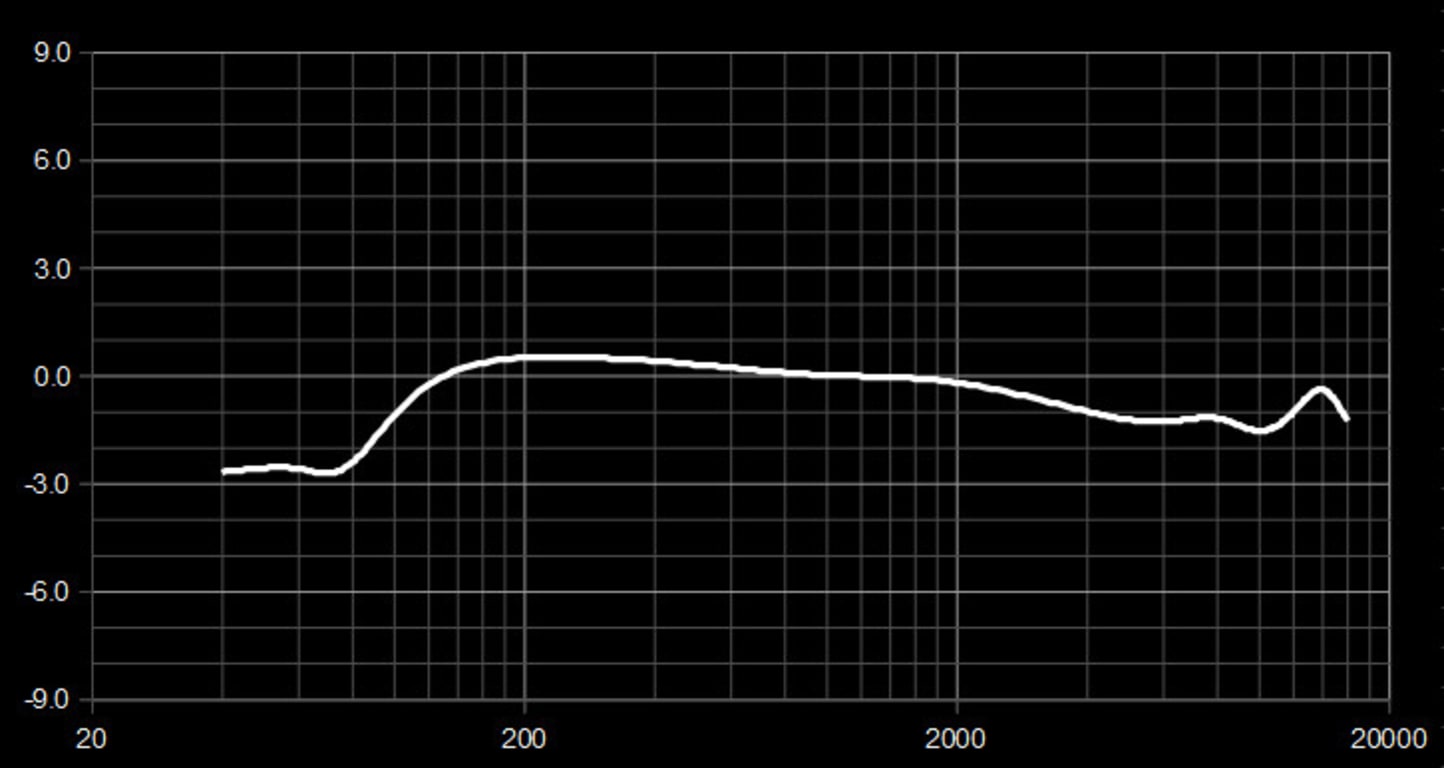
That bump centered around 14 kHz is what you are perceiving as it being bright-sounding, even though its treble response isn't actually boosted in that range -- it's just less attenuated.
That's one frequency response curve, anyway. I've seen others that look rather different. One that I came across this morning at the link below shows the standard response of the AT95E to be about .8 dB down below 1 kHz, flat between 1 and 5 kHz, then rising a couple dB between 5 and 10 kHz, and falling off after that. That's more in keeping with what I've heard in my own system from the AT95E, to my ears a rather thin, overly bright presentation. You'll note that the article seems to have used 300 pF capacitance, which is higher than AT wants but is close to what I had available to me with my turntable and phono stage at the time (IIRC, I had 270 pF total with my Linn 'table and AVA preamp).Here is the frequency response graph for the AT95E that is posted on Audio-Technica's web site . . .
My gold standard for pleasant listening, the M97xE, wasn't exactly flat either, but it went the other way, being elevated about 2 dB below 500 Hz, flat between 500 Hz and 2 kHz, sliding down about 3 dB between 2 kHz and 6 kHz, then remaining fairly flat out to about 16 kHz. Its recommended capacitance of 200-300 pF is also a range I've found much more common with the gear I've owned over the years. I've used up my last N97xE stylus, and, for the time being, I'll be using cheap AT's (the VM95C on my LP120X and an AT91R on my Rega RP3). Not as pleasant tonally as the Shure, but still engaging to listen to and avoids being irritating.
Last edited:
cloudy_cloud
New Member
Trying to decide between getting a Nagaoka MP-110 or upgrading the stylus on the stock AT-VM95E cartridge to a AT-VMN95EN Stylus (nude diamond stylus). The MP-110 is $120 and the VMN95EN Stylus is $99.
Any advice - or other suggestions?
Any advice - or other suggestions?
Trekkie4
Retired Member
Funny thing happened earlier today... I was browsing the HiFi store, which among other things & turntables offers "LP120X", and something caught my attention.
See if you can spot a difference between this unit here:

And this one, here:

In case you can't tell the obvious, these two models are using different tonearms ... or at least the back end shaft, with the counterweight. If I'd have to guess, I'd say the first pic (using the old counterweight, from LP120USB) was taken during development, when LP120X still wasn't quite finished. Or maybe they even released the earlier versions with the old cw, I don't know *shrug* One way or another, I find it interesting...
See if you can spot a difference between this unit here:
And this one, here:
In case you can't tell the obvious, these two models are using different tonearms ... or at least the back end shaft, with the counterweight. If I'd have to guess, I'd say the first pic (using the old counterweight, from LP120USB) was taken during development, when LP120X still wasn't quite finished. Or maybe they even released the earlier versions with the old cw, I don't know *shrug* One way or another, I find it interesting...
Just thought i’d chime in here with my experience with my own AT-LP120X and bypassing the preamp.
A friend gifted me his old Air-Tight PC-1 cartridge and although putting such an expensive cart on this plastic TT, it’s all i have right now.. with no VTA or Azimuth adjustments i was hoping the cart (which had hundreds of hours on it, 3 different owners etc) was not need too much extreme tweaking to set up. The stock headshell wasnt long enough to get the proper overhang so had to grab a longer headshell. Once dialed in with a Fozgometer and test LP blah blah i was left.. pretty underwhelmed. I tired to tame my expectations but the table is decently stable, but the sound was just veiled and no experimentation with loading or EQ tweaking on the preamp seemed to give me any low level resolution. Records i’ve known the sound of for decades just sounded off. So i took the plunge and removed the bottom to see how hard it would be to just bypass the internal board altogether.. thing is, the tonearm wires arent long enough to make it to the stock RCA solder points.. i ended up just drilling x2 1/4 holes and installing some nice RCA’s , soldering the tonearm wired directly to the rca’s (left the small black ground wire from tonearm soldered to the board. It was an absolute game changer. All is good now. Even though AT is claiming the line/phono bypass is cleaner, there are still a pair of ferrite bead units in the signal path in Line out mode. Bypassing any and all switches and board traces opened the table up greatly. If you are liking this table but just find it lacking.. try the mod. I can post pix if anyone cares..
A friend gifted me his old Air-Tight PC-1 cartridge and although putting such an expensive cart on this plastic TT, it’s all i have right now.. with no VTA or Azimuth adjustments i was hoping the cart (which had hundreds of hours on it, 3 different owners etc) was not need too much extreme tweaking to set up. The stock headshell wasnt long enough to get the proper overhang so had to grab a longer headshell. Once dialed in with a Fozgometer and test LP blah blah i was left.. pretty underwhelmed. I tired to tame my expectations but the table is decently stable, but the sound was just veiled and no experimentation with loading or EQ tweaking on the preamp seemed to give me any low level resolution. Records i’ve known the sound of for decades just sounded off. So i took the plunge and removed the bottom to see how hard it would be to just bypass the internal board altogether.. thing is, the tonearm wires arent long enough to make it to the stock RCA solder points.. i ended up just drilling x2 1/4 holes and installing some nice RCA’s , soldering the tonearm wired directly to the rca’s (left the small black ground wire from tonearm soldered to the board. It was an absolute game changer. All is good now. Even though AT is claiming the line/phono bypass is cleaner, there are still a pair of ferrite bead units in the signal path in Line out mode. Bypassing any and all switches and board traces opened the table up greatly. If you are liking this table but just find it lacking.. try the mod. I can post pix if anyone cares..