• The move to the new server is done. There are some software and database maintenance updates in process. This has us passing the hat around to help out. We appreciate any donations. Seriously, even a dollar helps. The payment page may be found here - https://www.audiokarma.org/support.html

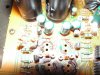
AU-717 Deadly Glue

The PC board isn't made of plastic, and is totally unaffected by any amount of acetone (and there are a considerable number of plastic types that are completely unaffected by acetone). Alcohol won't touch that glue...would work about as well as water. As far as scraping the glue off, I don't much care if you feel like it's a good idea. In lieu of board replacement, it's 100% necessary to clean up the mess.

If you've found what you feel is a better way to get things done, knock yourself out. ;) I've been cleaning PC boards this way for 25+ years without an issue.
 
Acetone causes plastics to loose it's plasticisers - it basically 'sucks' the plasticity out of the material leaving it rougher and more sustainable to breakage and cracks. You do not want that!!! If you have to use any solvent at all (I'm not sure scraping the glue off is a good idea to begin with) - Use Isopropyl alcohol which is a more suitable solvent. It's available as 'rubbing alcohol' in pharmacies (God knows what they rub with it) and you'll need a solution that is at least 90% pure. My pharmacy ripped me off with this - but I think in the US you can get it by the gallons for $15. If you use any thinner solution, you'll be able to see white residue, that may be electrically conductive, on the board.

Oh my goodness... stick around and read a little, start with the posts (and links) in this thread.
 
I really appreciate the work that's been put into this thread, and for the fella that created this website: http://www.cdkands.com/AU717-1.html

I used lacquer thinner and Q-Tips to saturate the areas of the board where the glue resided, repeating application several times. I then used bamboo skewers used for kabobs/satay to scrape most of it off, also a stiff plastic bristle brush. The skewers were awesome because using dikes I was able to cut the tip into whatever shape I needed to get to all the nooks and crannies. The stiff bristle brush came in handy once I had the caps off the board.

Thanks,

JP
 
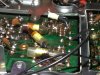
Harmon Kardon used this glue in the HK825 preamp too. I've spent some time removing it and replacing damaged components.

Here's some pics.

attachment.php
 

Attachments

  • PICT5598.jpg
    PICT5598.jpg
    104.9 KB · Views: 195
I was told to use a hair dryer to heat it ..scraping or acetone will remove printing on the boards..havent tried it yet
 
After removing the components in the affected area, use a small flat bladed screwdriver. The glue will either flake off or peel off. If the glue covered components I would suggest relacing them.
 
avoid touching components
use a q-tip to gently dab it directly on the glue then very carefully use something plastic like a old credit card shaped like a plastic chisel and break it loose..(if 99% alcohol won't do it)
 
How about glue on the other side?View attachment 1687672
Acetone as well?
That's going to be "fun". :p I wouldn't use acetone, but would try 99% alcohol. Failing that Toluene (or xylene). There will still be some scraping to do. If the green gets scratched off to bare copper anywhere, put a sealing coat over it. I use MG Chemicals 4226 Super Corona Dope.
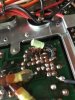
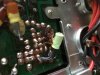
 
Was able to bend the farthest one capacitor up in the pic, this glue is not fully brittle yet, still rubbery at certain spot. I was able to work around it at this spot. Still need to find out the exact way to get rid of it in other spots of this board, they are just “massive”.F4191792-1AEC-4433-A29F-5CD98F0D3187.jpeg773B16DD-9B46-4A42-9EE5-4CCB410CCBAB.jpeg
 
Was able to bend the farthest one capacitor up in the pic, this glue is not fully brittle yet, still rubbery at certain spot. I was able to work around it at this spot. Still need to find out the exact way to get rid of it in other spots of this board, they are just “massive”.View attachment 1687862View attachment 1687863
Take a Popsicle stick (or other small wooden "thing") and grind it down into a small "chisel". It will do less harm when scraping the hardened crusty glue. If you have no sandpaper, file, or grinder, you can use smooth concrete, or a rock as your "grindstone" to shape the stick.
 
Take a Popsicle stick (or other small wooden "thing") and grind it down into a small "chisel". It will do less harm when scraping the hardened crusty glue. If you have no sandpaper, file, or grinder, you can use smooth concrete, or a rock as your "grindstone" to shape the stick.

Yes. Wood scrapers used with acetone have never harmed the silk sreening on the boards that I have used them on.

Living in Japan as I do, disposable chopsticks are easy to get and are perfect for the job of scraping away Sansui’s evil glue. (After treatment with acetone that is.)

Chopsticks provide pinpoint accuracy, a heck of a lot of leverage, and so far have proven to be silk screen safe.

The next time I face the crusty menace though I think I will very cautiously try an SMD air soldering tool on the glue instead.
That acetone stuff smells awful.

Happy scraping!
giphy.gif
 
Last edited:
a blow dryer will heat it up & soften that crudd and won't burn the board..avoid breathing the acetone fumes..& don't light a cigarette if you inhaled it..or it can burn your lungs.Id wear a mask for protection..some crazies like to sniff it..
Yeah, it doesn't taste too good either. :D
..try getting it in your eye
 
I used to clear enough of the glue off just to install fresh parts...clean around the through holes.
anymore, I try to remove all or almost all of the glue. I use IPA,a que tip, and a wood dowel sharpened to a blunt chiseled edge. soak the glue with dabs from the queue tip let it set for a min or two then use the wood stick to gently push it free of the board.

If you use metal tips or a screw driver you will eventually scratch the board.... but once you have the glue removed, it is sure much nicer looking and won't cause any corrosion issues in the future.

Back in the day, some assembly operators applied the glue sparingly, while others at the factory seemed to heap it on with a shovel....the latter requires more time to remove..
 

Too weak. I’ve tried 99% pure ethanol too. No effect.

I have some very glue polluted boards from a knackered 907.
Since acetone certainly works I will try, as an experiment, alcohol in one spot and hot air in another.

Which less toxic than acetone method will prevail?

I shall post results tomorrow. (Probably)
 
I like the way this thread keeps rising from the ashes....err...adhesives?

In the environments I worked in, there was always the danger of conductive paths being created by not only the adhesives, but even the leftover rosin, when you have the right combinations of heat, dust/particulates, and humidity. I have a lot of cleaning to do on the amp I am working on, so I look forward to finding out the most effective, "liver friendly" solution. Great discussion and lots of valuable suggestions.
 
Back
Top Bottom