• Please note that Audiokarma will be offline briefly for updates early on Monday morning, September 28th.

AU-777A fix-up

Aside from a clean up, all I've done so far is rebuild and beef up the power supply and check voltages and currents. I haven't touched anything else.

So this morning I hooked up some speakers and played some flacs for half an hour before work. All I can say is Holy Moly, this thing sounds like a million bucks! Big, open, 3D soundstage, individual instruments well-defined, slightly warmish, and plenty of slightly liquid, but not flabby or boomy, bass. I wasn't expecting this.

So I think I may be at the first critical decision point in my still newbie audio career: Do I recap or just stick with the 45 year old grey Elnas?

I'm going to listen to it for a week or two and try to compare it to my AU-555A and my direct coupled Kenwood.

I'm amazed.

I'd recommend recapping the old Elna's as well, but totally gets your point - when an amp sounds this good, why mess with it. However, you will gain a little more focus and detail, while not as dramatic as the power supply upgrade, then of course there is the reliability aspect of it. Replacing the 16 458's signal trannies will also push it another step up the audiophile ladder.

Because this model rarely comes up for sale, it doesn't really have a reputation and thus flies under the radar, besides, its just "an old cap coupled 30 Watt amp with 60'ties topology.

I think it is a masterpiece of an amp, and I will sell everything else before this one.
 
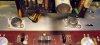
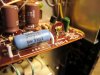
The mica insulators on TR805 and TR806 were shot. New TO-66 insulators made by Keystone were way too narrow at the "hip" for comfort, and the pin spacing was slightly off. So I homebrewed some custom sil pads. Sorry for the tungsten lighting.

EDIT: Color corrected photo
 

Attachments

  • 004 Sil Pads.jpg
    004 Sil Pads.jpg
    57.1 KB · Views: 206
Last edited:
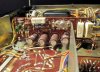
Power supply is done. More 105 C Chemicons. Also, new carbon films for the small resistors, new diodes and rectifiers. Overkill maybe, but they are 45 years old.

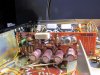
The two hot-running 220 ohm / 5W cement resistors (R005, R006), which were a scant 20mm from the bottom of one of the big output capacitors (C820, note the heat discoloration on the pix), have been exiled to a terminal strip on the power transformer chassis. There just happened to be an unused, threaded hole. Props to Conrad H. for this idea.

FWIW, the 45 year old 220 ohm resistors measured 223.5 and 224.3 when pulled. The brand new ones measured 216.5 and 215.9. They are dissipating roughly 3.3 watts.
 

Attachments

  • 005 Heat.jpg
    005 Heat.jpg
    75.6 KB · Views: 103
  • 006 New PSU Before Resistors Moved.jpg
    006 New PSU Before Resistors Moved.jpg
    85.9 KB · Views: 108
  • 007 New PSU After Resistors Moved.jpg
    007 New PSU After Resistors Moved.jpg
    147.5 KB · Views: 107
  • 009 Moved PS Board Resistors.jpg
    009 Moved PS Board Resistors.jpg
    68.1 KB · Views: 98
Last edited:
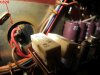
Triac is in. Props to K7sparky for this simple, switch saving mod. I couldn't find an easy mounting spot near the power switch, so I put it underneath the power transformer near the AC cord entrance.The sil pad underneath it is solely for added protection against the leads shorting to ground.

With the new 10K uf filter cap, inrush current through the irreplaceable switch peaks at 3.6 amps, then settles back to 0.8 amps. With the triac taking the hit, power-on current through the switch is a puny 140 ma and no arcing. Damn!

I carelessly ordered the triac in the wrong package. The proper component is Littelfuse Q4040J7TP, with the TO-218x package. Isolated case with the convenient little solder eyelets on the leads. Instead, I ordered a Q4040K7TP, which is a TO-218AC package. Isolated case, but no eyelets. A little trickier to solder.

Next up is replacement of all those 2SC458’s and a recap, but first I want to listen to it for a week or so to get an idea of the “original” sound. The plan is Nichicon Gold Tunes for the big coupling caps, with Nichicon Fine Golds and WIMA or Panasonic films in the signal path. General purpose Nichicons (PW or HE), Chemicons (lots of 105 C, low-z choices), or Panasonics (FC or FM) everywhere else, selected for pin spacing equal or as close as possible to the original caps.

EDIT: I'm getting some non-volume-dependent hash through the speakers with the triac installed. Moving it 18 inches away from the unit with some jumpers makes no difference. Taking the triac out of the circuit eliminates the hash. I haven't noticed any hash on the two amps and the receiver I've installed triacs on. Gotta give this some thought. Maybe I'll try the r-c snubber across MT1 and MT2, which I have never bothered with.
 

Attachments

  • 010 Triac.jpg
    010 Triac.jpg
    98.7 KB · Views: 89
Last edited:
The mica insulators on TR805 and TR806 were shot. New TO-66 insulators made by Keystone were way too narrow at the "hip" for comfort, and the pin spacing was slightly off. So I homebrewed some custom sil pads. Sorry for the tungsten lighting.

EDIT: Color corrected photo

That's a pity. i have some Keystone insulators in the mail for my 777A...
 
That's a pity. i have some Keystone insulators in the mail for my 777A...

Now that I have all the TO-3s and TO-66s tested and regreased or sil-padded, and the bias and center voltage set, I am happy to report that after 30 minutes of pretty loud playing (how's that for precise?) into speakers, they all run cool to slightly warm. I'm pleased. So the two sil pads will stay until I have a need to order more TO-66 mica.

I mentioned at the top of this thread that this was a smoker's unit. The original grease on the big trannies was almost completely dried out and gone. Some of the screws were loose enough that you could see visible gaps between cases and chassis. When I pulled them, I found that the smoke had actually worked its way in and discolored the micas.

By the way, Keystone appears to make two mica insulators labeled for TO-66, and they have different dimensions, which is clear if you read the datasheets, which I did not. I just assumed TO-66 was TO-66. Lesson learned.
 
Last edited:
I was reading about the hot resistors with interest. The two guys (R005/006) on the protector block get up to 100 C on my amp so I will also be doing something to cool things down.

So I went around my amp with the IR thermometer. None of my transistors are getting more than 10 C above ambient (I have installed heat sinks on small transistors in some other sansui including AU-666 on the main amp board). R821-822 on F-1183 sit at about 60 C - not a big deal but I will upgrade them a bit. And, R831 and R837 on F1170 get mildly warm (38 and 44 C) - also nothing to worry about but I will probably upgrade these guys too.
 
Last edited:
All the hot-running cement resistors on this unit are running within their rated dissipations, including the two I have moved, both of which get hotter than a witches you-know-what. This unit is just designed to run hot at spots.

The real worry is what that heat can do to surrounding components. I'm going to raise all the cement resistors off the boards to get them away from their surroundings and give them some airflow. I'll probably add a heatsink to TR001.

All of that aside, all the TO-3 and TO-66 transistors run just warm, even after thirty minutes of loud play into speakers.
 
Last edited:
Speaking of which, Mr. Mouser showed up today, and R007 is now elevated off the board. This should about do it for the power supply.

The 45 year old original measured 333.7. These cement resistors don't seem to drift.
 

Attachments

  • R007 stilts.JPG
    R007 stilts.JPG
    75 KB · Views: 95
Speaking of which, Mr. Mouser showed up today, and R007 is now elevated off the board. This should about do it for the power supply.

The 45 year old original measured 333.7. These cement resistors don't seem to drift.

Looking good.

I love those ohmites. I use them too, especially for bias resistors since the temeprature coefficient is only 20ppm/C. I've ordered some resistors with heatsinks for those two that get really hot. Will post pics in the other 777A thread when they arrive.
 
Looking good.

I love those ohmites. I use them too, especially for bias resistors since the temeprature coefficient is only 20ppm/C. I've ordered some resistors with heatsinks for those two that get really hot. Will post pics in the other 777A thread when they arrive.

I looked at these for R005 and R006, but couldn't justify the price. Plus, heatsinks would add to the cost. Way overkill.
 
I looked at these for R005 and R006, but couldn't justify the price. Plus, heatsinks would add to the cost. Way overkill.

I was thinking about those too. Much lower temperature variation than the other high power resistors I was finding on mouser. I am really keen to chasis mount.

I ended up ordering these aluminium housed chassis mount 10/12.5watt 220ohm 1%. A bit more reasonable at $3 each.
 
Service manual error

I finally got some free time, so I took a look this afternoon at the F-1170 Driver Amp Blocks. Comparing the resistors that I found on the board to the service manual parts list, the service manual schematic, and the big fold-out schematic that came with the amp, yielded a few discrepancies. See attached.

Everything is working fine, so I'm going with what the originally installed values.
 

Attachments

  • F-1170 Resistors.jpg
    F-1170 Resistors.jpg
    54.4 KB · Views: 49
Last edited:
I finally got some free time, so I took a look this afternoon at the F-1170 Driver Amp Blocks. Comparing the resistors that I found on the board to the service manual parts list, the service manual schematic, and the big fold-out schematic that came with the amp, yielded a few discrepancies. See attached.

Everything is working fine, so I'm going with what the originally installed values.

The 0.7 Ohm resistors are a change advised in a sansui service bulletin for the amp - I guess the schematic got updated at some point to include the change. There is a pdf floating around but here is a screenshot
IazcmVN.jpg


I am working on my driver board tonight and noticed the 0.5 Ohm resistors had cooked the PCB board a bit. How was yours?

Cheers
David
 
Last edited:
The 0.7 Ohm resistors are a change advised in a sansui service bulletin for the amp - I guess the schematic got updated at some point to include the change. There is a pdf floating around but here is a screenshot

I am working on my driver board tonight and noticed the 0.5 Ohm resistors had cooked the PCB board a bit. How was yours?

Cheers
David

Answering your last question first, I have no visible board damage from them, but the new ones will be elevated off the board, as will every resistor two watts and up. Why not? I am also going to re-flow every solder joint on both F-1170 boards.

Yeah. I have that service bulletin (it's the only one issued AFAIK). Luckily, "the trouble on the power transistor is [not] found" on mine. Mine was built in December, 1969, and has the 0.5's. and all polarized electro's.

More puzzling is R841 and R861. 3.3 ohms for R861 has gotta be a typo. Maybe they had 3.3K at each on early production runs. Did you have 2.7K at both spots on yours?

Anyway, this is why you look at every component when putting together an order, instead of relying on the SM or published lists. I don't always practice what I preach, but I did here.
 
More puzzling is R841 and R861. 3.3 ohms for R861 has gotta be a typo. Maybe they had 3.3K at each on early production runs. Did you have 2.7K at both spots on yours?

My amp had 2.7k Ohm resistors installed in both R841 & R861 positions. The 3.3 Ohms for R861 in the manual parts list is indeed the typo.
 
Wondering if the triac gets warm in the long term? Was just reading somewhere about them failing due to heat over time.
 
Wondering if the triac gets warm in the long term? Was just reading somewhere about them failing due to heat over time.

I haven't run the AU-777A for more than 30 minutes straight. It stayed cool that long. I've put Littelfuse Q6040J7TP triacs in a Sansui AU-555A, a Kenwood KA-3500, and a Marantz 2230. They run cool for hours on end.

I am having a little problem with hash into the speakers with the 777A. Never had any on the other units. I'll figure it out.

EDIT: If it fails after a reasonable lifespan, it's cheaper than the switch failing.
 
I haven't run the AU-777A for more than 30 minutes straight. It stayed cool that long. I've put Littelfuse Q6040J7TP triacs in a Sansui AU-555A, a Kenwood KA-3500, and a Marantz 2230. They run cool for hours on end.

I am having a little problem with hash into the speakers with the 777A. Never had any on the other units. I'll figure it out.

EDIT: If it fails after a reasonable lifespan, it's cheaper than the switch failing.

Thanks. Good to know they don't get hot. Looking forward go seeing what the noise issue is.
David
 
Back
Top Bottom