Caballo
New Member
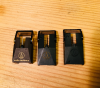
L to R: AT160ML carrier with ATN15 shibata/tapered alu,
AT15Sa carrier with ATN160ML Micro-Line/Gold-plated beryllium rod
AT15SS carrier with AT15SS Super Shibata/beryllium rod
Part I: cartridge reviews
I became interested in the Audio Technica moving magnet cartridge line after using a JVC-branded AT14S that came on a turntable I bought. It was a great cart for the Marantz system I had at the time, but an upgrade to a McIntosh MA6200 revealed sibilance and high-frequency distortion that I couldn't un-hear.
AT14S
2.7mV output
Tapered aluminum cantilever
Nude shibata stylus, square shank
370mH inductance
500Ω DC resistance
Every AT spec sheet at each price point looked much better than competitors' offerings, and being a value-minded person, I could justify the expense of moving up the line. The AT15Sa offered such great clarity, that my "civilian" partner immediately remarked on the difference.
AT15Sa
2.7mV output
Tapered aluminum cantilever
Nude shibata stylus, square shank
370mH inductance
500Ω DC resistance
There's nothing on the spec sheet to suggest where the improvement comes from, but the cantilever on the AT15Sa is thinner down the entire length. It makes sense that a lower moving mass would be able to track higher frequencies better.
I was very happy with the performance of the AT15Sa. However, during a search for replacement styli, I came across a low-use AT15SS. Don't mind if I do.
AT15SS
2.7mV output
Solid beryllium cantilever
Nude "super shibata" stylus, square shank
450mH inductance
500Ω DC resistance
When I first heard the AT15SS, I was immediately struck by the openness of the sound. The soundstage is much, much wider and deeper. It was hard for me to imagine an upgrade to the AT15Sa, but the SS added a new dimension of detail and clarity that I hadn't heard before from an LP. The entire frequency spectrum was represented in great balance with a sense of ease that encouraged me to listen more deeply. My 1952 copy of Masterpieces by Ellington has absolutely no business sounding as lifelike and immediate as it does when heard through this cartridge.
I was sold on beryllium cantilevers forever. There isn't much info on the internet about the Super Shibata, but let me clear up a few misconceptions and say that it's not just the cantilever that makes it "super", but the diamond itself is much, much smaller than the regular Shibata on the AT15Sa.
Wasn't long before I came across a NOS AT160ML. This was from the next evolution of the AT MM series and occupied the top of the line, with an even fancier cantilever and stylus.
AT160ML
5.0mV output
Gold-plated solid beryllium cantilever
Nude Micro-Line stylus, square shank
490mH inductance
790Ω DC resistance
To my surprise, I didn't like this cartridge. No matter how I adjusted various setup parameters, the sound was closed off compared to the AT15SS. Even after a considerable break-in period, high frequencies sounded one-dimensional and dominated the sound. I experimented with different turntable mats (thin leather vs Herbie's), different tonearms (Grace G707, G840f, G860f, SME 3009 II Non-improved), different turntables (TD125 MkI, TD124 MkI), and different tonearm board materials (birch, acrylic) and eventually settled on a combination that tamed the HF somewhat while retaining dynamics and impact. A low-capacitance cable (Monoprice, believe it! -- saw a study somewhere comparing various cable capacitances) was sourced for connection to my amplifier.
This was fine, except when when I swapped the AT15SS into this setup, the AT160ML was blown away again. Soundstage width and depth, clarity, inner detail, and dynamics were all much better.
-----------------------------
Part II: frankencarts
I'm a prototype engineer by trade, and small delicate assemblies have never intimidated me. My experience with the above carts led to these questions:
1. Lower inductance is usually a reliable indicator to cartridge performance due to reduced interaction with capacitance in cabling. However manufacturers do use inductance to tune cartridges' characteristics with regard to stylus assembly resonances. So -- given that the only difference between the AT15Sa and AT15SS bodies is that the AT15Sa has a lower inductance -- would the ATN15SS sound better on a AT15Sa?
2. By that logic, would transplanting the cantilever and stylus from the AT160ML to the round-shank AT15XX carrier allow that incredible stylus spec to live up to its potential? This is interesting because the main difference between the ATN15 and ATN160ML is the stylus profile (size is comparable), and that the ATN160ML cantilever is gold-plated. Both are beryllium, so that's nice for comparison.
3. What should I do with the AT160ML?
---------
1. Easy enough to swap the AT15SS stylus onto the AT15Sa. There's not much of a difference. There is a vague notion that the AT15Sa/SS is a little lighter on the bass and maybe the subtlest suggestion of more HF extension but not more HF clarity or detail. I'm willing the accept that what I think I'm hearing is actually the result of cognitive bias more than a significant difference there.
2. I carefully transplanted the ATN160ML onto the AT15Sa round shank carrier, taking care to set the proper azimuth and to preload the suspension rubber a bit before tightening down the compliance screw. You can actually change the compliance of these carts a bit by doing this, turning them into a medium-low compliance assembly. This played a bit better with my SME 3009 on warps. I installed the ATN15 (shibata / alu cantilever) onto the AT160ML carrier.
To my surprise, the AT15SS/ATN160ML combo sounded almost identical to the stock AT15SS -- that is, excellent! Gone was the exaggerated HF attack of the AT160ML, and the openness of the AT15SS is carried over with this stylus setup. There is a very slight difference in presentation, with the stock AT15SS being a tiny bit warmer. Clarity and soundstage between the two were about the same.
3. The AT160ML/ATN15 combo also sounded better than the stock AT160ML to my ears, but with this, it's more of a personal preference. Neither had the soundstage I desired, but had decent detail. Everything sounded very good and natural, but the cartridge was not as revealing. It was somewhere between the AT15Sa and AT160ML in character, with the biting attack of the stock AT160ML being tamed by the downgrade in stylus/cantilever.
--------------------------------
Part III - Conclusion and Speculation
There's nothing about the AT15Sa or the AT15SS body that strikes me as particularly out of the ordinary. Inductance and resistance values are where you would expect a decent MM cartridge to be. I was also surprised that the ATN15SS and ATN160ML sounded so similar.
Output voltage should probably be given more credence as an indicator of performance. Maybe it's simply because of increased headroom giving the amp a chance to do what it does best, resulting in a much better soundstage and even-handedness up and down the frequency range. I had thought that the AT160ML's brightness and smaller soundstage were due to high frequency peaking caused by the inductance-capacitance interaction. But the AT15SS and AT160ML bodies are pretty close in capacitance. I would not have expected much a difference in sound from the 160 if using the same stylus.
My long-held belief that effective tip mass is paramount to cartridge performance is also reaffirmed. Both the Super Shibata and MicroLine styli are much tinier than even the regular Shibata. Though their profiles are slightly different, it seems that the sound character is mostly determined by that low mass. Tracking and wear might be a different story between them, but that wasn't my focus here.
----------------------------------
Epilogue
You've probably noticed that I haven't tried the ATN15SS on the AT160ML. The reason for this is that I want to ask you what you think the result will be! Given what I've described above, what do you think we can expect from this combo?
Last edited: