• The move to the new server is done. There are some software and database maintenance updates in process. This has us passing the hat around to help out. We appreciate any donations. Seriously, even a dollar helps. The payment page may be found here - https://www.audiokarma.org/support.html

Auto Self Bias

Honestly, you don't need autobias to get good tube life. I have self-bias amps from the '50s and '60s with the original output tubes still working well. If tubes only last 12 months, it's not the topology, something is simply defective or misadjusted.

Jack
How well engineered the power supply, is a big part of long amp life. :thumbsup:
 
interesting... I read the Prima Luna adds... they claim a sophisticated technology for auto bias. Is it a valid claim?
There are legitimately automatic circuits that monitor current flow and adjust grid bias accordingly to maintain some specific set point. And then there is just a dumb resistor that biases things based on tube properties and that resistor's value. Both can be called auto bias but they don't really have much in common other than they require no user intervention.

1699928936134.jpeg

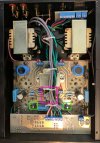
This is apparently a pic of the insides of the MP 301 MK3. I'd expect the black resistors in the upper left and right corners to be the cathode resistors, and probably the big blue caps near them are the cathode bypass caps. Thats just winging it based on a picture and no other info but I don't see anything in here that I'd suspect to be any sort of automatic circuitry.

 
There are legitimately automatic circuits that monitor current flow and adjust grid bias accordingly to maintain some specific set point. And then there is just a dumb resistor that biases things based on tube properties and that resistor's value. Both can be called auto bias but they don't really have much in common other than they require no user intervention.

View attachment 3035524

This is apparently a pic of the insides of the MP 301 MK3. I'd expect the black resistors in the upper left and right corners to be the cathode resistors, and probably the big blue caps near them are the cathode bypass caps. Thats just winging it based on a picture and no other info but I don't see anything in here that I'd suspect to be any sort of automatic circuitry.
Looks like 301-ohms. 1%, 5 or 10-watt wire-wound. That's puts those resistors in the typical cathode-bias range. Tracing do looks like those caps are in parallel. :idea:
 
Back
Top Bottom