• The move to the new server is done. There are some software and database maintenance updates in process. This has us passing the hat around to help out. We appreciate any donations. Seriously, even a dollar helps. The payment page may be found here - https://www.audiokarma.org/support.html

Best choice circa £200-300 uk and what to avoid?

Actually, they are growing on me! They are the only area of the amp to have been marked or scratched though, so if they are to stay, I will need to repaint them. Anyone have any tips?
 
What is the reason for it?
It can help with numbers of particular models produced, when, and on what production line, their revisions (if any), other internal and external differences, and any other time related details which may have a bearing on service related activities. ;)

Our serial number/model Guru @LBPete administers this 'database' and from time to time extracts information from it, especially but not limited to, the rarer models. ;)

(Not forgetting his trusty scribes, @Peter lye , @Oilmaster for their efforts trawling the Internet for serial numbers and previously unknown models, and all AK Sansui owners for their submissions).
 
Last edited:
Actually, they are growing on me! They are the only area of the amp to have been marked or scratched though, so if they are to stay, I will need to repaint them. Anyone have any tips?

For refinishing the steel rack handles I have used a simple standard spaycan with satin black (the ones for black car wheels are often spot on) with great result. Important as with all paint jobs is the preparation: Degreesing and (only if needed) carefully sanding some dammaged/scratched areas. Oh, and demount the handles from the amp first :rolleyes:

Sometimes I used a grounding/filling spray first (this also gives a bit of a rough surface finish that adds to the original look after spray painting satin black).

With this, I assume you have steel rack handles (there are also plastic ones, provided with the mk2 versions and items introduced in 1979 and upwards).

Have fun
-John-
 
I'm uk based and need to slim my collection down a bit,it's getting out of hand!

I have

Au-101
Au-505/tu-505
331
1000x
2000

If you're local enough you're welcome to have a listen to any of them
 
I'm uk based and need to slim my collection down a bit,it's getting out of hand!

I have

Au-101
Au-505/tu-505
331
1000x
2000

If you're local enough you're welcome to have a listen to any of them
I'm near skipton in north yorks, is that anywhere near you?
 
I assume you have steel rack handles (there are also plastic ones, provided with the mk2 versions and items introduced in 1979 and upwards).
Be aware that these AU-series (117-717) often need a good cleaning of all switches (a clue is intermitting sound or no sound at all from one ore both channels, that changes while working switches and pots).

Have fun
-John-
Thanks, John. Yes, metal possibly alloy handles, I haven't taken them off yet but the weight will tell... and yes you were right, after many hours listening I can tell the pots and switches do need a clean, left channel occasionally a little scratchy, connected with the speaker selector I think. It will go for service soon as my Trio comes back.

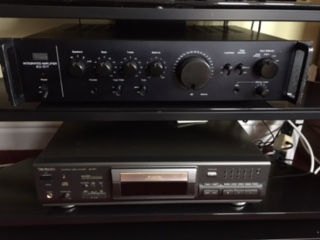
So what year is this, assuming it's a mk1 (and how do I tell? Is it a case of if it doesn't say mk2 it's a mk1?)
 
So what year is this, assuming it's a mk1 (and how do I tell? Is it a case of if it doesn't say mk2 it's a mk1?)

is there a serial number sticker on the back of the unit? if so, the third digit of the serial number is the last digit of the year it was produced. so, for example, if it’s an 8 then it was manufactured in 1978. if it’s a 1 it was manufactured in 1981 and so on.
 
.. So what year is this, assuming it's a mk1 (and how do I tell? Is it a case of if it doesn't say mk2 it's a mk1?)..

You have the original AU-317 (yes, if it doesn't say Mk2 it's a Mk1).
The mk2 has a different (white screened) logo on the front and the suffix MkII on front and rear. FYI Sansui only seldom made a mk2 product, problably the AU-117/217/317 are the only ones who had a prolonged lifespann by introducing an mk2 version.

is there a serial number sticker on the back of the unit? if so, the third digit of the serial number is the last digit of the year it was produced. so, for example, if it’s an 8 then it was manufactured in 1978. if it’s a 1 it was manufactured in 1981 and so on.

This is correct, your AU-317 probably has an 7,8 or maybe 9 as third digid, stating it was produced in 1977, 1978 or 1979.
I think the original AU-317 was introduced in 1977 and the most were produced/sold in 1978.
The Mk2 was probably introduced in 1979 and mostly produced/sold in 1980.

Have fun
-John-
 
Last edited:
Yes indeed, congrats on snagging one of my fav amp's - this amp will serve you well for a good while - Back in the day had a Pioneer PL-12D with a Shure M75 EJ, as recall matched well with the 317's Phono stage.
 
Yes indeed, congrats on snagging one of my fav amp's - this amp will serve you well for a good while - Back in the day had a Pioneer PL-12D with a Shure M75 EJ, as recall matched well with the 317's Phono stage.
Yes, I was very lucky there. After a little TLC I'll have it back to its full glory.

It has been interesting this.. a couple of things have come to mind.
  1. It's no wonder there are so few great bits of kit left from that era, given the complete lack of general 'nowse' that people have. I've lost count of the number of adverts I've seen where it says "Powers up but other than that untested". I was always told THE LAST THING YOU SHOULD DO is power up an amp without connecting the output stage to speakers. Heaven knows how many might have been OK till the unwitting finder did that.
  2. How on earth was I ever persuaded that CD was better than vinyl. More convenient perhaps, but often 'more convenient' simply means 'throwaway'. I'm struggling to believe the vinyl I have had stored for 40+ yrs still sounds as good as it does. But I am also surprised just how much better my CD player sounds through the Sansui too. It's quite obvious that perfection is subjective, the 'perfect sound of CD and modern amps is actually less enthralling. Depends on your metric I suppose. And CD has been replaced too now. That's progress.
I do have one observation: The 317 volume control is quite 'sharp', i.e it goes from zero to 'significantly on' in one step. It's not a problem, it is still low enough for use, but it is a considerable increase in the first step. Is that normal?
 
I was always told THE LAST THING YOU SHOULD DO is power up an amp without connecting the output stage to speakers.
Actually that's the correct advice for a Valve amplifier, but the opposite is true for a SS amplifier. ;)
I do have one observation: The 317 volume control is quite 'sharp', i.e it goes from zero to 'significantly on' in one step. It's not a problem, it is still low enough for use, but it is a considerable increase in the first step. Is that normal?
This can be the case if the input level to the amplifier - from a CD player for example, is a bit high. The input sensitivity for Sansui Tuner and AUX (or CD) inputs is often 150mV, whereas CD players without an output level control (common) can output up to 2V. This can give the effect you describe, where you are using the amplifier volume control as an attenuator to remove some of that excess input. It is however 'normal', and even if it happens when using the Phono input & turntable, providing you still have sufficient control of the volume there is nothing to worry about. Some amplifiers (like AU-717) have a front panel -20db switch which can be used to give the volume control a more usable adjustment range.

I have experienced this effect with my own CD player (which has no output level control), the simplest solution, and what I use is 'in-line RCA attenuators', 10 or 20db will make a useful difference. ;)
 
ziggydave said:
I've lost count of the number of adverts I've seen where it says "Powers up but other than that untested". I was always told THE LAST THING YOU SHOULD DO is power up an amp without connecting the output stage to speakers. Heaven knows how many might have been OK till the unwitting finder did that.
Some of these sellers pick-up bulk House-clearences and just want to move items on asap - as well as probably do not have set-ups to function test or do not want to get involved with potential buyers asking tech-questions(?) or too much specific questions which they dpo not know how the answer to etc.

With regards to the stepped-volume pot from zero to 'significantly on' in one step - this is normal for this amp (and other amps in this series) - On the amps that have the Muting switch, it is possible to have a little finer control at lower volume levels

Edit:
Good advice from John ^^
 
Last edited:
Actually that's the correct advice for a Valve amplifier, but the opposite is true for a SS amplifier. ;)
Sorry John, it's my poor grammar that's at fault. I didn't mean you should connect the speakers last before powering up, I meant something you should never do is power up without speakers or some sort of load connected. I was always told you could damage the output stage, is that not the case? (I've shied away from any that said they had powered up but had no speakers or anything to test it with, thinking it might be damaged. I might be missing opportunities!)

Yes, it's true of the phono input too, but if that's how they are that's fine. Thanks for the info.
 
Back
Top Bottom
