• The move to the new server is done. There are some software and database maintenance updates in process. This has us passing the hat around to help out. We appreciate any donations. Seriously, even a dollar helps. The payment page may be found here - https://www.audiokarma.org/support.html

Best DIY antenna for FM reception?

BellyUpFish

New Member
Hey guys-

I live in a relatively small town and we have very few radio stations available, we had 2 that were worth listening to, to be exact.

Well, the one I listened to most just recently changed formats and is no longer worth tuning to. The other station, while it comes in, can be pretty hard to clean up. I get static almost all the time.

So, I think I'd like to build an antenna for my tuner. I'm currently running my dad's old Sony ST-80 tuner and love the thing.

Anyone have a suggestion on the best direction to go for a DIY antenna? Loop? Bazooka? Dipole? Off Center Dipole?

Also, I guess this tuner is setup for a 2 wire, 300 ohm antenna. If I build something, I'll need a 300 to 75 ohm balun on one end and then another 75-300ohm balun on the other to carry the signal from the coax?

Thanks for the help.

Belly
 
Register to hide this ad
Greeting's.
I always wanted to build a loop antenna but too lazy to fork out for it. The loop certainly doesn't loop 'stupid' like a dipole on a wall. one might even look good with some ivy on it or something. This link is certainly worth a read. There are other ideas for antenna's out there. I have a few dipoles and have made them out of old phone jack wire that worked well. 75ohm cable is best imo.
https://fmdxing.wordpress.com/2014/07/09/simple-diy-fm-antennas-build-an-fm-loop-for-about-20/

My local reception has a lot of channels but mostly junk. I used to have a t.v. mount with rotor and fm antenna. Channel master. I could hit from Raleigh NC; Chicago on a skip, Toronto sometimes on a skip and Montreal and NYC real easy, though I did have good elevation plus the rotor mount. cold winter nights were best reception but in summer a lot of traffic subsides in early morning.
 
Well, the one I listened to most just recently changed formats and is no longer worth tuning to. The other station, while it comes in, can be pretty hard to clean up. I get static almost all the time.

So, I think I'd like to build an antenna for my tuner. I'm currently running my dad's old Sony ST-80 tuner and love the thing.

Anyone have a suggestion on the best direction to go for a DIY antenna? Loop? Bazooka? Dipole? Off Center Dipole?

With out knowing you location and station of interest it is difficult to give exacting advice, FM reception is all about the quality and amount of signal that your antenna will have to work with.

The antenna that Mike referenced is a good place to start.

None of the antennas that you have mentioned have much if any gain over a plain basic dipole, maybe a 1.5 dB or so and that may not be enough to clean up your signal of interest.

What are you currently using for an antenna? How is it mounted?

Here is a link to a recent thread. It contains some general information and an example of how to use Antenna-Locator to help determine the available signal for your station of interest. This can help you decide what level of antenna performance may be needed for your station of interest. Above and beyond, without more information about your particular conditions, it can be difficult and it can be somewhat trial and error.
 
Where is your antenna? If you can get it up into the attic, as high as possible, this will improve the signal. I use a pair of folded dipoles made from 300 ohm twin lead and can receive stations well enough to identify them on 60 of the 100 channels on the band.
 
Lots of factors involved especially obstructions or mtn ranges. i.e. the Appalachian mts block west of same and Adirondack in Upper NY would impede I'm sure sometimes but Montreal basically N from Raleigh gives example that skips can be had but a cheap tuner won't cut it.

Lookup your receiver/tuner Paul's Receiver Rack
http://www.fmtunerinfo.com/receivers.html

I.e. my sta-2300 with the rotor. (and plain back then antenna wire, too :D)
"The very last of the 120 watt per channel analog receivers sold by Radio Shack. The analog meters were replaced by LEDs, a sure sign we're in the early 1980s. Utilizes a 4-gang front end and 3 280 kHz ceramic filters. Not very selective stock, but can be aligned to get a sensitivity spec of at least 2 µV. Has that tubby sound many Realistic receivers were known for."
---------- e.g..This tuner has very good setup from factory for antenna mounting with a good lock for long distance muting local trash but it won't function well unless you have a good antenna with a signal strong enough for it to lock on.

Speaking of skips.. there are people on the west coast USA who can catch Australia at certain times of the day so atmospheric conditions, too. Raleigh to Montreal 'ain't no skip in the park'. but if you can provide that local information you can get a bigger map and actually focus a simple dipole rig up and find best potential reception then look at other design options. .. I put a vertical mount dipole outside and improved reception dramatically even on a 2 gang receiver and you'll find good fm built antenna are mounted vertically. certainly not a lightening attraction design... And yes I've known people to be hit by lighting or massive power on surge and take out equipment some posted here.
 
The feed point impedance of a square, full wavelength loop antenna is around 100 Ohms to 120 Ohms.

If it is fed with 300 Ohm feed line that will mean a mismatch loss (reduction in signal) of around 2.25 dB or so in round numbers.

If it is fed with 75 Ohm coaxial cable the mismatch loss will be less, around 0.5 dB or so.

These are generic numbers, but the ratio of the differences will stay in about the same ballpark range.

If the antenna is fed with coaxial cable, 3 or 4 common mode ferrite chokes should be placed at the feed point.

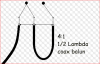
Since the input impedance of the tuner is 300 Ohms and the word "best" has been used, a coaxial balun should be used to match the coaxial cable to the receiver.

The length of the "U" shaped piece of coaxial cable is electrically 1/2 wavelength for the coaxial cable being used. Consult the cable manufacture's specifications for the velocity of propagation for the particular coaxial cable used.

upload_2018-6-17_19-37-38.png

An advantage of this type of balun is its very low insertion (reduction of signal) loss. With careful construction the signal loss can be in the range of 0.2 dB. While there are some very good quality TV type balun transformers, it can be just the luck of the draw to get one will low insertion loss.

I have measured some that have as much 3 dB of signal loss in the FM broadcast band.
 
The feed point impedance of a square, full wavelength loop antenna is around 100 Ohms to 120 Ohms.

If it is fed with 300 Ohm feed line that will mean a mismatch loss (reduction in signal) of around 2.25 dB or so in round numbers.

If it is fed with 75 Ohm coaxial cable the mismatch loss will be less, around 0.5 dB or so.

These are generic numbers, but the ratio of the differences will stay in about the same ballpark range.

If the antenna is fed with coaxial cable, 3 or 4 common mode ferrite chokes should be placed at the feed point.

Since the input impedance of the tuner is 300 Ohms and the word "best" has been used, a coaxial balun should be used to match the coaxial cable to the receiver.

The length of the "U" shaped piece of coaxial cable is electrically 1/2 wavelength for the coaxial cable being used. Consult the cable manufacture's specifications for the velocity of propagation for the particular coaxial cable used.

View attachment 1214752

An advantage of this type of balun is its very low insertion (reduction of signal) loss. With careful construction the signal loss can be in the range of 0.2 dB. While there are some very good quality TV type balun transformers, it can be just the luck of the draw to get one will low insertion loss.

I have measured some that have as much 3 dB of signal loss in the FM broadcast band.
Oops, I've been feeding them straight into the tuner. Picks up signals great even in my part of nowhere. Was looking into fractals but didn't have enough nails.
 
Tim64, I mentioned some of the confusing information about the author's description of this antenna

in Building A Simple Dipole FM Antenna.

It "appears" that he is applying velocity of propagation of the 300 Ohm twin lead to "possibly" just one side of the dipole antenna, although he clearly states that it should be applied to both arms. There is no direct relationship between this and offset fed dipole (Windom) antenna design.

Doing what he "may" be suggesting, might increase the overall bandwidth and change the design center frequency a little bit at the expense of the smoothness of the return coefficient (VSWR) curve.

To be clear, I am not trying to discourage experimenting with this antenna. I am just pointing out confusing inconsistencies in his post based on antenna theory 101.

Oh, and BTW, antenna theory tells us that the velocity of propagation for a folded dipole is closer to about 95 percent.

upload_2018-6-17_23-4-52.png

upload_2018-6-17_23-7-28.png

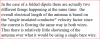
The difference that the folded dipole antenna is not acting as a transmission line, it is acting as an antenna with equal current in each of the folded elements. In a transmission line it is differential mode current and in a folded dipole it is common mode current.
 
Was looking into fractals but didn't have enough nails.

The magic of fractal antennas comes into play because of the meta-materials used in their construction.

Many of the so called DIY "fractal" antenna projects that are common on the internet are more akin to what is called "meandering element" antennas than true full performance fractal antennas. They lack any application of meta-materials (the magic).

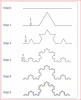
BTW, what fractal pattern are/where you considering, Koch, Minkowski, Sierpinski or some other? What construction materials were you considering?

And what order or iteration, see picture below, were you considering?

upload_2018-6-17_23-21-42.png
 
I got a "like" in my alerts... thought perhaps would peak some interest from the tuner users.
@PE9ZZ you're experienced with tuners, whats your slant on antenna's and types?
others with recent builds?
 
@PE9ZZ you're experienced with tuners, whats your slant on antenna's and types?
others with recent builds?
Heh- there's no such thing as "best antenna". You always have a compromise. As for FM: with a wavelength of 3 m antennas tend to be bulky. I have only a three element beam in my attic and it already takes up a huge amount of space. Just get the biggest antenna your budget and space allows. DX-ing requires it to be rotatable. The more gain it has the more narrowband it gets so there too is an optimum. DYI antennas can yield very high gain but ultimately are optimal for only a small portion of the FM band (87-108 MHz). Commercial designs sacrifice gain for bandwidth. I've never tried it but a good DIY alternative could be a log-per antenna but they usually have crap gain for their size. Found a cool calculator here. An antenna for 86-110 MHz with a boom length of 4.8 m yields a gain of only 7 dBd. This 11 element antenna is huge though...

Otherwise an omni antenna (vertical dipole or GPA) placed as high as possible above the EMC cloud would be a good start. And has a gain of 0 dBd.

And never, ever use twin lead, always coax. The symmetric nature of twin lead is supposed to make it immune to ingress but in the real world that always fails. Ingress destroys your multipath performance and picks up noise so I even remove the balun from tuners/receivers to harden them against this bane. Test this by not connecting anything to the antenna terminals and then tune across the dial. You will receive local stations at surprising high levels, even stereo.
 
Heh- there's no such thing as "best antenna"
I didn't title the thread :D I know what you're hitting on, I've constructed some antenna's per meter myself.
What about these 'FM gain' amps?
Also what about a Yagi for better phone reception.. read that even without connecting to anything it will focus signals. as you know antenna do attract regardless.. as do obstructions deflect

Just thought the thread would be a change.
 
Best antenna? Depends. The most important thing is height. FM broadcast is line of sight and doesn’t curve over the horizon or bounce off the atmosphere like lower frequencies. Mounting an antenna higher will increase the radio horizon and eliminate obstructions. Get some wire and build a few. I use a loop mounted vertically in my attic and get good results.
 
Back
Top Bottom