• The move to the new server is done. There are some software and database maintenance updates in process. This has us passing the hat around to help out. We appreciate any donations. Seriously, even a dollar helps. The payment page may be found here - https://www.audiokarma.org/support.html

Best FM Antenna

Zip, nada, on Radio Garden, oh well. You are in the mountains, definitely check to see if you have line of sight with a station you want to get, otherwise you are wasting your time and money.
So sad . . . Actually I'm in the valley, surrounded by mountains. I can get radio stations in my car until I get 10 or so miles from my house, then nothing. If a little antenna in a car windsheild can bring in stations, then a big antenna should bring in stations that last ten or so miles.
What about an antenna amplifier?
https://www.magnumdynalab.com/md-205-signal-sleuth-fm-amplifier/
No idea what it costs but is something like this what I need?
Let me ask a more general question - what do people do in my situation for the reception on their stereo tuners?

 
Yes they can. It's called a dipole array. Dunno whether FM in the US is vertically polarized but in the EU it is (car antennas are vertical). You can stack dipoles vertically, say four in-line, so your antenna radiation pattern becomes a disc instead of a donut. There are may excellent antenna books explaining how to stack. HAM radio amateurs (like myself) do it often too. The trickiest part is the distance between the dipoles and the phasing harness to feed them (or rather, get the FM signals to your receiver). You can also build a vertical whip with phasing stubs every half-wave. Again, many designs exist.
Perhaps if I ever saw a dipole array in real life and not just diagrams or distant pictures I could create something from common sense. I can't even get past step one as I don't know if I need a flat top configuration, or an inverted V configuration or a sloper configuration or the pros and cons of each. And everytime I start to read about how to design a dipole antenna I come across dipole directions like this:
 

Attachments

  • Antenna calcs.png
    Antenna calcs.png
    47.9 KB · Views: 7
Perhaps if I ever saw a dipole array in real life and not just diagrams or distant pictures I could create something from common sense.
Clickety click

It is called a collinear array. It is a successful and easy way of creating that disc-shaped radiation pattern that you need. If you use four folded dipoles and connect them in parallel using 300 ohm twin lead you end up with 75 ohm symmetrical that you can connect to a 75 ohm cable using a balun or 1:1 transformer. And there are many more techniques.
 
Yes they can. It's called a dipole array. Dunno whether FM in the US is vertically polarized but in the EU it is (car antennas are vertical). You can stack dipoles vertically, say four in-line, so your antenna radiation pattern becomes a disc instead of a donut. There are may excellent antenna books explaining how to stack. HAM radio amateurs (like myself) do it often too. The trickiest part is the distance between the dipoles and the phasing harness to feed them (or rather, get the FM signals to your receiver). You can also build a vertical whip with phasing stubs every half-wave. Again, many designs exist.
The Stellar Lab antennas only have an output cable connection, no input to connect them in series. Also, the signal from the upper antenna would be traveling a longer distance then the lower antenna, in an in-series two antenna array, and so the signal from the upper antenna would not be in phase with the lower antenna effectively smearing the signal out and resulting in a los of sound quality.

Penzz, What is your source for your statements in terms of FM antennas? And when I say source, I mean a website where your antenna can be bought, or made based on diagrams, again for FM radio signals! I mean, if it was so "successful and easy" to do, then why doesn't Stellar Labs, Wineguard, or any other FM antenna maker sell one?

As for your statement, "It is called a collinear array. It is a successful and easy way of creating that disc-shaped radiation pattern that you need". He is trying to receive a signal, not radiate one!

And the OP needs direct line of sight for an FM signal during the day, unless they have that, they will not be able to get good FM reception.
 
Last edited:
Most of the stations in my area are circularly-polarized, but a few of the smaller ones are vertically-polarized. I found that mounting the Stellar Labs directional antenna vertically instead of horizontally improved reception significantly on those stations.
 
I have an old Radio Shack crossed dipole omnidirectional antenna in my attic that gets a station 70 miles away. I’m a bit n. of Detroit and it’s in Lansing.

Radio-Locator.com can be a BIG help to you!!!
 
Hi, this AK newbie lives in a small town with only one FM radio station. What is the absolute best omni-directional FM outdoor antenna available? And a big plus is if it also has an AM antenna element, but not necessary.
It seems like most of the FM antenna posts here are about 10 plus years old and most of their links no longer work. And hopefully FM antenna technology has improved in the past ten years. I'm presently using a Kenwood KT-8300 which is supposed to be very sensitive but still receives only the one FM station with a small indoor antenna. Your suggestions and opinions are appreciated.
Thank you.
This seems to fit your needs.

outdoor omni directional fm antenna.jpg
 
And the OP needs direct line of sight for an FM signal during the day, unless they have that, they will not be able to get good FM reception.
Agreed. Without line of sight no antenna is going to matter. You can only do so much on the receiving end of things.
 
WOW.....I didn't realize there was so much involved in antenna selection!! I have a set of old rabbit ears that help me pick up stations from Baton Rouge 60 mile away.
 
Let me ask a more general question - what do people do in my situation for the reception on their stereo tuners?

I don't know. Maybe look more into AM? My recommendation would be to see if you can find a source for an FM antenna that can be returned if it does not work and try it in your attic at least first.
 
Let me ask a more general question - what do people do in my situation for the reception on their stereo tuners?
I had the same problem as you - a KT-8300 tuner without a decent FM station in listening range. In my case, I ended up dumping FM entirely and set myself up with a nice streamer. Internet radio is pretty good these days, and I find that even low bitrate stations sound good enough to be enjoyable so I don’t miss FM at all.
 
Just adding antennas without proper phasing and spacing will not improve signal. It’s already been stated but is the most important consideration: If you don’t have any signal, no amount of antenna gain will pull a signal out where there is none.

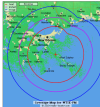
I would suggest going to a site like radio-locator.com and find the contour maps for the station. Here’s one for a station where I am in the fringe reception area. I can receive this station with a folded dipole outside about 15 feet off the ground, but not so well with a basic dipole inside.
1749395032639.png
These maps are estimated coverage based upon average terrain and not super accurate, but if you are outside the blue line, you may not be able to get the full quieting signal strength you want. There is undoubtedly areas too small to show up on the average terrain. Things like canyons, steep hills, heavy foliage, buildings, etc.

If you think you can get the signal, the best you can reasonably do is a high gain yagi antenna ( with a rotor if you want signals in other directions), a good quality LNA, and an FM band pass filter. The filter is not to be confused with more common FM notch filters that block FM on TV antenna systems. You want to block everything else.

There’s a filter on Amazon for around $50.
 
Back
Top Bottom