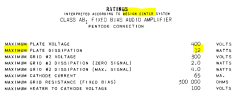
That's just because they used a different testing method. For instance, the data sheet you posted says Design Maximum Method which results in dissipation ratings that are 10% higher than the same tube tested under the Design Center Method. Eli Duttman used to post about this a lot on both AA and DIYAudio.Mullard lists the "limiting values" of the EL84 as 12W/2W, anode and screen. Sylvania shows the maximum for the 7189 as 13.2W/2.2W. That's 10% greater dissipation, for whatever it's worth.
Sylvania 7189
View attachment 3191300
View attachment 3191301
Jack
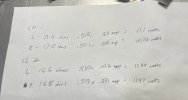
You're running at 87% of total dissipation under the more conservative Design Center method. The Soviet tubes should be fine at those levels.The plate voltage is 370v on the button. The resistors all measure out to about 16.7 ohms. So about 10% off. I ended up putting the matched el84’s back in (actually Soviet 6p14p tubes). There’s about -11v going to the grids. The voltage though the resistors is about .55v which come out to about .33ma@ 370v which is about 12.2 watts dissipation through the tube.
My math may be off please correct me if it is. It’s on and playing now. No red plating as of now.
Mullard lists the "limiting values" of the EL84 as 12W/2W, anode and screen. Sylvania shows the maximum for the 7189 as 13.2W/2.2W. That's 10% greater dissipation, for whatever it's worth.
Sorry, no. Both sheets - the Mullard EL84 and the Syulvania 7189 - refer to the specs as a maximum limit. It's possible they didn't make the measurements the same way or with the same lifespan in mind, but nothing in the sheets defines that. I seem to recall that a number of hi-fi amplifiers using 7189 are also rated at 15-20% more output power than any EL84/6BQ5 amps. Not referring to musical instrument amps here, their designers generally care less about tube life.design max v design center though.

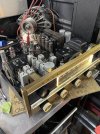
Ya it’s definitely an “in the eye of the beholder” thing. And the painted chassis is as well.Bogen could engineer an amplifier. They could also over-engineer one in some cases but its nice stuff. Some does have questionable visual design though. You can see their industrial design heritage in a lot of it. How many people were painting the entire chassis on stuff like this and making the effort to silkscreen the tuner alignment points?