• The move to the new server is done. There are some software and database maintenance updates in process. This has us passing the hat around to help out. We appreciate any donations. Seriously, even a dollar helps. The payment page may be found here - https://www.audiokarma.org/support.html

BIC 1000

Thank you - I’ll check all these things. I’ve worked with a lot of 940s, 960s and 980s - but I’m still learning my way around the 1000.
 
Looks like all the slide on connectors are intact. I’m going to try and get at the fuse this week. I hope it’s the fuse.
 
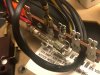
Ok, I got the fuse cover off the BIC 1000 and now I can see the fuse. I can't tell if it's toast, and I'm also not entirely sure how to safely remove and replace it (assuming that is the problem). My assumption is that the silver ends that are wired to the board are just holding a replaceable fuse between them. But I've put a little pressure on them, hoping they would retract and allow me to remove the fuse — but that doesn't seem to be working. Does anyone have any advice on removing and testing this fuse?
 

Attachments

  • IMG_9012.jpg
    IMG_9012.jpg
    93.4 KB · Views: 25
I just used a multimeter to check connectivity through the fuse. When I touch both ends of the fuse with my multimeter, the turntable lives! The red gear rotates for the end of record cycle, and the orange speed meter lights up. It would seem based on this test, I just have to figure out how to remove and replace this fuse — but I can't figure out if I just need to loosen up the grip with a bit of contact cleaner, or if this is something where I need to desolder this fuse and re-solder in a new fuse of the same type (though that seems odd). @Doug G. - have you ever replaced a fuse in a BIC table?
 
Never worked on any holder like that but it looks like those are cups the fuse is in and if you could remove the cups you'd be ok. You could try unsoldering 1 end and see if it works loose.
 
I did a bit of research and it appears there is a type of fuses that have “tails” on them. I’m going to order a replacement tomorrow and solder it into place. There is hope!
 
I have never had to replace a fuse in a BIC but have replaced them in many other pieces of equipment. Those are called "pigtail" fuses and the fuse, itself, is captive in those "cups". As you figured, you just have to unsolder the old one and solder in a new one. You probably wouldn't be successful, trying to separate the fuse from the "cups:".

At least you did discover it is the fuse. Usually fuses fail (actually, they aren't failing in this situation. They are doing what they are intended to do) because of an overload but they can mechanically fail too which, hopefully, is what happened with yours.

Doug
 
Last edited:
I’m glad I didn’t try too hard to separate the fuse from the cups. I’m going to order a replacement fuse with the pigtail ends, and try and clip out the old fuse and solder the new fuse wires to the old fuse wires. I suspect I’m going to have a lot more success with that technique than desoldering the old fuse wires. Wish me luck!
 
I was going to suggest that. Clip the old leads and make a little hook in the ends. Then cut the new fuse leads to a suitable length and make mating little hooks in the ends. Hook the hooks together and squeeze them with a needle nose pliers for a mechanical connection. Then solder.

Just make sure the leads aren't touching anything else when positioning the fuse.

Doug
 
Once I have soldered the new leads to the old, and cut the old fuse out of the middle - do you think there is any benefit to trying to wrap my soldered joints with electrical tape? Or is that entirely unnecessary?
 
I would cut the old fuse from between the leads first. try to get the length of the "new" leads close to what the originals were and position them like the originals. Then you don't need insulation. As long as the leads are far enough from adjoining parts/structures, they are stiff enough to not move around.

Doug
 
Quick update - I got my new fuse installed and soldered into place. The BIC 1000 is alive again! The only issue now is the auto return, which worked 2 weeks ago, but I think I tinkered too much with the speed of the arm drop, the lift pin height or the tonearm height.

I’ll have to get the BIC up between 2 end tables and see what is causing friction during the album run out. I can hear something rubbing - I just don’t know what it is.
 
I got it sorted out. I just took a break, came back and set the arm drop speed, and tonearm height to reasonable middle settings and backed off the lift pin a turn - and everything worked again.
 
One thing to be careful with on the original 900 series BICs is to make sure the hex-head screw, onto which the cuing rate knob is installed, is not adjusted to be too low or it will interfere with the arm lever, underneath the base plate, as it swings along with the tonearm.

Also, be sure the lift pin height, arm height, etc. is all adjusted correctly so the brake pin completely clears the cork pad while the tonearm is in normal playing operation.

One thing to get used to, with the 1000, after using other BICs, is seeing the platter stop during a change cycle. It was odd to me when I first got my 1000 several years ago, now, but then became normal and it is actually a good feature for changing records.

Doug
 
Last edited:
The relationship between those things has been the hardest thing to learn over the last year. Glad to have gotten the 1000 working great though — now that I've worked on a 940, 960, 980 and a 1000 — only the elusive 981 is left for me to find.
 
The only difference between a 980 and 981 is the platter/strobe arrangement. The 981 has the platter/strobe of the 1000 but is otherwise the same as the 980.

Doug
 
Back
Top Bottom