• The move to the new server is done. There are some software and database maintenance updates in process. This has us passing the hat around to help out. We appreciate any donations. Seriously, even a dollar helps. The payment page may be found here - https://www.audiokarma.org/support.html

Bipolar Junction Transistor Testing Basics

The idea with the heatsink grease is to eliminate the air gap between the transistor and the mica insulator, and between the mica insulator and the heatsink (air is a piss-poor conductor of heat). To accomplish this, only a thin coat of the grease is necessary, as the grease itself isn't such a great conductor either (but it beats an air gap). Too much grease is as bad, or worse, than no grease at all.

Sil-pad is short for silicone pad. They are available from many sources, and vary considerably in their ability to conduct heat. The only ones I use (when I use them, which is rarely because of cost...they are terribly expensive [$2.30 each]) are K-10 pads made by Bergquist: http://www.bergquistcompany.com/tm_sil_pad_detail.cfm?oid=104264

Sil-Pad K10® is a thermally conductive Kapton composite film coated with
boron nitride filled polyester resin, offering the highest thermal properties of
the Kapton insulators with minimum thickness and lower thermal resistance.
Designed to replace brittle ceramic insulators. (Electrically Insulating Material)

The other problem with the Sil-pads are that, once they are used (compressed), they must be replaced if the part is later removed. Mica insulators are cheap, reusable, and as long as they are nice and thin, adding a thin coat of heatsink grease makes for pretty decent setup (I buy them by the 100 lot, and pick the thin ones to use. For the ones I deem too thick, I either use an X-Acto knife to 'split' them into something usable, or just toss them out).
 
EW: thanks for the clarifying points and info. Very informative. I fear I've been over-applying the grease. The link that you provided allowed me to see why the silpads are so expensive.
Mica insulators are cheap, reusable, and as long as they are nice and thin, adding a thin coat of heatsink grease makes for pretty decent setup (I buy them by the 100 lot, and pick the thin ones to use....
WOW! I thought the thins ones were production anomalies; I deselected them for use.
 
Mica is a naturally occurring mineral. The shape can be cut but there is no way to accurately control the thickness.

- Pete
 
I have seen plastic insulating washers for a wide variety of package styles - sometimes this plastic is orange in colour - the good thing about these is the thickness is controlled - but I do not know how good they are compared to the Mica ones or other alternatives discussed.

John
 
Last edited:
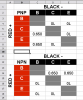
I've been testing transistors lately and found it easiest to have a worksheet I can fill in.

Helps make I'm measuring everything and keeping track of it all. Also helps to know what the measurements 'should' be.

So, based on the first post, I put this together for BJT testing, in case it helps someone else. First, gotta know if it is pnp or npn and use the right chart. I start with red on 'base' then measure with black on C then E and fill in the corresponding cells. Then move red to C, measure black on B and E and fill in. And then red on E and measure black on B and C. Then compare the readings with the pre-populated numbers to make sure it is aok.

Michael
 

Attachments

Last edited:
Thanks to all those who have posted useful stuff so far. Once again I'm heading towards being up-to-the-tits in a vintage relic — this time an AR-AU (the first and original model) integrated amp I've owned since 1972. What I've learned here will help in regards to a unit that often runs more hot than cold. BTW — a great and very musical machine.
 
The prices for these 'one-use' parts are ridiculous, and they can tear and cause shorts. From that perspective they can't touch a good, thin mica insulator.

That said, I do occasionally use them (Bergquist K-10's), but it's a rare event primarily because of cost (the cheap silicone pads sold by the likes of Parts Express are worthless).
 
This is very helpful and ill start some testing very soon, As said ealier in the thread by EW if in doubt pull the transitor to test and thats more than likely what ill do . I am very green on this so i want to be 100% on what im testing . Im hoping that not overkill ?
 
BUMP!

Thinking that it should be made a sticky! I see almost daily reference to it, and having it handy on the 1st page for new guys would possibly help lighten some guru's classroom load.

Larry
 
Guys,
I'm almost embarrassed to ask this question... I'm working on an old Pioneer... some of the replacement transistors are a TO126 package. I can't find the lead arrangement. Is it BCE like the TO202? I can't find this, and I've already soldered on into the receiver. Got to find out for sure before I continue...
Thanks,
Dave
 
Back
Top Bottom