• The move to the new server is done. There are some software and database maintenance updates in process. This has us passing the hat around to help out. We appreciate any donations. Seriously, even a dollar helps. The payment page may be found here - https://www.audiokarma.org/support.html

Blocking out Bass

Talk to your neighbor. You may be surprised that they may, 1. like the same kind of music, if not, ask them what they like, 2. invite them to listen to what you have, 3. ask them if there is a time, and do put a limit on the time, that you can rock out for a while, but be considerate in the process. I have found this approach has worked quite well. Above all else, do not use AC/DC's tune "Thunder" for an opening intro! Condition them gently!
 
Last edited:
Actually, if your unit has a basement with cast concrete wall's and slab floor, probably your best bet if you do something with the ceiling. Even if a shared stud wall to another unit, a little extra masonry divider wall load on the floor shouldn't be a problem.
 
RevMen's solution is probably the most realistic. What you need is more mass without too much rigidity or coupling. The coupling is unavoidable at the floor and ceiling if you're going to build a wall inside an existing room, but another layer or two of gypsum wallboard, especially with a base layer of a sound board like QuietRock is going to be much better than nothing.

That said, some townhome party walls are built quite well. Some have a continuous gap between your wall and your neighbor's wall, all the way up.
 
Actually, if your unit has a basement with cast concrete wall's and slab floor, probably your best bet if you do something with the ceiling. Even if a shared stud wall to another unit, a little extra masonry divider wall load on the floor shouldn't be a problem.

CA homes usually do not have basements, but one of the units (out of 34 that will be auctioned) does have one room that has about 5 feet of it under ground and the neighboring walls are 2 garages (one mine and one the neighbors). The entire 1 side of my basement wall where it meets the ceiling runs along my neighbors room where the entire 1 side of his wall meets the entire one side of his floor (hope that made sense). nothing else of his touches this room. Knowing this, which wall(s) need soundproofing?
 
I would suggest thinking of it like this...Stand inside the room where the audio system will play. Then go pound on the walls with your fists at any and all heights. If that would disturb a neighbor, that's the wall that needs soundproofing most.
 
RevMen's solution is probably the most realistic. What you need is more mass without too much rigidity or coupling. The coupling is unavoidable at the floor and ceiling if you're going to build a wall inside an existing room, but another layer or two of gypsum wallboard, especially with a base layer of a sound board like QuietRock is going to be much better than nothing.

That said, some townhome party walls are built quite well. Some have a continuous gap between your wall and your neighbor's wall, all the way up.

Thanks. Now these townhouses only share walls (and I will only buy an end unit, and there are quite a few to choose from) so there is no one living above or below me. Knowing this, do you still recommend decoupling from the floor?

Also, since some of the end units have connecting units that are vacant (and they are never locked) I plan to take my HT sub and the bear minimum so I can play it as loud as I play it where I live now (and really, I don't play it that loud, but at home, in another room, the bass is a lot louder than I thought it was because i only hear bass). So whle I play it and a friend makes sure no one steals it, i'll go to the next unit to see if it is loud or not.

I wish the unit with with the basement I wrote about in my previous post had an adjacent empty unit so I could hear how loud it is. Maybe i could just ask the neighbor when i do it (like you guys recommended)
 
The reason decoupling from the floor and ceiling is important is so you minimize transferring vibration into the rigid structure. If the layers of sheetrock are not entirely rigid and not rigidly connected to the structure they can absorb vibration better, as opposed to dissipating it into the floor and ceiling where it can travel to another room or even another townhome.

The main thing it seems important to do is to avoid directly vibrating your neighbor's wall. That would seem best accomplished by building another wall in front of it in your audio room and cladding that in gypsum wallboard or better yet, sound board and regular wallboard...two layers total. Even regular Sheetrock applied in two layers will dramaticially improve performance. In fact, one layer of regular Sheetrock applied to your existing wallboard would improve its performance. It would add mass and its resonant frequency would be different than your neighbor's side of the wall, which would add to the frequencies the assembly resists.
 
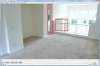
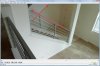
I video taped a few of the homes for auction and took some screen shots and attached them here. It looks like I can get a wall built where I drew in the 2 red boxes. So that way the stair case will be enclosed, wich is where te common wall is. I thought all 4 floors of the stair case were exposed but after looking at the video it looks like only the 1st and 2nd floor are expose (the screen shot is when i was on the 2nd floor). So I'd create one big thick wall wall that is sound proof - and it can be pretty thiick. then create another thin wall against the exisitng wall (can't make it too thick otherwise I can miove furniture up and down the stairs). Plus I'll need to good doors, one for each floor. Would that work? Or would I have to do my floor and ceiling (no townhouse units are above or below and this is an end unit). I think I'd be willing to pay $10K tops to do this. Sounds possible?

I would put the speakers up against the rails, so they would be I guess about 16 feet away from the back wall. I have Martin Logan electrostatic speakers. Is that too far away?

attachment.php


attachment.php


attachment.php
 

Attachments

  • 2nd floor.jpg
    2nd floor.jpg
    52.4 KB · Views: 50
  • 2nd floor close.jpg
    2nd floor close.jpg
    58.7 KB · Views: 50
  • 1stfloorPlus2nd.jpg
    1stfloorPlus2nd.jpg
    69 KB · Views: 51
Last edited:
That would seem best accomplished by building another wall in front of it in your audio room and cladding that in gypsum wallboard or better yet, sound board and regular wallboard...two layers total.
Building a second wall and using QuietRock (assuming that's what you mean by "sound board") would be somewhat redundant and unnecessary. If you do build a furring wall, a single layer of 5/8" wallboard would be fine, unless you like it loud, in which case 2 layers is warranted. But you don't need any special materials.

But yes, some townhomes do already have separated, double stud-row party walls. If that's the case with your building, there's no point in building a third stud row. You may not need to do anything, actually.
 
I think I'd be willing to pay $10K tops to do this. Sounds possible?
A budget of $10k should be more than sufficient to build up very good noise isolation.

Before you commit to anything, you should find out what the existing construction is. Try to get drawings that show the party wall detail. Theoretically they shouldn't be too hard to get your hands on.

If the adjoining unit is vacant, you may be able to perform a test to see how much sound transmits. If the developer/realtor will let you, you can set up a speaker or two on one side, play some music at the loudest volume you would imagine yourself listening, then go next door to see if it's audible.

If you can't hear anything then you have nothing to worry about. If you do hear something, then you can get an idea of how much improvement you would need to build into your unit.

If the developer/realtor really want to sell you the property, they would probably be very happy to accommodate your unusual request. In fact, if you discover that there are deficiencies, you may be able to work the cost of doing sound isolation renovations into the purchase price. Although, being for auction, that may not apply.

 
Flying speakers on cables helps.. and keeping the volume down is the cheapest way to solve a bass problem...
 
Building a second wall and using QuietRock (assuming that's what you mean by "sound board") would be somewhat redundant and unnecessary. If you do build a furring wall, a single layer of 5/8" wallboard would be fine, unless you like it loud, in which case 2 layers is warranted. But you don't need any special materials.

But yes, some townhomes do already have separated, double stud-row party walls. If that's the case with your building, there's no point in building a third stud row. You may not need to do anything, actually.

Whether or not a 2nd wall is beneficial depends on the situation. If you put a separate insulated stud wall and wallboard in front of an existing single stud wall, it will perform better than if you put that wallboard on resilient channels on the existing wall. If you put a 2nd wall in front of an insulated double stud wall, then I'd agree it's redundant and unnecessary.
 
My point is the decoupling that the constrained layer in QuietRock provides is unnecessary if you already have separate stud rows.
 
Last edited:
Hi, I remember an episode on Holmes on Homes.
I went ahead and found your video. Watch it all the way through especially in the second half.
hope this helps: http://www.youtube.com/watch?v=ks3I4KbRKCA
P.S. at the end of the video you can skip to part 3 of 4 episodes. Parts 2 and 4 are more about the other house problems.
 
Last edited:
A budget of $10k should be more than sufficient to build up very good noise isolation.

Before you commit to anything, you should find out what the existing construction is. Try to get drawings that show the party wall detail. Theoretically they shouldn't be too hard to get your hands on.

If the adjoining unit is vacant, you may be able to perform a test to see how much sound transmits. If the developer/realtor will let you, you can set up a speaker or two on one side, play some music at the loudest volume you would imagine yourself listening, then go next door to see if it's audible.

If you can't hear anything then you have nothing to worry about. If you do hear something, then you can get an idea of how much improvement you would need to build into your unit.

If the developer/realtor really want to sell you the property, they would probably be very happy to accommodate your unusual request. In fact, if you discover that there are deficiencies, you may be able to work the cost of doing sound isolation renovations into the purchase price. Although, being for auction, that may not apply.

thanks, and yes I will try to play my actual subwoofer in the next vacant unit (see post 27).

Thanks for all your suggestions!
And thanks to everyone else for your replies and suggestions!
 
Whether or not a 2nd wall is beneficial depends on the situation. If you put a separate insulated stud wall and wallboard in front of an existing single stud wall, it will perform better than if you put that wallboard on resilient channels on the existing wall. If you put a 2nd wall in front of an insulated double stud wall, then I'd agree it's redundant and unnecessary.


But it would be extra attentuation for my neighbor. I'm sure the high frequencies will not be heard by them, but it is the bass I am worried about. I'm using a HT sub woofer (12" Hsu)

I'm afraid adding to the existing wall will make it difficult to bring furniture in and out of the unit.

I am taking your advice, I hope it isn't coming out like I do not appreciate or or am not considering it. I am. I guess i am preparing for worst case scenario.
 
np. We went on vacation S.Cal and our favorite place was Huntington Beach. Best of luck to ya.

Thanks.

BTW, I live a block from PCH/the beach now, in downtown HB. I grew up in your neck of the woods (Orange County NY - Port Jervis), vacationed in Lake George, college in Utica and Middletown, partied in New Paltz...I'll be going hiking/camping a few months in the Adirondacks. I miss seeing all the greenery back east :(
 
Back
Top Bottom