• The move to the new server is done. There are some software and database maintenance updates in process. This has us passing the hat around to help out. We appreciate any donations. Seriously, even a dollar helps. The payment page may be found here - https://www.audiokarma.org/support.html

Boombox Build

Register to hide this ad
OK, so I suggested you make a new thread, and no one has answered yet . . . I feel bad about that. But usually starting a new thread works best if the topic question is changed to any degree. So hopefully you will get some helpful responses from folks who really know about speakers - which I do not.

A quick note that the link to "these speakers" in your new post actually goes to the link for the bluetooth amp on Amazon. So you might want to fix that.

Other than that I have a few comments I hope will be helpful -

1) Speakers you're looking at might match up OK with the bluetooth amp

I went back to your original post, and using the link there, I looked again at these speakers as listed on Amazon. There's a missing piece of info you need, which is the impedance for these speakers when they are hooked up using the crossovers (you would not want to hook them up without the crossovers, by the way). A quick way to find out the impedance is to copy the JBC model number from the Amazon page (GT7-6C) and do a web search using that - this gets a hit for the JBC page on this product - link is here. And that product page gives the impedance as 4Ω (4 ohms). Per the somewhat confusing info given on Amazon for that bluetooth amp, an impedance of 4Ω for the "2.0 mode" of setup (no subwoofer) would be fine.

Then there is the question of power handling, which is measured in watts. Basically this is making sure the average output (and also the max output) of the amp in question won't be too powerful for the speakers & thus risk blowing them out, on the one hand; and also won't be too weak for a given set of speakers and fail to provide the power needed for the speakers to perform their best, on the other hand.

In this case, the makers of that little bluetooth amp seem to be suggesting (see my last post in your previous thread) that if you're going with the 2.0 setup for that amp (i.e. left/right stereo channels, but no subwoofer channel), then 4Ω speakers that are rated at 50W each for average power handling and somewhat more than that for max power would be a good match.

As it happens, the Amazon page for your speakers lists them as "Power Handling: Peak: 300 watts per pair / RMS: 100 watts per pair." But given that the Amazon page seems to be untrustworthy, I'd rather go back to that JBC page for the speaker and noodle around to find what JBC says is the power handling for the speakers. What you want to look for is "specifications." There is a tab on that page for specs; and on that tab you will also find a link for a PDF that gives the complete specs for the entire line of that speaker type: https://www.jbl.com/on/demandware.s...wf5c0398f/pdfs/JBL_GT7_Spec_Sheet_English.pdf

Scroll to the second page of that PDF, then scroll to the bottom of that page, and you'll see the full specs for the GT7-6C:
Peak power handling: 150W
Power handling, continuous average: 50W Frequency response: 50Hz – 20kHz
Nominal impedance: 4 ohms Sensitivity (2.83V/m): 92dB
So that would seem to match up pretty well. Again, if you went with these speakers, you would want to use the crossovers - leaving them out would be a mistake. The amp just hooks up its stereo outputs to the inputs of the crossovers. (FYI, note that the picture on page 1 of that PDF does not show the product you're interested in, so don't be alarmed at it for showing what seems to be a single speaker with no separate tweeters or crossovers - that's not what you'd be buying).

HOWEVER - you may also want to scroll down to the review comments by buyers of the GT7-6C (the specific model you are looking at) on the JBL page. Apparently folks think the tweeters are really, really harsh. Plus remember these were designed to be car speakers, not speakers going inside a box.

2) The video you link to refers to an "Instructables" project that you might want to look at

When I went to watch that badly made video again, I noticed a link on the Youtube page below it saying the video author has also created an Instructable for his project. If you go to that project page you'll find he lists parts & sources for every part he uses. And there are a LOT of parts. That page is here: https://www.instructables.com/id/INSANELY-Loud-150W-Bluetooth-Speaker-Boombox/

So you may or may not want to build the project that he built - but if you are using it as a model for your build, at least you now have lots of details for how the guy went about his version of it. The only flaw here is that given you don't know much about speakers & amps, you would probably have a difficult time using his project as the takeoff point for a project of your own that used fewer parts, or cheaper parts, etc. etc.

3) Build around the bluetooth amp?

Let's say you don't want to go with the JBL speakers out of concern over comments about the harsh tweeters. You could think about getting some other pairs of speakers that would match up with this little bluetooth amp (i.e. 4 ohms impedance, 50W RMS [a.k.a. "average"] power handling and somewhat in excess of that for peak ouput). If so I'd suggest hunting for speakers on Parts Express rather than Amazon - Parts Express does a far better job of providing accurate specs & has prices that are at least as good for whatever it is you might want to buy. If you find a few speaker candidates you like, you could then come back and ask here about those candidates.

Plus, you could look at the review comments on the Amazon page for this amp - some reviewers may describe in general terms the sorts of speakers & other parts they used to build powered speakers around this amp. That too could be useful info. Similarly, speakers on Parts Express also have review comments, and those are always worth reading as to how other buyers are using the speakers - i.e. what sorts of enclosures, what sorts of purposes, etc.

And lastly, one other part you'd definitely need for that bluetooth amp is a power supply! So you'd have to look into that.

4) This amp, or some similar amp without a subwoofer?

Now, to play devil's advocate, I'll offer a thought to the contrary: Given that this little bluetooth amp you're looking at was designed for use either with or without a subwoofer, you are sort of wasting some of your money if you don't go with a subwoofer as part of your speaker setup. What I mean is, you might be able to find a similar but less expensive (because no subwoofer provision) bluetooth amp to handle right/left stereo output at with similar impedance and power-handling.

And there is also the big, complicated matter of how enclosures affect speaker performance . . . but I’ll stop there.

A learning curve would seem to be involved here . . .

 
Last edited:
Built the Dayton Audio MK Boom from Parts Express with my son for Christmas. Speakers are matched to cabinet volume and amp. It's 50 wpc. They have bigger ones too. It's a really easy way to go. MDF cabinet is precut. That's a huge time save. It was around $130 total and leaves retail bluetooth boom boxes of many times of the cost in the dust.
 
Built the Dayton Audio MK Boom from Parts Express with my son for Christmas. Speakers are matched to cabinet volume and amp. It's 50 wpc. They have bigger ones too. It's a really easy way to go. MDF cabinet is precut. That's a huge time save. It was around $130 total and leaves retail bluetooth boom boxes of many times of the cost in the dust.
I believe the MK Boom is out of stock right now and is not going to be back in stock for another few months...
 
OK, so I suggested you make a new thread, and no one has answered yet . . . I feel bad about that. But usually starting a new thread works best if the topic question is changed to any degree. So hopefully you will get some helpful responses from folks who really know about speakers - which I do not.

And lastly, one other part you'd definitely need for that bluetooth amp is a power supply! So you'd have to look into that.

If I want to run this speaker off of 18650 batteries so that it's portable do I need a power supply? Another speaker build by that same guy doesn't use a power supply, just batteries. He also uses the same or similar amplifier board.
 
I believe the MK Boom is out of stock right now and is not going to be back in stock for another few months...

In stock now as near as I can see. Also have the large one.

The main advantage to these or any pre-made kits is that the speaker enclosures are tuned to the drivers. There's a lot of engineering in matching them.
 
Last edited:
If I want to run this speaker off of 18650 batteries so that it's portable do I need a power supply? Another speaker build by that same guy doesn't use a power supply, just batteries. He also uses the same or similar amplifier board.
Not sure I understand. 18650's need to be charged. On my son's build, the battery holding board is also the power/recharge board. These amps needs a lot of power to deliver full rated output. Things get louder and clearer with the powersupply plugged in. But still a lot of oomph on batteries.
 
The main advantage to these or any pre-made kits is that the speaker enclosures are tuned to the drivers. There's a lot of engineering in matching them.
Yeah, I'm looking at the $129 version of Dayton Audio MKBoom Portable Bluetooth Speaker Kit on Parts Express, and it shows as in-stock for me too.

I didn't stress this point before, but in general I agree w/ @Scott75s1974 about a speaker kit taking a lot of the gamble out of the result.

I'm guessing that at least some DIY projects of this sort are likely to have been based on existing gear - i.e. the persons putting together those projects might have gotten hold of an existing commercial product, whether kit or otherwise, and taken measurements; and after that subbed in other parts (speaker, amp, etc.) that seemed fairly similar. And probably the result more or less "works." And it might be fun to go that route.

However there is also the issue of cost. Back in @LotzaMatza's first thread on this topic, he says (in his comment #3) that he'd really like to build something based on his own design. Okay, no problem. But he also says that as far as Parts Express kits go, "they are a little too expensive for me and I have the tools to cut the pieces in a similar way with a laser cutter."

Right there I see a problem that I hadn't noticed before. Being able to cut your own enclosure pieces might seem like it ought to really save you money. But I wonder if it would really save you money in the end, if you were trying to build something as good as the kit. I tend to doubt it.

What I mean is, with a kit, the cut wooden parts for the enclosure are not likely to cost a ton. Probably they are made of MDF or some such - it will be cheap stuff but do the job. If you're a home builder you may already have wood sitting around, so your cost for the box might also be very little. But this is not the issue. The issue is that sourcing individual electronic parts at low volume will always end up costing you much more than you think, esp. if you haven't done it before and are somehow expecting to "save money" by buying the parts yourself.

I learned this several years back when I started getting into building my own guitar pedals from schematics & other plans available on the web. Anyone who gets into this (or into electronics as a hobby overall) soon learns that making your own pedal is fun . . . and much more costly than buying pedals the normal way. Two reasons: 1) shipping costs kill you; and 2) retail prices for electronic parts are much higher than wholesale prices. Companies that make and sell pedals (and bluetooth/boombox speakers, and pretty much everything else) are typically building & selling in volume. They put things together as cheap as they can but still get reasonable quality at a price point most consumers can afford. Us DIY types simply cannot match the low price of parts most of the time - not unless we are so crazy about the hobby we have 8 million extra parts sitting in our shop that we can kite together as needed. And even then I'll bet we never really saved any money, even if we did volume buys at near whole-sale prices as some folks do who run small shops in addition to doing DIY stuff.

So - @LotzaMatza - I would be curious to see you put together your project cost based on doing all this stuff. For example, this battery issue - where are you going to get the gear for batteries, and how much will it cost you? If you source all the parts you would need to build something as good as the Dayton kit, at the retail prices w/ shipping charges that you will have to pay, are you really going to save $$ over the $130 kit?

Again I doubt it. Scroll down on that kit page at PartsExpress, and you'll see they list all the parts that go into that kit. Follow the links and add everything up - remember, this is not including the cost of the MDF for the enclosure - and you get something like $141. Or even just add up the prices listed for the amplifier board plus the 2 woofers and 2 tweeters alone (and note, the woofers listed are not for cars!!). Those parts alone are $80.

By contrast say that you went with your own choice of tweeters + woofers - i.e. the set of car speakers that you linked to on Amazon, which go for $45 - and then add in a cheap bluetooth amp board that you find somewhere - say it's really cheap and you spend just $20 on it. So now your speaker/amp cost is $65 versus $80 for the PartsExpress version. You'd be saving $15 here . . . and almost certainly getting a pair of inferior speakers not intended for the use you want to put them to. And you're still going to have to source all the other parts listed in that kit - e.g. the control panel (volume knob etc.) or something similar; the battery holder/charger; the batteries; etc. etc.

So in the end I don't see you saving any money at all & taking a gamble on how it will all sound.

But . . . even so, I think it's fine to go DIY with your "own design" if your goal is mostly to get in the shop & mess around & have the satisfaction of sourcing your own parts; and if an ideal result isn't what matters to you at this stage. But don't go this route if what you want is just this particular kind of boombox thing and if you want it to sound good right out of the gate.
 
Last edited:
I love me some boomboxes!:rockon:
I built a wooden enclosure for the Daughter. She strapped it onto her "Parade Bike" and used it to advertise for her radio station. 7" speakers and enclosures stuffed to some crazy specification/mind-spaghetti level.
I have a design for an Aluminum "high tech" boom box. it's construction allows for attachment to bike hand rails and attachment of different accessories ( you can put mirrors, a phone, or a camera onto it) The box attaches to handrails with a camera mount so is easy to detach and carry in a pack away from bike and thieves/used as a stand-alone in your house . I bought and modeled 3' full rangers from US Speaker. These: https://www.usspeaker.com/faital pro-3fe25-1.htm They are good for that purpose. I also bought a Sure amp board but am not going to use it since it doesn't have Bluetooth and that is a requirement, IMO. Alternative amp board will be Bluetooth enabled and be driven by Lithium battery pack with outboard connection for charging.

#1 Son has been trying to find a small speaker box and has had poor results. The first two he purchased broke within days. I know I can fix them but why? Today, I heard the JBL small speaker enclosure and it is an impressive bit of kit. Good sound, lots of bass and it appears rugged as only JBL would do. For $50, it's a good buy and eliminates fussing with speaker installations. That isn't in the DIY tradition, though. Madisound and other vendors carry small speakers Parts Express has closeouts on them, occasionally. You can copy JBL and use small passive radiators instead of a port. I'd bet their engineering team spent days getting them to the right consistency but hey, experiment.

The great thing about boomboxes are that the pieces are small and typically inexpensive. Good luck on your boombox!
 
How might I put together something similar to the bluetooth boombox in this video, but get away with spending less money? Might this bluetooth amp be suitable for that purpose, whether in 2.1 or 2.0 mode?

Also, I had these speakers in mind but apparently they might not be the best option?
This looks like a good topic to share Bluetooth Boombox experiences.

I got myself a ZK-MT21 2.1 Bluetooth amp. 15-ish bucks on Aliexpress.
An adapter for a cordless drill battery pack. 10-ish bucks on Aliexpress. The battery pack I already had of course..
Pioneer speakers cost me 12-ish bucks at a goodwill.
10" Subwoofer driver 23-ish bucks.
Building materials (scraps from larger projects and some stuff I'll scavenge from disused items) I already have.

Grand total around 60 bucks.

Experiences so far:
~ The ZK-MT21 2.1 Bluetooth amp works PERFECTLY. Not great sound but equally good to commercially available bluetooth speakers. And boy, does connecting properly designed speakers in 'normal' wooden enclosures to it make a difference.
~ You could use the amp as a stereo amp just as easily.
~ Bluetooth just *works*. So good. Several older Lepai d-class amps and similar sucked in this respect. This is fantastic.
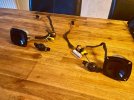
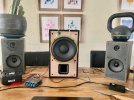
~ I tried all stereo speakers I have at home just now with the ZK-MT21. a couple of little goodwill Pioneers sound the fine and make the most sense in terms of performance/dimensions for the upcoming 'integration' into a boombox. Another pair that made less sense is pictured below.
~ I'm not fully set on design just yet, wanted to build a boombox beercrate at first, but it deserves a wooden enclosure having all parts in front of me now, actually listening and enjoying it. I think it'll be Pio's on the sides and a compact basshorn for the sub driver in the middle, battery and amp neatly tucked away at the back.

Anyway. A good start.

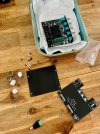
2.1 Battery Amp 1.jpeg
Some assembly required..

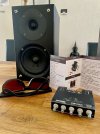
2.1 Battery Amp 2.jpeg
Sunglasses for scale. :)


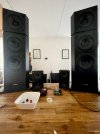
2.1 Battery Amp 3.jpeg
Size matters?

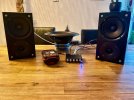
2.1 Battery Amp 4.jpeg
Now playing
 
Last edited:
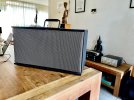
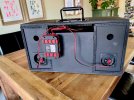
Cables still need to be worked away, but I'm calling it done for now. :)
Even though it was hard to get nice cuts with my wonky old saw, I'm chuffed as the Brits would say. :cool:

It's fun to build one of these things!

HBBB1.jpeg

HBBB2.jpeg
 
Last edited:
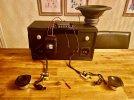
A couple of gifted, ugly LG speakers from a 5.1 set needed to disappear from my house, so I've started disassembling them and will pair them with an unused subwoofer for another 2.1 boombox. Drawing up some options for a correct-ish (and fitting with the concept 'boombox') housing now.
The lower 'woofers' in the 5.1 speakers are passive radiators by the way.

LGBB1.jpeg
LGBB2.jpeg
LGBB3.jpeg
 
Well. Those gifted LG's with their plastic domes displayed some very ugly frequency response, so I've disgregardes them for now and found some other 'components' in my collection.
Looks like these bits will soon be transformed into my second 2.1 BT Boombox:
PBBB2 0.8.jpeg
 
Back
Top Bottom