I don't try to make it a huge secret that I'm no fan of Bose speakers. Not because Amar wasn't capable of designing good speakers, he certainly has the capabilities to do so, but that he instead focused on marketing over product. I am not a Bose "hater", I see myself as rather pragmatic about the whole thing. They are there, they perform within their limitations, and many people enjoy listening to them. Cool for them, I'm just not one of them. That said, the reliance of FR charts to determine speaker quality is a bit of a sham. While FR charts are great to figure out where a speaker has issues, they don't convey the tonality of the speaker or many other things that are very important.
I remember a night with a friend who had some Klipsch speakers and a pair of Klipsch pro bass bins driven by a pair of tube amps. I brought over an RTA and we set about trying to tune his system to his room. In the end, we laughed our asses off. While the system sounded pretty good, the readout from the RTA was atrocious, looking more like a sawblade than a speaker response. However, the tonality was actually pretty respectable and the system was very enjoyable. I did the same thing a few months later with a friends hombrew speakers and although they measured much better, the tonality was way off. RTAs measure energy over octaves, not accuracy in tonal reproduction.
Tonality is where most Bose speakers really blow it. With either no tweeters or paper tweeters which have poor dispersion characteristics into the room, the speakers are already at a distinct disadvantage. Bose is correct when they say, indirectly, that you can't separate the room from the speaker. However, that being said, you can't use that as an excuse for not properly engineering a speaker. Since the late 70s, using paper cone tweeters really hasn't been socially acceptable in engineering circles. Using multiple paper cone tweeters to make up for the lack of dispersion, again, is not an acceptable engineering adaptation. However, it is a great differentiation ploy for marketing.
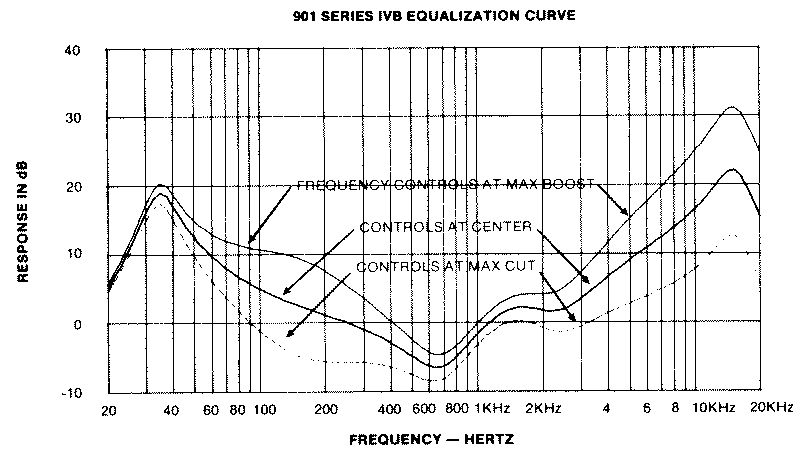
The 901 is the most successful failure in the audio industry. As a speaker at it's price point, it was a technological failure. As a platform for launching a speaker company, it was a complete success. The success was in differentiation, not in performance. The 901, given power, can play loud and will sound huge. Where they fail is in any form of accurate presentation in scale or tonality. They don't perform well at frequency extremes, are very colored through the presence and midbass areas, and lack dynamics. This isn't to say that they can't be pleasant to listen to. On the contrary, they have largely been designed to be somewhat pleasant, as has the rest of the line. The reason Bose speakers sell is that they DON'T perform very well. It's their inaccuracy that provides their appeal. They will make a bad recording sound acceptable, especially if you are not a person interested in imaging, tonality, or accurate soundstaging, as most people aren't.
using nine 4 1/2" drivers is a massive compromise in frequency response, especially highs and lows. Using an equalizer to get those drivers to go where they don't want to go can only be partially effective. There are physical limits to such actions, and the dispersion characteristics of such drivers over 500 Hz or so is not going to be stellar, and using 8 of them to fire off the back wall introduces more problems into the chain.
I mentioned before that it's not possible to remove the room from the performance of any speaker. However, introducing MORE room interaction is asking for more problems. Where a bipole will equalize energy from front to back, a 901 throws 8/9ths of it's energy into the room and only 1/9th of it's energy at the listener. This unequal loading creates many issues and adds a different dynamic to tuning issues. Where the logical ideal of a speaker system that is trying to include the room into the mix would be to create a dispersion pattern that would attempt to load the room equally over a, for simplicities sake, a 360 degree pattern from the speaker. (Actually, spherical would be more accurate but I'm trying to keep the discussion simple here.) In this attempt, the 901 fails, making it more placement sensitive, and subjecting the rear output, 8/9ths of it, to the tonal shifts of the room it's in. This means that it will sound dramatically different in sheetrock rooms than concrete, paneled vs softer, etc. A situation that guarantees a larger chance of failure than success.
The 901s have more drawbacks than attributes. Again, this isn't to say that they can't be a pleasant listen, but they just haven't been engineered to eliminate the drawbacks, they have been engineered with the drawbacks as functionally integral to the speaker.