• The move to the new server is done. There are some software and database maintenance updates in process. This has us passing the hat around to help out. We appreciate any donations. Seriously, even a dollar helps. The payment page may be found here - https://www.audiokarma.org/support.html

Box tuning for Altec 604-D

That's just it - I'm so new to this, and not surrounded by friends who are interested in it, that I'm basing all my decisions on READING stuff, which is ridiculous and could get me in trouble, but I really have no other recourse. I can't exactly waltz into a store and ask to hear some Cornwalls, or Altec 19s. I haven't the faintest clue what a SET amp sounds like. The only McIntosh equipment I've ever even heard is my little C-8 mono preamp that I play 78s through. So I'm reading, and picking up stuff as it comes available at below-market prices (the only way I can do it and still pay my rent) and listening carefully to what does happen to make its way into my house. And trying to optimize those components as much as possible. It's been fun so far (although my girlfriend might beg to differ).

I do know that one day I'd like to build an SET amp, maybe a 2A3. And I'd like to try it on these Altecs once I get them up and running. First thing's first, though.
 
The best advice i can think of is this:

You have the majority of what you need to get these up and running to enough of a degree to decide if 604's are for you.

Get sufficient and solid baffles in place, choose a tuning scheme that allows for adjustment, put those Markwart XO's together, and get to listening.

Just a curiosity question, what are you listening to now?

Better yet, what's been the speaker of choice that you have lived with thus far?

FWIW, many of Tom Brennan's comments on altec duplexes have IMO been some of the most illustrative of what i hear from them.

I think you'll find the consensus among 604 owners is that "they may not go up real high, nor drop the lowest, but what they do, they do so well that the shortcomings are quite irrelevant"
 
I have Ohm L speakers that I've had since I was in high school (1990s). They are the best thing I've had. I also have recently had AR-3A, AR-4X and original large Advents. The Advents are gone, 3As going, and the 4X are staying because they are small. The Ohms were out of commission for a while until yesterday when I finally got a replacement mid driver for a dead one. I'd been using the 4X for a few months. I'm happy to have the Ohms back, they sound better. But I can't wait to try out the Altecs.

I think the 3As go lowest of everything I've had, but going lowest is not the most important thing to me. I'm not saying it's unimportant, but not #1. The Ohms seem to present the most detail - I feel like I can hear cymbal decays and reverbs that I haven't heard in the ARs or Advents. From everything I've read I think the Altecs may indeed be my cup of tea. We'll see.

Incidentally I never found the Advents or AR-3A's to sound very good with the tube amps I used - which were El84 based - it could be an efficiency thing and they required more power, but both sounded infinitely better with solid state receivers to m ears.
 
Ok, just talked to the folks at GPA and they said that the T/S parameters don't exist for the "D" because when it was introduced in 1955 T and S hadn't come up with their parameters yet, so he recommended I measure them myself.
 
Will do. I'm pretty sure I have all the appropriate equipment, and found a recipe online. Let's see if I end up with the same numbers as judgeschreber who previously measured these guys.
 
Well, I attempted a slightly hamfisted measurement. The solid state oscillator I found in my house wouldn't work, so I used an old Eico tube signal generator I got at an estate sale a while ago. I'd brought it to life on a variac but hadn't used it yet. I fired it up and voila, it seemed to work and be pretty close to accurate according to my DVM. I ran this through a Heathkit UA-1 power amp. The positive went to the woofer positive and the negative went to a 10ohm resistor, the other end of which went to the negative of the woofer. I connected my DVM across the resistor.

The website I used (http://sound.westhost.com/tsp.htm) mentions setting the output voltage of my amplifier. I didn't know how to do that and never got a measurement out of the amp that was anywhere near 1v, AC or DC. But I did manage to measure AC volts (in mV) across the resistor and find the lowest dip as I changed the frequency on the oscillator. Then I measured the frequency and got 39.5 Hz. Would that be the Fs?
 
Yup.

Driver's not face down on the floor, is it?

Face up, or horizontal, that's the free-air resonance.

Measure both woofers and see if they're the same....
 
No, the compliance may have stiffened with age. They're not 50 Hz, at least.

What Bowtie said: Build your baffle and crossover and tune the box. Listen to them before you invest in anything like reconing to get better bass.

I don't believe the highs get much improved until "H" with Tangerine and MantaRay.
 
yeah i would never recone them without knowing they were lacking anything. i basically only plan to recone them if they sound like a victrola horn or i put a screwdriver through one trying to install it, knock on wood!

Is there a way to un-stiffen the cones? Or is it like untreatable speaker arthritis?
 
It's not the cones, but the spiders and surrounds.

Recone is the only rational answer, unless you have Gordon rebuild them, maybe.

They are both measuring close to the expected Fs. Just load them and try them, in the existing box, even, to determine for yourself if they're "All that." :yes:
 
Tuneable ports: PE sells adjustable port tubes. They also sell multi-piece assembleable flared type; you'd adjust the tuning using different length center sections.

Me, I'd just be using ABS pipe from Home Depot, and swapping in different lengths as desired.

i was just at home depot, but didn't recall what kind of pipe you'd mentioned. What diameter should I get? Still having not yet received the books I ordered I'm not sure what the effect of longer vs shorter pieces and what diameter would be the right ballpark.

ultimately will i be tuning by ear, or is there a sciencey way to do it with a sine wave generator and multimeter? i felt (and looked (and sounded)) like a mad scientist doing the Fs measurement yesterday. I enjoyed it.

I bought MDF and had it cut for the new baffles. I was going to get plywood, but it was way more expensive and I recall people saying MDF is acoustically deader and preferable. I also bought contact cement to apply roofing felt to the interiors of the cabs. I also bought a nice power drill (mine was busted) and a jigsaw because I'm tired of borrowing tools from my landlord!

One other thing - one of my "D"s is missing the foam gasket where the woofer attaches to the baffle...any ideas on a replacement for that?
 
ultimately will i be tuning by ear, or is there a sciencey way to do it with a sine wave generator and multimeter? i felt (and looked (and sounded)) like a mad scientist doing the Fs measurement yesterday. I enjoyed it.
Measuring the box tuning is the same. There'll be two peaks instead of one, and the the tuning is nominally the valley between them. The book'll tell you how, as well as how to do it more precisely by closing the ports, measuring the single peak that produces, and doing a "Scientific" calculation.... :p:

Get the black ABS pipe, 3" diameter. You'll start with two ports, about 4" long. You'll also need the right size hole saw for that from the tool department. Masking tape wrapped around the port O.D. will make a good enough seal for tuning purposes. Locate the ports so that you can add one or two more, if necessary.

MDF is really not a good material for baffles, as it has no structural rigidity. 3/4" birch ply is considered minimum standard, but regular ply will do for experimenting....
 
Ah, that makes sense about the MDF...I'll go back and get some 3/4" ply...as well as the ABS pipe and the 3" hole saw. For the hole for the driver will I want to use a jigsaw? That was my assumption, but I should spend less time assuming. I would not have known to get the hole saw. And is there an optimal diameter for the hole for the 15" driver? What's the best way to determine the exact size of the hole to cut? Please forgive my ignorange - I'm excited to learn though! Thanks again (and again) for all the coaching!
 
It's a 3.5" hole saw for the 3" ABS; the wall thickness is 1/4".

I don't know the cutout sizes for the Altec drivers. They my be on the data sheets. Otherwise, measure. You may also have the option of mounting to the front or rear of the baffle, and the hole sizes may be different depending upon which you do.

Router and Jasper Jig is a preferred method of cutting the large holes, but a jigsaw will do fine by hand. Use a narrow blade likely available for your saw made for scroll sawing, i.e., cutting curves.

You may have to make your own replacement gasket using closed-cell neoprene weatherstrip of the appropriate thickness from the hardware store.

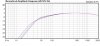
Edit: BB6P says you want to tune your boxes to ~40 Hz. We're unsure of the exact duct length, as we don't know the internal volume precisely. I opted for four ducts, 5" long. In a 5.25 cuft volume, all four open gives 40 Hz, one closed, 35 Hz, and two closed, 30 Hz. That way, you can try different tunings using plumbers' plugs.

Since we don't have the T/S parameters, I modeled using a driver having similarly high Fs:
 

Attachments

  • 604D in 5 cuft.jpg
    604D in 5 cuft.jpg
    38.1 KB · Views: 27
13-1/4 inches for the cutout, the bolt centers are on a 14-9/16 inch circle.

A good jig saw and steady patient hand can cut perfect circles down to 4 inches, definitely go with a holesaw for anything smaller.

I recommend a "hollow ground" jigsaw blade, it'll have a ground finish on the sides behind the cutting teeth and allows much more tail clearance for turning than standard blades made from flat stock.

Another hint i'd offer is to cut out an approximate 12 inch circle first, then make radial cuts out to your 13-1/4 inch line spaced 1/2 to 1 inch apart for the entire circumference.

The Jasper jig is good too, if you have a plunge router and the appropriate bit. I've just settled on the jigsaw and a compass made of plexi to mark the lines as it's the quickest and needs least setup for my highly cluttered and unorganized shop.

Also, since you're using a speaker that must be rear mounted to the hole, masking tape firmly applied over the area to be cut will help keep splintering along the cut to a minimum. draw your circular cut line, then tape over it, and draw again on top of the tape.
 
One last question about layout - does it matter where the ports are? Should they be towards the bottom of the baffle? Should all 4 be in a line across, or two rows of two? does it matter? I know the driver should be as high as possible so the horn gets as close to ear level (in these more like thigh level - i'll have to always listen on a bean bag chair!) but I'm curious how I should arrange the 4 ports. Should I do them in a rainbow so it looks like a cyclops frowning?
 
Back
Top Bottom