

You are using an out of date browser. It may not display this or other websites correctly.
You should upgrade or use an alternative browser.
You should upgrade or use an alternative browser.
Box tuning for Altec 604-D
- Thread starter currituckco
- Start date

currituckco
Super Member
Home Depot didn't have ABS pipe, only PVC - is that suitable? I also couldn't find closed cell weatherstripping (I don't think so, at least - nothing was labeled in those terms) - why is closed cell important?

ABS is the black stuff with a thicker wall than the white PVC. PVC will work too, and is commonly used. You'll need a different size hole saw for it. I just suspect it resonates in this application, though I've never documented that. They should have it in the plumbing department. Pick up your test plugs there, also.
Closed-cell neoprene is what's on JBL drivers. I assume Altec used the same. We're talking the gasket on the face, right? Open-cell poly foam is generally soft and squishy, and does not make as good a seal.
http://www.acehardware.com/product/...rstrip&parentPage=search&searchId=22449528193
http://www.acehardware.com/product/...rstrip&parentPage=search&searchId=22449698563
High density says "Open cell" on the package. Don't want it, I don't think: nope:
http://www.acehardware.com/product/...rstrip&parentPage=search&searchId=22449744633
You're going to need a large roll of thinner stuff to seal your baffle and back, as well, if it's not already in place.... :yes:
Closed-cell neoprene is what's on JBL drivers. I assume Altec used the same. We're talking the gasket on the face, right? Open-cell poly foam is generally soft and squishy, and does not make as good a seal.
http://www.acehardware.com/product/...rstrip&parentPage=search&searchId=22449528193
http://www.acehardware.com/product/...rstrip&parentPage=search&searchId=22449698563
High density says "Open cell" on the package. Don't want it, I don't think: nope:
http://www.acehardware.com/product/...rstrip&parentPage=search&searchId=22449744633
You're going to need a large roll of thinner stuff to seal your baffle and back, as well, if it's not already in place.... :yes:
currituckco
Super Member
When I compared the 3" PVC pipe to the 3.5" hole saw they seemed the exact same outer diameter. The people who worked at the store said they didn't carry ABS pipe and implied I'd have a hard time finding it in the NYC area. Maybe I'll look for a plumbing supply place.
I just ordered some of the proper weatherstrip online.
So I should use the self-adhesive closed cell weatherstrip to seal the back of the cabinet as well? Also, I have roofing felt and was told to apply 2 layers to the insides of the cabinet. Will that do, or should I attach some sort of bracing? My plan would then be to apply insulation to combat standing waves.
I just ordered some of the proper weatherstrip online.
So I should use the self-adhesive closed cell weatherstrip to seal the back of the cabinet as well? Also, I have roofing felt and was told to apply 2 layers to the insides of the cabinet. Will that do, or should I attach some sort of bracing? My plan would then be to apply insulation to combat standing waves.
Use the PVC if you can't get ABS conveniently.
Yes, use 1/8" thick gasket tape to seal the baffle and rear. Ace has that as well, and Parts Express, too. It flattens to nearly nothing under clamping pressure.
I've never heard of roofing felt as cabinet resonance damping. A friend tried thick bitumenous waterproofing, but that didn't do much; he has more sophisticated measurement capabilities than me, so I trust that conclusion until proven otherwise. There are materials made for the purpose, which Parts Express also sells, but I have no experience with them, either. I'd say forget it for now, and consider that an embellishment for later addition should you decide you like the speakers.
Fiberglass damping is essential, yes....
Yes, use 1/8" thick gasket tape to seal the baffle and rear. Ace has that as well, and Parts Express, too. It flattens to nearly nothing under clamping pressure.
I've never heard of roofing felt as cabinet resonance damping. A friend tried thick bitumenous waterproofing, but that didn't do much; he has more sophisticated measurement capabilities than me, so I trust that conclusion until proven otherwise. There are materials made for the purpose, which Parts Express also sells, but I have no experience with them, either. I'd say forget it for now, and consider that an embellishment for later addition should you decide you like the speakers.
Fiberglass damping is essential, yes....
currituckco
Super Member
I'll leave off the roofing felt for now - I might try using some of the MDF I got earlier as internal bracing - at least make a cross bar between the two side walls.
I'll use the PVC. Would it make sense to damp that somehow, if you're worried about resonance? Perhaps a crapload of roofing felt?
I'll use the PVC. Would it make sense to damp that somehow, if you're worried about resonance? Perhaps a crapload of roofing felt?
currituckco
Super Member
Consider it done!
currituckco
Super Member
Ok...I put one baffle together tonight - I'm far from done even with this one speaker (waiting for some last xover components, gasket seal, etc), but I mounted it and played it with the original xover and without even securing the back of the cabinet and WOW!!! holy crap does this sound amazing!@! and the bass? it's a helluva lot more bass than I've ever gotten out of a speaker!!! I am going to be HAPPY with these, NO DOUBT IN MY MIND. some friends of mine who were rehearsing (they're all musicians) were also blown away by the fidelity and naturalness, especially on acoustic bass. I played a mono original 50s press of Jimmy Giuffre's amazing album Tangents in Jazz through a recapped Dyncao PAS2 into a Heathkit UA-1 amp and the sound is pretty galldarn magical!
I am one happy camper. Thanks again Zilch and bowtie for all the pointers. I may come back with more questions as the finishing touches get finished and touched, but for tonight I may have to just kick back and listen to every mono record i own (which is a bunch!)
bananas:

I am one happy camper. Thanks again Zilch and bowtie for all the pointers. I may come back with more questions as the finishing touches get finished and touched, but for tonight I may have to just kick back and listen to every mono record i own (which is a bunch!)
bananas:
currituckco
Super Member
By the way, what's a good method of permanently affixing the ducts into the ports?
I'm enormously pleased your experiment is sounding so good to you. :yes:By the way, what's a good method of permanently affixing the ducts into the ports?
For right now, just wrap masking tape or blue painters' tape around the end to get a snug fit in the ports.
Depending upon your measurements and listening tests, you may be shortening the ducts.
Ultimately, they're go in with silicone sealant.
You got some 3" plumbers' test plugs, or whatever size fits your PVC ducts, right? I use Oatey #33422 for 3" ABS. You'll need four of them. Get a small can of silicone or teflon spray lube to make them work easy. I'll tell you how once you get that stuff, and how to do the measurements, as well.
[We still gotta do the mad scientist bit yet.
 : ]
: ]p.s.: "Train and the River" on that album? We're going back 45 years since I've last heard it. May have to make a trip to Down Home Music here....
currituckco
Super Member
I just have the big bulky two piece end plugs that fit over the end of the pipe - one fits over the end and the other screws into that fixture. And I only have two sets because they were expensive. Where do you get the Oatey fixtures?
Also, after misreading one of your posts I cut 4" lengths of PVC, so that's what's in there now. I have yet to cut my other 24" piece of PVC so I'll cut that to 5" lengths. I was thinking I would put 2x4" and 2x5" lengths in each cabinet. Is that terrible?
I'm such an amateur!
I have the ducts supported with masking tape currently. At what point should I do the measurements - should I have the new crossovers done first? And should the cabinet be properly sealed with caulk and weatherstrip?
I attached the driver using T-nuts and since the T-nut is slightly raised from the face of the baffle I need to wait for the weatherstrip to come in the mail so I can create a proper seal there.
Also, after misreading one of your posts I cut 4" lengths of PVC, so that's what's in there now. I have yet to cut my other 24" piece of PVC so I'll cut that to 5" lengths. I was thinking I would put 2x4" and 2x5" lengths in each cabinet. Is that terrible?
I'm such an amateur!
I have the ducts supported with masking tape currently. At what point should I do the measurements - should I have the new crossovers done first? And should the cabinet be properly sealed with caulk and weatherstrip?
I attached the driver using T-nuts and since the T-nut is slightly raised from the face of the baffle I need to wait for the weatherstrip to come in the mail so I can create a proper seal there.
Oateys come from Home Depot or the local hardware store. Plumbing supply will have them, too. $3.95 apiece here. Two metal plates sandwiching a thick rubber ring, and a big wingnut to squeeze them together.

Just go with the 4" long ducts for now. We'll find out where the tuning is once you measure. Different length ducts is a bad idea for this, so, no.
You don't need the crossovers; you'll be measuring with just the woofer connected, like your Fs measurements, but this time in the cabinet. The cabinet must be all properly sealed to do it, so you're not ready until all that is done....
Just go with the 4" long ducts for now. We'll find out where the tuning is once you measure. Different length ducts is a bad idea for this, so, no.
You don't need the crossovers; you'll be measuring with just the woofer connected, like your Fs measurements, but this time in the cabinet. The cabinet must be all properly sealed to do it, so you're not ready until all that is done....
Attachments
currituckco
Super Member
A special thank you to you Zilch, for taking the time/accepting the challenge to meet somewhere in the middle with those of us who wish to preserve as much of the originality as possible of some of these old speakers.:thmbsp:
Amen, brother!
I'm just in it for the data....Amen, brother!
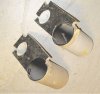
Here's a pic of ducts I cut out of a pair of JBL S99s. You can see the JBL used masking tape for tight fit, and then glued them in:I have the ducts supported with masking tape currently.
Attachments
currituckco
Super Member
I got the Oateys - actually I got 33402 instead of 22, but they are also 3" and looked to be about the same except they're red instead of silver, and moreover they are all HD had. I also got my copy of the Dickason book, and also "How to build speaker enclosures" by Badmaieff and Davis, which is nice because it has some vintage designs laid out.
Cool!I got the Oateys - actually I got 33402 instead of 22, but they are also 3" and looked to be about the same except they're red instead of silver, and moreover they are all HD had. I also got my copy of the Dickason book, and also "How to build speaker enclosures" by Badmaieff and Davis, which is nice because it has some vintage designs laid out.
Dickason's measurement setup is Fig. 8.3. Same components as Elliot, but inverted output. See also Fig. 8.5, and the accompanying text.
Measuring box tuning Fb is at 2.72, and how to calculate it most accurately at 2.100.
[You're gonna be "Expert" here pretty quick.... :thmbsp: ]
currituckco
Super Member
Ok, so I measure the impedance peaks and try to find the set-up in which the valley between peaks is closest to 40hz, which is the Fs I measured for the woofers....right?
Do it in an organized fashion for all five of the tuning options.
You want to find the two peaks Fh(igh) and Fl(ow) and also Fm(in), the minimum impedance between them, which may not be in exactly the middle. Fm is an approximation of the box tuning Fb(ox).
Do that for all ports open, then 3, 2, and 1 port(s) open.
Finally, do it for all ports closed, Fc(losed), which will only have one peak, like your earlier Fs measurement, and will be somewhat above 40 Hz. All of these readings should fall between 10 and 100 Hz.
Then do the calculation at 2.100 for each of the four tunings: Fb = Sqrt (Fl^2 + Fh^2 - Fc^2).
Fb for all ports closed is simply Fc.
Vented, Fb will be highest with all ports open, and get lower with each successive port closure.
*****
Yes, you're aiming for a tuning near the driver Fs, but one higher or lower may provide the best listening, according to your preference. See the simulation curve(s) I posted above. That's why we're doing the multi-port and plugs thing, so you can try listening to different tunings conveniently, once you know what they are. It's a DIY luxury not many speaker owners have available to them.... :thmbsp:
You want to find the two peaks Fh(igh) and Fl(ow) and also Fm(in), the minimum impedance between them, which may not be in exactly the middle. Fm is an approximation of the box tuning Fb(ox).
Do that for all ports open, then 3, 2, and 1 port(s) open.
Finally, do it for all ports closed, Fc(losed), which will only have one peak, like your earlier Fs measurement, and will be somewhat above 40 Hz. All of these readings should fall between 10 and 100 Hz.
Then do the calculation at 2.100 for each of the four tunings: Fb = Sqrt (Fl^2 + Fh^2 - Fc^2).
Fb for all ports closed is simply Fc.
Vented, Fb will be highest with all ports open, and get lower with each successive port closure.
*****
Yes, you're aiming for a tuning near the driver Fs, but one higher or lower may provide the best listening, according to your preference. See the simulation curve(s) I posted above. That's why we're doing the multi-port and plugs thing, so you can try listening to different tunings conveniently, once you know what they are. It's a DIY luxury not many speaker owners have available to them.... :thmbsp:
currituckco
Super Member
Thanks for the description! I'll do this when I get them sealed up good n' tight. I can't wait to get everything ready!