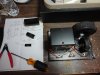
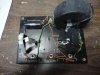
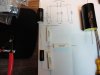
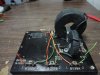
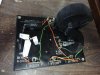
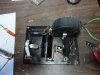
I perform the Tobin crossover modifications to my 1968 Bozak 302a Centurys
Here is what I base my changes on
From Pat Tobin:
Regarding Tony's mods to my mods: for the lower xover freq., Bozak used 800 for the (single woofer) 302A systems
and 400 Hz for the larger Symphony (two woofs per box) and Concert Grand (four woofs per box). The reason for using
800 on the 302A is not clear. I believe it has to do with the use of the B-207A 'coax' as the woofer-tweeter unit.
This brings the tweeters down in front of the woofer and away from the midrange. I feel that 800 Hz might have served
better for that driver relative spacing, altho I can't swear to it. The 400 Hz lower xover freq. was available as an
option for the 302A, altho not promoted.
If my theory is correct, 400 Hz is better when the tweets are 'liberated' from down low, in front of the woofer.
Now for the upper xover freq. What Tony is alluding to is that the world-beating B-209B midrange sings quite happily
up to 10 kHz. (The upper bandwidth limit could not be lowered in the physical construction of the driver without
degrading transient response.) Rolloff is theoretically by means of the inductor in series with the midrange.
Problem is, any driver has a rising impedance characteristic in the top portion of its range. So just as the inductor
would be rolling off response above 2,500 Hz, the rising impedance of the midrange keeps the response almost flat.
This is a given: Using the B-209B with the N-10102A xover, the midrange will double with the tweets from 2,500 Hz to
about 10kHz. There is no question that Rudy knew about this. But let's jump in the time capsule and go back 40 years.
Most speaker systems of every stripe had a boosted high end. It was glitzy and impressed customers in the demo room.
Rudy probably felt that this doubling was in a range that was very appealing to most users.
But it is not my job to help Bozak sell speakers in the '60s. It is my task to revise the xovers (and other elements
such as cabinet design) in order to allow the world-class drivers to sing in their true, natural voices.
Here's what works best to curtail that upper end doubling: On the N-10102A xover, at terminal strip A, move the jumper
from the N-101/N-104 terminal to the other one, marked N-102. That doubles the inductance feeding the midrange, which
happens to lower the drive to the midrange in the 2.5 kHz ~ 10 kHz range, exactly what we need. (For technocrats: that
inductance was used for an 800 Hz rolloff for the 16-ohm B-305 midrange.)
As for using a 3,300 Hz upper xover: that's OK but there are a couple of drawbacks. For one, when the frequency is high
(short wavelength) compared with the diameter of the radiator (cone), the upper frequencies get very directional.
That might not be noticed very much, but it could actually reduce the acoustic output at a considerable angle off
straight ahead. Secondly, needless to say, at any given frequency, the transient response of a small cone is superior
to that of a large, heavier cone. And if I had to pick the one most outstanding property of Bozak drivers, it would
have to be transient response.
That's my two cents worth for now. If I can answer any questions, fire away.
I want to sincerely thank Tony Jerant (DrJ) for disclosing my xover mods to the group, and for his most gratifying compliments.
Best wishes to all,
Pat Tobin"
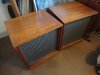
The cabinets were stripped and I used Watco Danish Oil on them
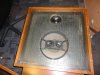
B-200Y tweeters
B-209B mid
B-199A Woofer
Pat Tobins latest crossover schematic
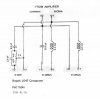
The original B-302a crossover. If you can make out the writing this original schematic shows the original coil connnections are on the lower connector
L1 - tapped at 509mH but provides a 1.1MH tap (Upper connector)
L3 - tapped at 1.58MH but provides a 3.15MH tap (Upper connector)
When performing the Tobin mods, use both upper connectors
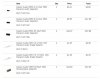
Parts express order list (I did not order the 25uf caps) as I used 50uf caps
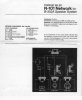
These images were collected from those who have gone before
Here is what I base my changes on
From Pat Tobin:
Regarding Tony's mods to my mods: for the lower xover freq., Bozak used 800 for the (single woofer) 302A systems
and 400 Hz for the larger Symphony (two woofs per box) and Concert Grand (four woofs per box). The reason for using
800 on the 302A is not clear. I believe it has to do with the use of the B-207A 'coax' as the woofer-tweeter unit.
This brings the tweeters down in front of the woofer and away from the midrange. I feel that 800 Hz might have served
better for that driver relative spacing, altho I can't swear to it. The 400 Hz lower xover freq. was available as an
option for the 302A, altho not promoted.
If my theory is correct, 400 Hz is better when the tweets are 'liberated' from down low, in front of the woofer.
Now for the upper xover freq. What Tony is alluding to is that the world-beating B-209B midrange sings quite happily
up to 10 kHz. (The upper bandwidth limit could not be lowered in the physical construction of the driver without
degrading transient response.) Rolloff is theoretically by means of the inductor in series with the midrange.
Problem is, any driver has a rising impedance characteristic in the top portion of its range. So just as the inductor
would be rolling off response above 2,500 Hz, the rising impedance of the midrange keeps the response almost flat.
This is a given: Using the B-209B with the N-10102A xover, the midrange will double with the tweets from 2,500 Hz to
about 10kHz. There is no question that Rudy knew about this. But let's jump in the time capsule and go back 40 years.
Most speaker systems of every stripe had a boosted high end. It was glitzy and impressed customers in the demo room.
Rudy probably felt that this doubling was in a range that was very appealing to most users.
But it is not my job to help Bozak sell speakers in the '60s. It is my task to revise the xovers (and other elements
such as cabinet design) in order to allow the world-class drivers to sing in their true, natural voices.
Here's what works best to curtail that upper end doubling: On the N-10102A xover, at terminal strip A, move the jumper
from the N-101/N-104 terminal to the other one, marked N-102. That doubles the inductance feeding the midrange, which
happens to lower the drive to the midrange in the 2.5 kHz ~ 10 kHz range, exactly what we need. (For technocrats: that
inductance was used for an 800 Hz rolloff for the 16-ohm B-305 midrange.)
As for using a 3,300 Hz upper xover: that's OK but there are a couple of drawbacks. For one, when the frequency is high
(short wavelength) compared with the diameter of the radiator (cone), the upper frequencies get very directional.
That might not be noticed very much, but it could actually reduce the acoustic output at a considerable angle off
straight ahead. Secondly, needless to say, at any given frequency, the transient response of a small cone is superior
to that of a large, heavier cone. And if I had to pick the one most outstanding property of Bozak drivers, it would
have to be transient response.
That's my two cents worth for now. If I can answer any questions, fire away.
I want to sincerely thank Tony Jerant (DrJ) for disclosing my xover mods to the group, and for his most gratifying compliments.
Best wishes to all,
Pat Tobin"
The cabinets were stripped and I used Watco Danish Oil on them
B-200Y tweeters
B-209B mid
B-199A Woofer
Pat Tobins latest crossover schematic
The original B-302a crossover. If you can make out the writing this original schematic shows the original coil connnections are on the lower connector
L1 - tapped at 509mH but provides a 1.1MH tap (Upper connector)
L3 - tapped at 1.58MH but provides a 3.15MH tap (Upper connector)
When performing the Tobin mods, use both upper connectors
Parts express order list (I did not order the 25uf caps) as I used 50uf caps
These images were collected from those who have gone before
Last edited: