• The move to the new server is done. There are some software and database maintenance updates in process. This has us passing the hat around to help out. We appreciate any donations. Seriously, even a dollar helps. The payment page may be found here - https://www.audiokarma.org/support.html

Braun Turntable with traces of thorens

robiles

Active Member
As an architect living in Germany, there was no way i could avoid beying attracted by some Braun gear. I can honestly say that they are not only nice, but also nicely designed, with a few unexpected features.

So is the case of the Bran PS 430 turntable. It is the simpler brother of the PS 500. Both are a belt idler hybrid (the other way arrounf compared to the TD 124), almost identical and made mostly of metall. But they also have a few differences, the 500 has an oil damped chassis, while the 430 has a spring suspension (similar to, but much more sturdy than the TD 150).

After owning (for a short time) a td 150, and seeing the importance of damping, i thought why not try to apply the same principles to the Braun. The 430 has really hard springs, that make the chassis seemed almost glued to the top plate. You push it down, and it comes back almost instantly, while on the TD it bounces gently for a while.

My idea was to try and use Linn springs (430 chassis is massive and heavy), which should be more suitable, and try to see if it bounces, and see if it is an improvement or not. Other upgrades are also possible with a bit of diy (or a friend with a cnc which i do not have).

First step is to do a visual check of the suspension system of both decks, and see if this can be done with minor, and most importantly undo-able, mods.

Will be back with some side to side under the hood photos. Interesting to see the differences in ideology, manufacturing and complexity between the two.
 
Register to hide this ad
Braun subchasis hangs on the springs, so the main force vector is stretching them. TD150 and Linn subchasis is placed on top of the springs, so they are compressed. They are not compatible.

I had a similar idea some time ago, as I own both a PS500 and a TD150.

IMG_3944.jpeg
 
Braun subchasis hangs on the springs, so the main force vector is stretching them. TD150 and Linn subchasis is placed on top of the springs, so they are compressed. They are not compatible.

I had a similar idea some time ago, as I own both a PS500 and a TD150.

View attachment 2419392
So, what did you do? I have the PS600 and the hydraulic cushions on my table were refurbished and refilled prior to my buying it. They work well. I was offered the opportunity to switch to springs, but decided to leave the table stock. If I had I wonder what springs they would have used. This is why I’m asking. These TTs are outstanding. I do love mine.

Best, Chris
 
I am aware of the differences between the two suspension systems, but the 430, unlike the 500 has no hydraulic damping. As the suspension is fixed with normal M screws - changing the suspension system should not be too difficult.

I find the spring assembly on the braun much too stiff. I will try to remove the suspension inserts at first to see if that changes anything, and the proceed with adapting to a linn style suspension.

The bushings will be 3d printed for proof of concept, and see what the results are before i venture into more expensive waters. Will probably have to buy a spare subchassis if some agressive modifications are needed - for example larger holes for the suspension support screws.

P.S. the 600 is, as far as i know, not a real Braun but made by Elac - so it is a bit different than the 430 and 500
 
If you want to go this way, you need to recreate the entire mechanism. Linn springs need to be compressed, so the entire chasis has to stand on them. You have to replace the original screws that hold the spring assembly, and put much longer ones, that will nearly reach the bottom of the plinth. Then, you will be able to add something (round plates) below the chasis mounting points to support the rubber grommets for linn springs, and put the springs below the chasis. There is no need to make the holes in the chasis larger, because they only have to let the screws go through, which they already do.

In theory this can be done, because there is plenty of space below the chasis. But, I am afraid that the resulting wobble will be a bit too much.

I find the spring assembly on the braun much too stiff.

This is not really a bad thing in this case. These turntables are well engineered. Changing the stiffness of the suspension will change the inherent resonance of the entire unit, and may lead to many issues including rumble transmission and cartridge mistracking.
 
If you want to go this way, you need to recreate the entire mechanism. Linn springs need to be compressed, so the entire chasis has to stand on them. You have to replace the original screws that hold the spring assembly, and put much longer ones, that will nearly reach the bottom of the plinth. Then, you will be able to add something (round plates) below the chasis mounting points to support the rubber grommets for linn springs, and put the springs below the chasis. There is no need to make the holes in the chasis larger, because they only have to let the screws go through, which they already do.

In theory this can be done, because there is plenty of space below the chasis. But, I am afraid that the resulting wobble will be a bit too much.


This is not really a bad thing in this case. These turntables are well engineered. Changing the stiffness of the suspension will change the inherent resonance of the entire unit, and may lead to many issues including rumble transmission and cartridge mistracking.

Thank you for your input. While i agree that the Brauns are well engineered, i have a feeling that the suspension (at least on the 430) was not designed, but taken from the 500 and simplified (oil damper removed). The size of the platter is also smalles, 10 vs 12 inches, thus resulting in a lower assembly weight..

I say this because I have to press hard on the chassis to get it moving moving... the spring are under constant pressure, pushing the sub-chassis into the MDF-like bushing located inside the spring. Plan is to first remove these and try to readjust the suspension to see if it makes any difference.

I also found that the tolerances are too tight, making some adjustment unnecessarily hard. For example with the suspension adjusted according to the manual, the sub-platter was too low in relation to the motor, making the belt ride on the tilted side of the pulley, and making a flapping noise. It also suffers from the warpage of the subchassis - horizontal axis of movement is slightly off, with aprox 3mm difference between the outside and the inside of the LP, which causes more problems than just azimuth and tracking force (spring adjusted) discrepancies.

A lot of small thing add up to a love-hate view of this TT. I lost a lot of time taking thing apart and puting them back together to see if the problems can be solved (sadly not all). But the sound it produces is just sooo nice that i can't easily give up on it. Have at the moment two possibilities to improve it, one is the suspension, and another is to use a 12 inch free standing tonearm.

Btw, how do you like your CSV 13? It is a piece of gear that i would like to own, but the reviews that iread were polarising.
 
PS430 is basically a PS420 in a PS500 plinth. PS420 had a smaller plinth, so the smaller platter did not look too small on it.

As for the suspension. PS500 is very dangly when the dampers are removed, it is not usable in that configuration. So I would assume the springs in 430 would be stiffer to alleviate that issue. The spring assembly is the same in both, and there should not be anything inside the springs. (Maybe sponge inserts, but I doubt it). Springs themselves are closed on both ends with threaded plates that are screwed into the springs. One side of the assembly is screwed into the top of the plinth, while the other has a threaded rod attached that goes through a hole in the subchasis and has an adjustment nut on the end. The subchasis should dangle a bit, like in a Thorens.

There must be something wrong with the springs in your PS430.

For example with the suspension adjusted according to the manual, the sub-platter was too low in relation to the motor, making the belt ride on the tilted side of the pulley, and making a flapping noise. It also suffers from the warpage of the subchassis - horizontal axis of movement is slightly off, with aprox 3mm difference between the outside and the inside of the LP, which causes more problems than just azimuth and tracking force (spring adjusted) discrepancies.

There may be two things causing this. The first one is the bearing needle. The subplatter has an inverted bearing, and the needle that it sits on may have been bumped into the subchasis too much. It should not protrude more than 3 mm from the bottom of the subchasis. If it does, use a hammer to move the needle upwards. This will move the subplatter up and make for a better adjustment range on the springs.

The warped subchasis is the second issue, but it can be fixed with a hammer and a bit of patience. Do not bang the hammer on the subchasis directly, but through a piece of wood. It has to be disassembled first, so it is a painful and time consuming repair.

It is a good idea to get long threaded rods at a hardware store and screw them into the transport screw holes to see how the warpage is affecting the subchasis. In a straight subchasis they are all parallel.

I spent many hours fixing my PS500 but it was well worth it.

As for the CSV13, in stock configuration it can be terrible. It was build with the electrostatic speakers in mind so it is very bass heavy. The closed box speakers from its era were also pretty light on bass (I had the L60s), so the amp kind of makes up for the deficiencies of the speakers. There is a significant bass and treble bump even when the tone controls are at 0, and the always-on loudness circuit makes things even worse, so when you connect modern speakers things can get complicated. Another thing is huge gain in the preamp section, which makes the volume pot unusable with standard line inputs that are common today.

All of these things can be fixed though and to an astonishing effect. When done right, this amp is out there with the best in class. It just needs some love and patience.
 
You can't use a free standing tonearm with a suspended table. The platter spindle and the tonearm pivot needs to be rigidly locked together or any movement of the suspended platter will be picked up as a signal from the cartridge. The cartridge doesn't know or care what's causing the cantilever to move, it will just convert that movement to an electrical signal that you will hear.

BillWojo
 
PS430 is basically a PS420 in a PS500 plinth. PS420 had a smaller plinth, so the smaller platter did not look too small on it.

As for the suspension. PS500 is very dangly when the dampers are removed, it is not usable in that configuration. So I would assume the springs in 430 would be stiffer to alleviate that issue. The spring assembly is the same in both, and there should not be anything inside the springs. (Maybe sponge inserts, but I doubt it). Springs themselves are closed on both ends with threaded plates that are screwed into the springs. One side of the assembly is screwed into the top of the plinth, while the other has a threaded rod attached that goes through a hole in the subchasis and has an adjustment nut on the end. The subchasis should dangle a bit, like in a Thorens.

There must be something wrong with the springs in your PS430.


There may be two things causing this. The first one is the bearing needle. The subplatter has an inverted bearing, and the needle that it sits on may have been bumped into the subchasis too much. It should not protrude more than 3 mm from the bottom of the subchasis. If it does, use a hammer to move the needle upwards. This will move the subplatter up and make for a better adjustment range on the springs.

The warped subchasis is the second issue, but it can be fixed with a hammer and a bit of patience. Do not bang the hammer on the subchasis directly, but through a piece of wood. It has to be disassembled first, so it is a painful and time consuming repair.

It is a good idea to get long threaded rods at a hardware store and screw them into the transport screw holes to see how the warpage is affecting the subchasis. In a straight subchasis they are all parallel.

I spent many hours fixing my PS500 but it was well worth it.

As for the CSV13, in stock configuration it can be terrible. It was build with the electrostatic speakers in mind so it is very bass heavy. The closed box speakers from its era were also pretty light on bass (I had the L60s), so the amp kind of makes up for the deficiencies of the speakers. There is a significant bass and treble bump even when the tone controls are at 0, and the always-on loudness circuit makes things even worse, so when you connect modern speakers things can get complicated. Another thing is huge gain in the preamp section, which makes the volume pot unusable with standard line inputs that are common today.

All of these things can be fixed though and to an astonishing effect. When done right, this amp is out there with the best in class. It just needs some love and patience.

Thank you for taking the time to post such a detailed guide to repairing the TT. I agree with your statement that something must be wrong with the suspension system, but did not have the time yet to take a more detailed look at it. After owning and tuning the Thorens, i am pretty sure that the spring are too compressed with the platter positioned at the right height.

Regarding the deformed subchassis, this is the best piece of information on the whole internet - i have seen a guy that redrilled the tonearm hole so that it sits vertically, but your method is much more DIY friendly for those with no workshop. Some even sugested placing it in the oven, with weights at the 3 corners of the chassis, but again, your method is more immediate and controllable. At the moment i am still thinking if i should go all out on this one, or get a ps 500 that should be a bit better than the 430. The auto stop system (Steuerscheibe in german) also has to be replaced, but should not be difficult, just a bit expensive.

As with everything in life, plans do get postponed, and sadly i will have to postpone this one too, as i have a few other TT that i must get rid of first (that also need a bit of work). But i will continue with this one as soon as time permits.

Also, if you ever happen to be in Frankfurt, ther beers are on me.
 
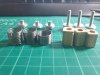
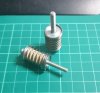
Short update, i have taken the subchassis off, and also took a closer look at the suspension. The springs have a memory foam like inner filling - I think these are meant to reduce vibrations.

What i find odd is that these fillings have different lenghts, and the springs seem to be of a different lenght too, but this might be due to age? They compress to the same lenght, but the shorter the stiffer.

I think they should be placed according to the weight of the chassis (small sprinng at heavy side), but i am not sure which point has more load...

20220119_121658.jpg 20220119_115216.jpg

Will try to take care of the subchassis next, check out if it is warped, and if so, to straighten everything out. I have already taken care of the spindle - it was aboit 3mm too low. A few hammer hits (on a wooden piece), and it should sit correctly now.
 
Last edited:
Back
Top Bottom