

You are using an out of date browser. It may not display this or other websites correctly.
You should upgrade or use an alternative browser.
You should upgrade or use an alternative browser.
Buzz's OTL Build
- Thread starter BuzzK
- Start date

NOSValves
Super Member
Buzz,
I have to commend you for such nice work. I really appreciate you honoring Bruce's patent wishes in respect to intellectual property. He is one of the true innovators of tube audio with this design and very few of them in this day and age, I sure am not one of them. Most if not the majority of us are trudging along on are forefathers backs....even if some of us won't admit it. Very little new in tube audio exists today... most designers and companies resort to sneaking in nasty SS parts and IC's to pump those chests and marketing departments that they made something new...in reality they took something old and put a mild twist on it IMHO. Those very same modern SS parts and IC's are exactly what fail in most of those products.
IMHO making tube amps the old fashion way proves again and again how it should be done. The vintage gear is proof of that since they are still playing great tunes and are very rebuild-able to work as new...do that with many of these modern high end tube amps from the big boys of the industry 20 to 30 years from now....those nasty SS parts and IC's will not be available, the replacements that can be made to work will have to be cobbled onto the circuit board they will forced to reside in, well that is if the circuit board didn't burn up in the failure..... It's obvious you are doing Bruce's design justice!
One request I have, please keep a running tally of the parts costs to share with folks what doing it right costs. If you use parts you already own or bought in surplus please guestimate the new cost for those... I'll find this end cost very interesting. It would also be cool if you tally up total hours X a reasonable $40 an hour spent start to finish. I bet folks will be shocked at the costs involved.
Cheers and keep the posts of progress coming Craig
I have to commend you for such nice work. I really appreciate you honoring Bruce's patent wishes in respect to intellectual property. He is one of the true innovators of tube audio with this design and very few of them in this day and age, I sure am not one of them. Most if not the majority of us are trudging along on are forefathers backs....even if some of us won't admit it. Very little new in tube audio exists today... most designers and companies resort to sneaking in nasty SS parts and IC's to pump those chests and marketing departments that they made something new...in reality they took something old and put a mild twist on it IMHO. Those very same modern SS parts and IC's are exactly what fail in most of those products.
IMHO making tube amps the old fashion way proves again and again how it should be done. The vintage gear is proof of that since they are still playing great tunes and are very rebuild-able to work as new...do that with many of these modern high end tube amps from the big boys of the industry 20 to 30 years from now....those nasty SS parts and IC's will not be available, the replacements that can be made to work will have to be cobbled onto the circuit board they will forced to reside in, well that is if the circuit board didn't burn up in the failure..... It's obvious you are doing Bruce's design justice!
One request I have, please keep a running tally of the parts costs to share with folks what doing it right costs. If you use parts you already own or bought in surplus please guestimate the new cost for those... I'll find this end cost very interesting. It would also be cool if you tally up total hours X a reasonable $40 an hour spent start to finish. I bet folks will be shocked at the costs involved.
Cheers and keep the posts of progress coming Craig

Pio1980
AK Member
That is an interesting, good-looking project!
Looking forward to your long-term assessment re "better" vs "different" when it's been working a while..
Brings to mind the Counterpoint SA-4 DC coupled OTL amp, interesting amp using 8 now-unobtanium matched 6LF6 tubes per channel. I heard a pair on Dayton Wright electrostats ca 1984-ish, a decent sounding impressive set-up I'd love to revisit thru the Wayback.
Looking forward to your long-term assessment re "better" vs "different" when it's been working a while..
Brings to mind the Counterpoint SA-4 DC coupled OTL amp, interesting amp using 8 now-unobtanium matched 6LF6 tubes per channel. I heard a pair on Dayton Wright electrostats ca 1984-ish, a decent sounding impressive set-up I'd love to revisit thru the Wayback.
Last edited:

Craig: Thanks for your words of encouragement and perspective.
I'm guessing I started this project about 10 years ago, and stuck it on a shelf. I think I have a version of ADHD when it comes to projects . . . something new and shiny comes along, and I'm distracted and off to the races. At the time, my goal was to evaluate different topologies. I still have Lundahl iron for a pair of SE 6C33 monoblocks; Magnequest iron for various driver configurations, etc. All unbuilt.
I'm trying to reign in the new projects and finish the old, so I turned my attention back to this project.
I'm afraid the horse is long gone out of the barn when it comes to compiling a B.O.M. The iron is the most expensive and 8 EL509s come next. It gets more complicated after that. i.e: I know I got tubes from Frannie but I don't recall whether I paid or bartered. The chassis is one of my own making. The fabricator punched out the holes in the steel frame and silkscreened it as a favor (it would be pretty costly otherwise). I do remember thinking years ago that the parts cost on this would be about $1,000.00 if that helps.
My time? Thank goodness this is a hobby for me and I don't do it to make a living! I haven't logged the hours, but I will sometime because I am sure that I would be the most surprised at the end of the day! I have no idea what I've spent this far, but it includes layout time, cutting holes in the top, etc. 15 hours would be a guess.
There are solid state rectifiers and zeners but no transistors or ICs. I'm not so much worried about the future unavailability of SS as I am about discrete parts, which are drying up too. Try to find some nice Panasonic electrolytics & etc . . . That really can put a crimp in our hobby.
Bruce has done some nice work, and he'll be the first one to tell you. He's a good engineer, but otherwise I'm not a fan.
I've worked in both software and hardware engineering fields, and I have respect for the notion of intellectual property because I have seen first-hand how costly and time-consuming it is to produce a finished product. One of the companies hired 40 people to produce basically one software utility.
If you want to talk about real innovation in tube design, look no further than Audiokarma's own David Gillespie. That EFB circuit he designed is, IMHO, the greatest advance in tube technology in quite some time. Why? It lowers distortion; increases maximum power output; extends output tube life; and lets the iron idle at lower temperatures. It's a grand slam, and it's brilliantly and simply executed.
Plus Dave is one the nicest, most helpful fellow-hobbyists I've met. His generosity to members on this forum is almost legendary.
I'm guessing I started this project about 10 years ago, and stuck it on a shelf. I think I have a version of ADHD when it comes to projects . . . something new and shiny comes along, and I'm distracted and off to the races. At the time, my goal was to evaluate different topologies. I still have Lundahl iron for a pair of SE 6C33 monoblocks; Magnequest iron for various driver configurations, etc. All unbuilt.
I'm trying to reign in the new projects and finish the old, so I turned my attention back to this project.
I'm afraid the horse is long gone out of the barn when it comes to compiling a B.O.M. The iron is the most expensive and 8 EL509s come next. It gets more complicated after that. i.e: I know I got tubes from Frannie but I don't recall whether I paid or bartered. The chassis is one of my own making. The fabricator punched out the holes in the steel frame and silkscreened it as a favor (it would be pretty costly otherwise). I do remember thinking years ago that the parts cost on this would be about $1,000.00 if that helps.
My time? Thank goodness this is a hobby for me and I don't do it to make a living! I haven't logged the hours, but I will sometime because I am sure that I would be the most surprised at the end of the day! I have no idea what I've spent this far, but it includes layout time, cutting holes in the top, etc. 15 hours would be a guess.
There are solid state rectifiers and zeners but no transistors or ICs. I'm not so much worried about the future unavailability of SS as I am about discrete parts, which are drying up too. Try to find some nice Panasonic electrolytics & etc . . . That really can put a crimp in our hobby.
Bruce has done some nice work, and he'll be the first one to tell you. He's a good engineer, but otherwise I'm not a fan.
I've worked in both software and hardware engineering fields, and I have respect for the notion of intellectual property because I have seen first-hand how costly and time-consuming it is to produce a finished product. One of the companies hired 40 people to produce basically one software utility.
If you want to talk about real innovation in tube design, look no further than Audiokarma's own David Gillespie. That EFB circuit he designed is, IMHO, the greatest advance in tube technology in quite some time. Why? It lowers distortion; increases maximum power output; extends output tube life; and lets the iron idle at lower temperatures. It's a grand slam, and it's brilliantly and simply executed.
Plus Dave is one the nicest, most helpful fellow-hobbyists I've met. His generosity to members on this forum is almost legendary.
Pio1980
AK Member
You are an inspiration and thnx for the ref to Dave Gillespie! I took a look at his site and I do have a Heathkit AA-151 on the "someday" shelf waiting to be turned into something with enhanced sonix and utility value and will remember the EFB as a must-add. I also want a better phono section and to get rid of the 6AU6s for 6AV6 or 6AT6 as I despise them in this app, if I leave it as an integrated amp.
Last edited:
NOSValves
Super Member
Craig: Thanks for your words of encouragement and perspective.
I'm guessing I started this project about 10 years ago, and stuck it on a shelf. I think I have a version of ADHD when it comes to projects . . . something new and shiny comes along, and I'm distracted and off to the races. At the time, my goal was to evaluate different topologies. I still have Lundahl iron for a pair of SE 6C33 monoblocks; Magnequest iron for various driver configurations, etc. All unbuilt.
I'm trying to reign in the new projects and finish the old, so I turned my attention back to this project.
I'm afraid the horse is long gone out of the barn when it comes to compiling a B.O.M. The iron is the most expensive and 8 EL509s come next. It gets more complicated after that. i.e: I know I got tubes from Frannie but I don't recall whether I paid or bartered. The chassis is one of my own making. The fabricator punched out the holes in the steel frame and silkscreened it as a favor (it would be pretty costly otherwise). I do remember thinking years ago that the parts cost on this would be about $1,000.00 if that helps.
My time? Thank goodness this is a hobby for me and I don't do it to make a living! I haven't logged the hours, but I will sometime because I am sure that I would be the most surprised at the end of the day! I have no idea what I've spent this far, but it includes layout time, cutting holes in the top, etc. 15 hours would be a guess.
There are solid state rectifiers and zeners but no transistors or ICs. I'm not so much worried about the future unavailability of SS as I am about discrete parts, which are drying up too. Try to find some nice Panasonic electrolytics & etc . . . That really can put a crimp in our hobby.
Bruce has done some nice work, and he'll be the first one to tell you. He's a good engineer, but otherwise I'm not a fan.
I've worked in both software and hardware engineering fields, and I have respect for the notion of intellectual property because I have seen first-hand how costly and time-consuming it is to produce a finished product. One of the companies hired 40 people to produce basically one software utility.
If you want to talk about real innovation in tube design, look no further than Audiokarma's own David Gillespie. That EFB circuit he designed is, IMHO, the greatest advance in tube technology in quite some time. Why? It lowers distortion; increases maximum power output; extends output tube life; and lets the iron idle at lower temperatures. It's a grand slam, and it's brilliantly and simply executed.
Plus Dave is one the nicest, most helpful fellow-hobbyists I've met. His generosity to members on this forum is almost legendary.
Oh I agree, while Dave and I have bumped heads a few times I have the upmost respect for his EFB circuit and him in general. In fact he came to mind when I wrote that "not many innovators out there today" as one of the true innovators. I personally prefer total bias control and give little respect the specification, specification, specification point of view that in the end means about nothing in the real world of audiophiles in the listening room enjoying music. But Dave is absolutely a smart guy and indeed made something totally new. I had an amp fashioned with that circuit built by another AK'er here and while I did not have time to do the testing I wanted too it sure performed nicely in my brief testing period. The amp was brought up here by a buddy for a coupling cap upgrade. I should of made my buddy leave the amp for a few days
 The entire project took a few hours...
Cheers and keep having fun Craig (take those ADHD meds and get this bad boy done
)
Last edited:
Rat's Nest Part 1
Tonight I'm wiring up one channel of my OTL tube amp first. Uncharted waters here . . . trying to make the best of a complex circuit in a (relatively) compact enclosure.
E.g. will I have a ground bus? Where will I put it? What's the resistor value I need to calculate for dropping the filament voltage to 6CG7s (vs. 12AU7s)? And so forth . . .
Tonight I'm wiring up one channel of my OTL tube amp first. Uncharted waters here . . . trying to make the best of a complex circuit in a (relatively) compact enclosure.
E.g. will I have a ground bus? Where will I put it? What's the resistor value I need to calculate for dropping the filament voltage to 6CG7s (vs. 12AU7s)? And so forth . . .
Attachments
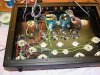
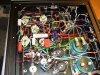
PROGRESS REPORT: Almost half complete
Almost half way -- just one channel is close to being wired up. Figuring out stuff as I progress. This is a lot more complicated than I had envisioned. I'm hoping the music that comes out of it will be worth the investment in time and parts . . .
Almost half way -- just one channel is close to being wired up. Figuring out stuff as I progress. This is a lot more complicated than I had envisioned. I'm hoping the music that comes out of it will be worth the investment in time and parts . . .
Attachments
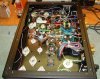

Half way point!
OK, we've finally made it to half way!
Part-way into construction, I realized this is the most complicated piece of tube gear that I've ever built.
My intent is to make sure this much works before I wire up the remainder.
OK, we've finally made it to half way!
Part-way into construction, I realized this is the most complicated piece of tube gear that I've ever built.
My intent is to make sure this much works before I wire up the remainder.
Attachments

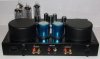
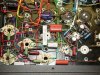


Jon -- An incredible looking unit -- just like all your projects are! There sure are a lot of wires and parts in there buddy. This is definitely NOT a project to do casually while multitasking other more mundane efforts!
Dave
Dave
I had two EL509 failures - one was my fault. Had a nice matched quad +1 before that happened. So I'm one tube short on the one channel. I've ordered as many NOS tubes that I can find to get two quads. I was getting music out of it, but it was upside down in my workroom with shitty speakers, etc. so I never got a "proper" listen.
Thanks for asking. I should have it up again for another listen (and report) shortly, as soon as I figure out what tubes give the lowest DC offset. Tonight I'm testing some of the tubes I bought. If all works, I'll complete the other channel.
Thanks for asking. I should have it up again for another listen (and report) shortly, as soon as I figure out what tubes give the lowest DC offset. Tonight I'm testing some of the tubes I bought. If all works, I'll complete the other channel.

ab0ez
AB0EZ
Jon -- An incredible looking unit -- just like all your projects are! There sure are a lot of wires and parts in there buddy. This is definitely NOT a project to do casually while multitasking other more mundane efforts!
Dave
That's for sure Dave, and I know you know about this by looking over my work!
Thanks for the kind words. Dave has save my butt more times than I care to admit . . . 
I determined that none of my 3 tube testers (including two Hickock's) can test the EL509s right now. The 539B needs an SA-8 Magnoval adapter that is scarce and could probably be cobbled together if I had more confidence in what to do. I imagine I could do a pin-for-pin adaptation, but that doesn't mean that Hickok part works the same way.
An alternative is to build a custom jig that will put the actual B+ on the plate; provide the -40V of bias, and measure the resulting currents and other specs needed.
Any advice would be welcome. (yo-hoo, Dave!)
I determined that none of my 3 tube testers (including two Hickock's) can test the EL509s right now. The 539B needs an SA-8 Magnoval adapter that is scarce and could probably be cobbled together if I had more confidence in what to do. I imagine I could do a pin-for-pin adaptation, but that doesn't mean that Hickok part works the same way.
An alternative is to build a custom jig that will put the actual B+ on the plate; provide the -40V of bias, and measure the resulting currents and other specs needed.
Any advice would be welcome. (yo-hoo, Dave!)

Hiya,
You could also use a CA4/CA5 adapter box and I might actually have an extra one here I can loan you to test those. Or there are schematics if you want to go nuts and make one
Its how I tested the quad I sold you with my WE tester.
EDIT: Scratch That .. Novar vs Magnoval .. I used the stupid SA-8 which is misplaced (Of Course) ..
Sigh,
Frannie
You could also use a CA4/CA5 adapter box and I might actually have an extra one here I can loan you to test those. Or there are schematics if you want to go nuts and make one
Its how I tested the quad I sold you with my WE tester.
EDIT: Scratch That .. Novar vs Magnoval .. I used the stupid SA-8 which is misplaced (Of Course) ..
Sigh,
Frannie

