• The move to the new server is done. There are some software and database maintenance updates in process. This has us passing the hat around to help out. We appreciate any donations. Seriously, even a dollar helps. The payment page may be found here - https://www.audiokarma.org/support.html

Calling all horn-heads

I'm no expert but my understanding is a 2 inch throat on a compression driver is superior to the 1 inch....

Horns don't need to be confined to the upper end range.. Woofers like horns too... :D

+3.19472 on each of the above.

PWK said that 'if it moves, it distorts' So, what moves the most but the woofer, right?

I'd think that is really where you want to start if you want to garner the most benefits of a horn. Downside of course, is size. Bass horns can be large.

On the midrange/tweeter horn (I have a 2-way horn) the larger format drivers is clearly a step up. I'm not technical enough to factually state numbers but I think a 2" format has something like 1/4 the distortion of a 1" format (all other factors similar I suppose?)

I jumped from smaller horns to 2" and now the smaller horns sound more like toys. It's not an insignificant difference.

Regarding shape of the horn, I once asked Roy Delgado (big cheese engineer at Klipsch) about "why rectangular verses round"

If I can butcher the paraphrase of his answer... it was to keep more sound off the ceiling. i gathered from his answer that the final shape of the horn wouldn't influence the sound (as much as perhaps the throat) but, the final shape would help keep the sound from splashing onto the ceiling (rectangular horn) as much as other designs (round).
 
Very few, if any can cover the high end adequately for most hifi listener's demands. That alone pushes the cost for many designs over the top as they by necessity require more extensive crossover engineering and a 3rd speaker component(tweeter) to allow the system to be truly full range.

With a well engineered driver like a JBL 375/2440(for example), EVERYTHING, from ~500hz to ~10khz.
Can you/Tom/anyone give a short list of tweeters that compliment the 811 horns?
 
If I can butcher the paraphrase of his answer... it was to keep more sound off the ceiling. i gathered from his answer that the final shape of the horn wouldn't influence the sound (as much as perhaps the throat) but, the final shape would help keep the sound from splashing onto the ceiling (rectangular horn) as much as other designs (round).

Things that make you go hhmmm.
harman1.jpg


I agree with keeping the first reflection off the ceiling/floor, I'm not sure why the Arrays work so well.
 
I use JBL/Selenium ST400's crossed over at about 10K with my Edgarhorns. Dr. Edgar's earlier versions used Fane ST5022 horn tweeters seen in the linked picture. Both are the 'bullet' style tweeter seen most often in old JBL 075 and 2402 designs.

It is less about whose horns they are used with but about how they're all crossed over together - oh and how they're time aligned, too.

Cheers,

David
 
Can you/Tom/anyone give a short list of tweeters that compliment the 811 horns?
I use Altec 802-g on 811's complimented by a Heil AMT. I found that when I was assembling my horn sleds there were a lot of folks dissing the aluminum 811 and 511, saying that there was "ringing" and folks should use all manner of mass dampening to control it. I couldn't hear this effect but went as far as mass loading the horns with 40 lb bags. I didn't hear any difference. These directivity horns do have some downsides but like AA states, "listen to a few" to form opinions.

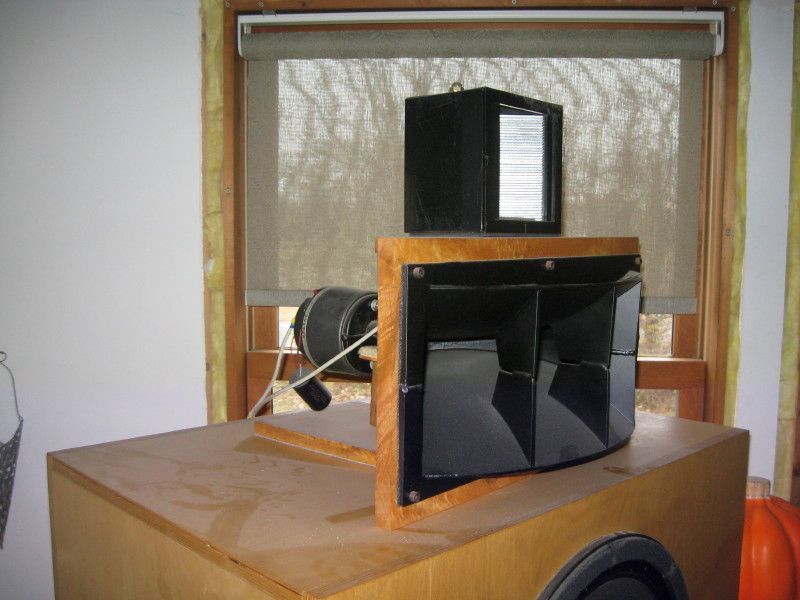
The combination high end sled:
IMG_0001_1-3.jpg

Sorry about the dust, you can see that we were in remodeling mode (when aren't we?).
 
PWK said that 'if it moves, it distorts'

A couple little factoids(basic physics/acoustics) that Paul should have added to his sage words of wisdom.

a) If it produces acoustic energy(sound), it moves.

b) if it doesn't move, it doesn't produce ANY acoustic energy(sound).
 
I found that when I was assembling my horn sleds there were a lot of folks dissing the aluminum 811 and 511, saying that there was "ringing" and folks should use all manner of mass dampening to control it. I couldn't hear this effect but went as far as mass loading the horns with 40 lb bags. I didn't hear any difference.
Once you bolted the horn mounting flange to any manner of baffle, it was damped as much as it needs to be for use with a small format driver. A small format driver simply does not produce enough acoustic energy to excite a "ring" out of those horns.

Some folks seem to be put off by the fact that they ring when you rap on them with your knuckles or an object. Those folks should stop rapping on them, the ringing will stop.

When Altec modified the 511 to accept the large format 288, they coated the horn with damping compound. A 288 driven to reference levels will make an un-damped 511 "ring" as it produces substantially more acoustic energy than any small format driver.
 
Some folks seem to be put off by the fact that they ring when you rap on them with your knuckles or an object. Those folks should stop rapping on them, the ringing will stop.

LOL, it reminds me of that old joke:
"Doc, it hurts when I do this"
"Well then, don't do that!"
 
For EV fans HR90's driven by 1824M's, and ST350 tweeters give excellent mids and highs and a great soundstage JOHN
 
A small format driver simply does not produce enough acoustic energy to excite a "ring" out of those horns.

Some folks seem to be put off by the fact that they ring when you rap on them with your knuckles or an object. Those folks should stop rapping on them, the ringing will stop.

Which all makes perfect sense to me, but doesn't explain why, on a certain song (Don't Know Why, by Norah Jones), at one point (where she belts out the word "waiting"), my 811B horns with 902 GPA drivers made a horrible transient blaring noise until I damped the outsides with Damplifier. After that, the blare disappeared completely. I don't know if the right word for that distortion was "ringing," but it was extremely evident, and the damping killed it completely.
 
Last edited:
Tom, I still listen to my rebuilt Val's every day, but that roll off at the top still kills me.
Adding a sub helped the basement, but I still want for the very top.

I never felt my 511b horn with 808-8b drivers requiring any extra tweeter. I find it produce enough air energy as is and prefer it even if on spec it with will probably show slight roll off at 10khz by some places I saw online where it was measured. Can use eq and compensation circuit if want but in my opinion not needed. I actually prefer these 511b/808-8b combo to lot of other speaker designs personally. All other speakers I find too bright or strident nowadays, even speakers with silk domes I use to like...even headphones I prefer roll off after 10khz and maybe small bump 1db at 14khz to add bit extra air but, that's bout it.

I have my 511b horn in a simple ugly 1204b cab with 9" thick fiberglass lined on the walls and bout 11lbs worth of fiberfill stuffing in the cabs filled up from top to bottom. I plan on eventually restoring it aesthetically to my taste but, for now its perfect and sounds amazing in acoustically controlled room. I actually use them as monitors.
 
Which all makes perfect sense to me, but doesn't explain why, on a certain song (Don't Know Why, by Norah Jones), at one point (where she belts out the word "waiting"), my 811B horns with 902 GPA drivers made a horrible transient blaring noise until I damped the outsides with Damplifier. After that, the blare disappeared completely. I don't know if the right word for that distortion was "ringing," but it was extremely evident, and the damping killed it completely.

Cause to be honest, lot of norah Joan's while good singer but, in my opinion, lot of her stuff is not very well mastered. Comepare albums to simple soundtrack like the original lion king soundtrack. Lion king soundtrack was probably one of the best mastered albums I had experience with so far and still use it as a reference for sound and dynamic capabilities most of the times.
 
The main problem with an Altec 902 on an 811 is going to be the 1/16 inch "step" between the Altec 902's 7/8 inch aperture, and the 811's 1 inch throat. This is an area where the transition should be a smooth as possible, not a completely circumferential reflective surface. 800 series drivers are the proper hifi mates to 811's and 511's. 900 series drivers were optimized for use with MR-931 and MR-902 horns which have complimentary 7/8 inch throats. A clever fella could fabricate a spacer of appropriate dimensions to maintain proper throat angle and a smooth transition between the 902 and earlier horns, the results will be both measurable and worthwhile.

I have not had hands on one of Bill's 902's to measure them, so i don;t know if they have 7/8 or 1 inch apertures. They differ from an Altec 902 in other ways, so a variation in dimensions wouldn;t come as a surprise either.
 
The Radian is a very good driver. It is essentially the evolution, or continuation of the Emilar small format compression driver, picking up where Plus One Engineering left off with them. It should be right at home on any one inch horn that can load it acoustically. You will find that it plays better than many small format drivers at lower XO frequencies, as low as 500hz.
 
Back
Top Bottom