• The move to the new server is done. There are some software and database maintenance updates in process. This has us passing the hat around to help out. We appreciate any donations. Seriously, even a dollar helps. The payment page may be found here - https://www.audiokarma.org/support.html

Can dirty or corroded contacts cause channels to drop? NAD C370 help

ewoods

New Member
I thought about bringing this thread back to life due to Jerry's great advice in there, so let me know if I should post in there as well.

I have a NAD C370 integrated that I bought used about a year ago. I love this amp. This past week the left channel has dropped out. Occasionally it pops back in momentarily, or will stay on for awhile, but eventually it always drops out. The issue persists on all inputs. I've changed the speaker wire, changed speakers, etc.

I've isolated it to the preamp section by plugging my DAC (which has volume control) to the main in input, which resolved the problem. I called a couple of local tech shops. One suggested deoxit/cleaning, and the other said it would be a minimum of $300 charge to replace the "filter, caps and regulator", which is more than the amp cost me in the first place.

I plan on cleaning it, but my questions are: is it common for channel dropouts to be caused by dirty/corroded parts?

And if the issue persists on all inputs, does this suggest that the problem is with the volume control?

Funnily enough, there's a NAD 3100 for sale locally for a good price that I could get to use as a dedicated preamp (which is a route I've been interested in taking anyway), and the seller says in the ad that it has a channel dropping problem that's always resolved by moving the volume knob, and claims that cleaning it would likely be a permanent fix.
 
Register to hide this ad
Yup, dropouts can be contributed to dirty pots and switches, and sometimes even dirty relay contacts and in rare cases, cold solder joints.

Most of the time it can be a dirty tape monitor switch or button so the next time you are playing it and the channel drops, just exercise all buttons and switches and see if it pops back in. This will definitely tell you if it is indeed a dirty switch or button.
 
I have had a C370 that had this fault, which I had recapped and upgraded, and after much checking it turned out to be the volume control, where it would drop a channel at random and unpredictable intervals. My customer and I searched for a replacement volume control, however none was found that was a direct replacement (there was one offered in France which was bought , but turned out to be the wrong one).

Fortunately the volume control can be disassembled, and with a little dexoit and very gently making sure the wiper of the pot is making good contact, the volume control now works and the unit is now functioning.

as @cademan stets, check all the switches and controls first, however your diagnosis and symptoms suggest the volume control.
 
Interesting. Well my can of Deoxit just arrived, so I'll give this a try. I had the thought to check if the headphone out was affected by the same problem, so I reconnected the pre out and main in, and then plugged my headphones in. Both channels came in loud and clear, and this seems to have brought the left speaker channel back as well (for the time being).

I'll try the cleaning the volume control and check out the switches and controls, and report back.

Thanks for the help, it's very much appreciated!
 
I plan on cleaning it, but my questions are: is it common for channel dropouts to be caused by dirty/corroded parts?

And if the issue persists on all inputs, does this suggest that the problem is with the volume control?

channel dropouts are commonly caused by dirty contacts and i am not being specific to your machine but it can be caused by anything from a dirty volume control to a dirty tape monitor selector, loudness switch, etc.
 
Thanks everyone!

I finally had some time to look inside the unit, and I'm completely stumped as to how to disassemble the volume pot.

I have no idea how to get Deoxit inside of it. Anyone know? @painttoad ?
 

Attachments

  • 20221105_154411~2.jpg
    20221105_154411~2.jpg
    68.3 KB · Views: 32
  • 20221105_151250.jpg
    20221105_151250.jpg
    118.1 KB · Views: 32
  • 20221105_151256.jpg
    20221105_151256.jpg
    118.8 KB · Views: 32
Last edited:
To update everyone, after a closer inspection, I found a tiny hole where the pot meets the board. I was able to get some Deoxit in there and work it around by moving the volume knob back and forth. Voila, that's corrected the channel drop out (so far).

I would still be interested in finding out how to disassemble the pot, as I'm sure it could use a better cleaning.

Thanks again!
 
From memory ( so beware!), I think there are some small clips that hold the elements of the volume pot together. These can VERY gently be bent back and the elements of the pot then can be disassembled. However if these are broken, then the pot is toast. I used a jewelers screwdriver and very small pliers and very very little force.

Then you can deox the contacts in the pot and make sure that the wiper is making consistent contact withe the track, that said if it is working now, perhaps leave it be.
 
Thanks for the info @pwauk12 !

I agree, it's working now so I'll leave it. But if the issue happens again, I might try to tackle the disassembly.
 
This era of NAD equipment is littered with "JH" brand electrolytic capacitors. To put mildly, they are horse excrement. I recently recapped a C270 power amp and a C162 pre-amp and just about every electrolytic cap in both units had ridiculously high ESR and the capacitance was nowhere near where it should have been. I am not a blanket re-capper. I believe in only replacing parts that have failed, but when it comes to these early-2000 NADs, do yourself a favor and completely re-cap it. Also, there are those vertical black box modules - these also have several electrolytic caps within them and they are cooked as well.
 
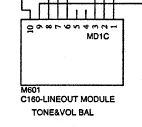
@Electone - From the schematic it looks like Pre-amp Module 4 (inside one of those vertical black box modules) is responsible for Tone & volume balance.
I'll try to take a look in there and see what's up.

What's ESR?
 
@Electone - From the schematic it looks like Pre-amp Module 4 (inside one of those vertical black box modules) is responsible for Tone & volume balance.
I'll try to take a look in there and see what's up.

What's ESR?

Equivalent Series Resistance. Look up an ESR chart on google. Those are the nominal values you can expect for a certain capacitance/voltage. You don't want high ESR.
 
Back
Top Bottom