• The move to the new server is done. There are some software and database maintenance updates in process. This has us passing the hat around to help out. We appreciate any donations. Seriously, even a dollar helps. The payment page may be found here - https://www.audiokarma.org/support.html

Cart/ Stylus Terminology question.

chaz

AK Subscriber
Subscriber
When the term 'nose up' / 'nose down' ( or tail up/tail down) is used what does it mean.
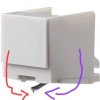
Due to the rotation of the album (clockwise) the part of the stylus that reads the information in the groove 1st is the area that looks like the back of the stylus (purple) and the part that looks like the 'front' of the stylus is actually the trailing edge ( red).
In the attached image the purple arrow is what I think of as the back , but it encounters the music in the groove first.
So when I read 'Nose up/Nose down'
Does 'Nose' refer to the area indicated by the red arrow or the purple arrow.images.jpg
 
Register to hide this ad
Refers to the perspective of somebody in front of the turntable (with regular arm placement and orientation) - so "tail up"/"nose down" would mean an upward slope from the front of the arm towards the counterweight.

Greetings from Munich!

Manfred / lini
 
@chaz ,
Yes...red arrow is the front/nose...
purple arrow is the tail/rear of the cartridge.

Also, You are very correct that the rotating disc "sees" the tail of the cartridge/pickup, first.
Sometimes, reality is a backwards world...
 
My understanding...
The top of the cartridge's Body is supposed to be level with the surface of the vinyl on the platter.
"Tail Up"- Rear of the cartridges Body is higher than the front...relative to the surface of the vinyl on the platter.
 
Thanks for clearing that up for me folks. It's one of those things that if you over think it, it just gets more and more confounding.
 
Certain cartridges can respond differently, with a slight, front lift or a slight, front sag.
Don't overthink this...

Most cartridges are designed to be mounted so they are "level" with the platter.
 
Actually this 'tail' term is more common in describing the tonearm position. "Tail high" shifts balance towards treble etc.

Regards,

I agree.

I think what is confusing in the discussion is an alternative consideration that is probably more important: of how the stylus is vertically oriented in the record groove, which is called vertical tracking angle, a specification provided by the cartridge manufacturer. How the stylus contacts the record groove is very important, it's how "the rubber meets the road".

The tonearm position is a different matter. It has to do with the bearings in the tonearm and their position when the stylus is in the groove.
 
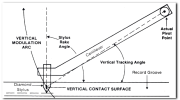
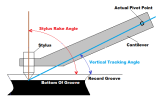
Actually that is what I have thought, just like @sound hound, until watching some videos at the WallyAnalog site. Turns out that the stylus angle in the groove seems to be the Stylus Rake Angle......or, SRA and I've been calling it the VTA as I trust many have and do. Let me see if I can paste this diagram here:

1788408511018.png

That is the best diagram I have seen that explains those two angle very well. The VTA angle, established by the angle the cutting head was set to when cutting the master, is right around 18 deg., at least that's what the cutting engineer typically aims for. The SRA is typically right around 92 deg., and that is what we are trying to approximate. However, since the two geometries are inextricably linked, changing one changes the other, so it is very difficult to achieve both spot-on.

So, in previous posts that mentioned how to change VTA by raising or lowering the tonearm, that is from what I am now understanding not the correct way to do this but rather by changing the angle of the cartridge itself in the head shell through the use of shims. While it is possible to change VTA by raising or lowering the tonearm, it is only by a very, very small amount that the VTA, and therefore the SRA, will change. You might be able to hear the difference slightly, as I mentioned I could on my linear tracker that has the on-the-fly tonearm adjustment, but only at the extremes.

I was actually rather stunned to learn about all of this as I realized I have not been using the proper terminology. I invite anyone who is interested to watch some of these very informative videos at Wally Tools WAM Engineering.

PS - Oooops, sorry @borchee, I think our posts crossed in cyberspace!
 
Boisclair at Wally Tools is correct, and that is why I am using shims to optimise VTA. It reduces distortion and often improves crosstalk. But there is no difference of frequency response. So any tail up or tail down does not seem to alter bass or treble.

index.php


index.php


index.php


Thanks @borchee and @Fishead for the explanation. It does seem from the diagram that SRA would be more relevant than VTA, Each cartridge manufacturer and the cantilevers used and the angle they use at the end of their cantilevers to mount the stylus on would probably vary by more than an infinitesimal amount. And think of replacement styli made by many different manufacturer's! I don't see how VTA can really be maintained reliably.
 
Thanks @borchee and @Fishead for the explanation. It does seem from the diagram that SRA would be more relevant than VTA, Each cartridge manufacturer and the cantilevers used and the angle they use at the end of their cantilevers to mount the stylus on would probably vary by more than an infinitesimal amount. And think of replacement styli made by many different manufacturer's! I don't see how VTA can really be maintained reliably.
On the contrary, current knowledge says VTA is more important than SRA. All within limits of course.
 
OK, if and when you have some time (and it does take a little time as the videos aren't exactly short) have a look here:


While you're watching, grab your digital tracking force scale and calibrate it.....that was one of the first takeaways for me since small errors in tracking force can mean larger ones in VTA and SRA.

Which is more important? Can't really say as it's kind of like a car engine and oil.....take away the oil, and the engine becomes useless in a short time.....take away the engine, and all you have is a mess of oil!!! Everything in cartridge setup seems to be dependent on another thing, so it's a really "fluid" proposition where we're generally just trying to arrive at the best possible compromise. I'd love to have a full "stable" of all the Wally Tools which would permit getting close, really close, to optimal setup.....currently, all I have is a few humble tools, determination, OCD (not clinical, but close :-)) and a blessing of patience......and most of all, MY EARS!!!

If it sounds really good, I'm pretty good with that even though I know it might not be perfect, but on the other hand, I may be closer than I might suspect! It's all so very interesting to me, and I believe that is something of a necessary ingredient in the process as well.....carry on, amigos!
 
OK, if and when you have some time (and it does take a little time as the videos aren't exactly short) have a look here:


While you're watching, grab your digital tracking force scale and calibrate it.....that was one of the first takeaways for me since small errors in tracking force can mean larger ones in VTA and SRA.

Which is more important? Can't really say as it's kind of like a car engine and oil.....take away the oil, and the engine becomes useless in a short time.....take away the engine, and all you have is a mess of oil!!! Everything in cartridge setup seems to be dependent on another thing, so it's a really "fluid" proposition where we're generally just trying to arrive at the best possible compromise. I'd love to have a full "stable" of all the Wally Tools which would permit getting close, really close, to optimal setup.....currently, all I have is a few humble tools, determination, OCD (not clinical, but close :-)) and a blessing of patience......and most of all, MY EARS!!!

If it sounds really good, I'm pretty good with that even though I know it might not be perfect, but on the other hand, I may be closer than I might suspect! It's all so very interesting to me, and I believe that is something of a necessary ingredient in the process as well.....carry on, amigos!
It is certainly possible to buy a lot of tools, but you will come a very long way with a cheap digital scale, a good protractor and a USB microscope. If you see that VTA is off you would need headshell shims and to finally fine adjust azimuth you would need a test record and either adjustable azimuth of the tonearm or again, shims.
 
It is certainly possible to buy a lot of tools, but you will come a very long way with a cheap digital scale, a good protractor and a USB microscope. If you see that VTA is off you would need headshell shims and to finally fine adjust azimuth you would need a test record and either adjustable azimuth of the tonearm or again, shims.
This is basically what I and others probably are doing to arrive at the "best possible" outcome given the inherent limitations. You have clearly done your homework and taken advantage of the research done by the late Wally Malewicz (RIP) and his successor, J.R. Boisclair, whose videos I have linked to above. Further, when you say "If you see that VTA is off" I assume you are using the USB microscope to determine that angle, and I also assume you are doing this with the record spinning as in a dynamic sample, correct? Then yes, as long as you aren't introducing error somehow with the placement of the microscope you are very likely to get a pretty close, if not spot on reading of VTA. There is so much to take into consideration, so many variables!! I am the sort who finds this kind of stuff fascinating and admire those who actually succeed in accomplishing it successfully.....so, @Thomas_AA, well done sir!
 
and to finally fine adjust azimuth you would need a test record and either adjustable azimuth of the tonearm or again, shims.
Correct again......for those of us with a tonearm that can be rotated to change azimuth, what remains necessary is a test record (as you stated) as well as something to measure the 1kHz tone in both left and right channels to determine crosstalk and adjust the tonearm position until it is equal in both channels and as low as you can get it. Some might use an instrument such as the Fozgometer to do this albeit that is a rather pricey solution.

When I was looking for a Fosgate Signature II phonostage (a friend has one that I thought sounded beautifully so I wanted one!!) I ended up talking with the good folks at Jolida (now Black Ice Audio) that convinced me to give their newest offering a try, the BIA F159. What intrigued me was that this unit (F for Fosgate who designed it so I thought I couldn't be too far off the mark set by the Signature II) was that it had a built-in feature, the XTR circuit, that I had a hunch would serve to set azimuth also. The way this feature works is that it measures crosstalk in both channels and then, by setting each channel independently using the 1kHz test tone record, one can clearly see which channel is "bleeding" more into the other. Then by rotating the tonearm (which changes the azimuth of the stylus in the groove), I simply kept doing the measurements until I found the position where there was least crosstalk in both channels......that, I believe, is the best possible orientation of the stylus in the groove with respect to azimuth(another of those "compromises" as it is never perfect, i.e. zero in both channels). Checked it with another friend's Fozgometer and it showed to be spot-on......nothing but the green light in the middle lighting up! If I had to use shims I don't know that I would have even attempted the procedure but you are correct, that would be another way to do it but tedious would be too kind of a word to describe what I would imagine such an endeavor would present with......carry on, amigo
 
@Thomas_AA , good posts!
I am wondering if a listening test with different shims/VTA may be useful. We know that correct VTA lowers all kinds of distortion significantly and can improve crosstalk too, and that the frequency responses hardly changes. So what are folks hearing ? Is it the change in distortion when they subjectively report tonal changes? Or is tail up/down just hearsay and a myth? Or what?
 
Back
Top Bottom