
@Thomas_AA, where did you get that collection of shims? From Wally Tools?



No, I designed them and had a friend print them.@Thomas_AA, where did you get that collection of shims? From Wally Tools?
Thanks!@Thomas_AA , good posts!
I am wondering if a listening test with different shims/VTA may be useful. We know that correct VTA lowers all kinds of distortion significantly and can improve crosstalk too, and that the frequency responses hardly changes. So what are folks hearing ? Is it the change in distortion when they subjectively report tonal changes? Or is tail up/down just hearsay and a myth? Or what?

Antiskate could play a role in channel imbalance. Riding one side of the groove or the other will definitely make a difference. In drastic cases you can view the stylus from the front of the cartridge and see the cantilever skew to one side or the other. Overall the preferred method would be a test record, which I've never owned after 40 yrs of this silly game.Thanks!
One problem with measuring frequency response left/right is that it may not always be representative. We know that crosstalk gets higher with frequency, and that VTA affects crosstalk. So it is possible that VTA, affecting crosstalk, change levels and/or channel balance in the 10-20 kHz range. A second point is that VMA (cutting angle) is not fixed at all frequencies. But any change would be quite small.

It would be very useful. Not only to see what kinds of effects will be audible in what way, but also in the scope of amount of vta change.I am wondering if a listening test with different shims/VTA may be useful.
In my experience, for imbalance due to antiskating becomes audible, you have to be off by quite a large amount.Antiskate could play a role in channel imbalance. Riding one side of the groove or the other will definitely make a difference. In drastic cases you can view the stylus from the front of the cartridge and see the cantilever skew to one side or the other. Overall the preferred method would be a test record, which I've never owned after 40 yrs of this silly game.


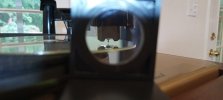
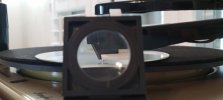
What you don¨t see is the alignment of the coils/magnets to the groove walls. Needs measurement using crosstalk.It is likely that most of us have the tools necessary to adjust SRA and azimuth. A compact disc, magnifying device and good lighting. When viewed from the front, the stylus and it's reflection should form an hourglass shape. Same goes for the SRA if using a conical or elliptical stylus when viewed from the side.
Azimuth is pretty easy to adjust if using a bayonet SME type mount headshell on a J or S shaped tonearm. There is usually a little bit of wiggle room on the rotational axis. Rotate the headshell until the hour glass shape is good and then lock down the collar. This adjustment works best with a cheap headshell as there is more "slop".
Pictures are from a Magnavox Imperial TT pulled from a console. Just what happens to be in my downstairs rig today. Rake angle is past 90 degrees at 2.5 grams tracking force. At 1.5 grams it is at 90 degrees.
View attachment 3830772
View attachment 3830773
It's small. Channel imbalance is often cantilever being off, and while it can be off with wrong antiskate, this is usually small effects.Antiskate could play a role in channel imbalance. Riding one side of the groove or the other will definitely make a difference. In drastic cases you can view the stylus from the front of the cartridge and see the cantilever skew to one side or the other. Overall the preferred method would be a test record, which I've never owned after 40 yrs of this silly game.
