• The move to the new server is done. There are some software and database maintenance updates in process. This has us passing the hat around to help out. We appreciate any donations. Seriously, even a dollar helps. The payment page may be found here - https://www.audiokarma.org/support.html

Cartridge overhang gauge? Which one is good?

6BQ5

New Member
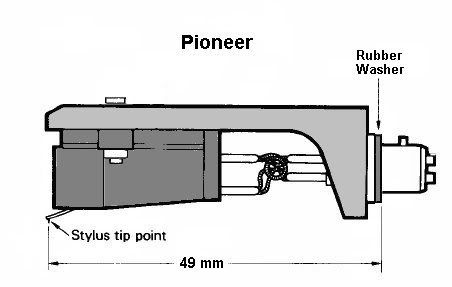
I'm getting ready to install a new cartridge in a new headshell on my Pioneer PL-600. The overhang should be 49mm if I remember correctly. What is the best way to measure this distance? I see a few gauges on Amazon with good ratings. Any particular recommendations?

Thanks!

-=- Boris
 
Register to hide this ad
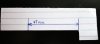
Using a caliper like Jeff mentions, I made a jig out of an index card that has the correct distance for my table.
 

Attachments

  • 001.JPG
    001.JPG
    33.2 KB · Views: 168

I use similar, lots of ten dollar variety on Amazon. :)
https://www.amazon.com/YKS-Composit...d=1490296288&sr=8-10&keywords=digital+caliper
PioneerOverhangcolor.jpg
 
Last edited:
Thanks, everyone! How critical is it to hit that 49mm? What happens if I'm +/- 1-2mm? I may have been overthinking it.

-=- Boris
 
Thanks, everyone! How critical is it to hit that 49mm? What happens if I'm +/- 1-2mm? I may have been overthinking it.

-=- Boris
The measurement of 49 mm is very easy to do with a tape measure. You can adjust it to the exact measurement pretty easy. You won't have a problem doing this. When done just make sure you have the cartridge aligned perfectly parallel to the head shell.
 
Thanks, everyone! How critical is it to hit that 49mm? What happens if I'm +/- 1-2mm? I may have been overthinking it.

-=- Boris

It would be perfect for JVC or Yamaha S tone arm cartridge alignment. :music:

You have a Pioneer though.
 
yeah, easy to get spot on that 49mm, just be slo and determined and get the cart aligned properly.
a good magnifying lens can help, say 8x or 10x about. you will want a 20x or more for seeing the diamond for wear.
get em off the bay.
 
49mm gets you to the proper alignment for the table as per Pioneer spec.

You can dl an alignment protractor/gauge to put on the tt and set up the cartridge to the Baerwald or Stevenson alignment if you want. These minimize the tracking error (cartridge skewed in the groove compared to a straight cut by the cutting lathe) overall for Baerwald and inner groove for Steveson, using two point checks on the platter. Common separate tonearm methods.

For the generic 40-52mm measurement I use the Technics gauge which is 52 but I drilled a hole on one at 49 for the table I have that needs a 49mm setting.
google: technics alignment gauge and look at images for what it is and it might show some platter protractors to get a different alignment. Drilling a hole a 49mm in plastic is up to you. KAB has the gauge.

The location of the stylus is critical to good sound. 1/64" makes a difference. But I don't know what alignment Pioneer used to set up the PL-600.
 
Thanks, everyone! How critical is it to hit that 49mm? What happens if I'm +/- 1-2mm? I may have been overthinking it.

-=- Boris

Boris,

That all depends but first the engineering - The two most common alignments are Baerwald and Stevenson. The former provides the lowest average tracking error. Stevenson, more popular for Japanese turntables, has a bit higher average tracking error, but tracks the inner grooves a bit better which lowers IGD. The reasons for which have nothing to do with Japanese tables or any other table for that matter. It has everything to do with the standard to which the record is cut. The Japanese, JIS, and DIN standards allows a few mm smaller inner groove diameter (~57mm) so many Japanese tables recommend something pretty close to Stevenson. Most all other records use the RIAA ~60mm inner groove diameter making Baerwald a better choice (IMO). I've run the numbers using the calculator on VE for hundreds of tables and arms and most (all) fall on or between these two alignments. The difference between these "polar" alignments is just 2mm and and a degree of offset angle. So no you aren't over thinking it and the farther towards line contact stylus shapes or away from conical the more pronounced the effect. So if you're only a mm off you could be between the two alignments which is OK or you could be outside them which is no man's land and not a place to be. Personally I dislike paper protractors and so-called "overhang gauges" so I made my own mirrored 2 point protractors which precisely align the cantilever instead of the cartridge body providing better accuracy with less fussing about. As a matter of fact I've sold about a 100 of them on Barter Town. I've been out of town on a project for 2 years so it's been that long since I've made them. The project is winding down so I'm heading home in a month so they may be available again a month or two down the road.

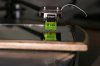
IMG_4168.jpg IMG_4201.jpg
 
Thanks for the replies, everyone! :)

I ended up using a combination of a right triangle and a metric ruler to get the stylus tip at 49 mm. It took me about 15 minutes. Then I used the same to get the cartridge with the stylus straight in that headshell. That was another 5-10. It's not perfect but it's probably as good as I can get. Then I spent another 15-20 minutes balancing my tonearm and verifying the tracking force. All together it was about an hour but felt like an all day project! Must be the emotional stress. ;) I did bounce the tonearm once and nearly passed out from the shock. Heh!

-=- Boris
 
If you can do $50, get yourself the Geo-Disc* from Mobile Fidelity Sound Lab for future aligning. It will take all the tedious guess-work and time-consumption out of cartridge alignment.

It's extremely easy to use and works on both "straight" and "s-shaped" tonearms. I've aligned everything from a Thorens TP-16 to SME M2-12R arms and everything in-between.

Fast, easy and accurate.

It's the best $50 you'll probably ever spend in this hobby.

No affiliation. JAHC (just a happy camper). ;)

* (based on the Baerwald alignment curve)
 
"Of course, Löfgren "B" has the lowest average cumulative distortion across the entire playing surface, but at the expense of exceptionally high distortion on inner grooves."

"Here is something you might find interesting.."

http://db.audioasylum.com/mhtml/m.h...um=ALL&sortRank=None&sort=date&sortOrder=DESC

In the end, it seems like Baerwald offers the best compromise between the three alignment methods (Stevenson, Lofgren & Baerwald).

Let your ears be your guide.
 
Back
Top Bottom